







Question: Exercise 1 - Simultaneous Public good game = = Consider two consumers (1, 2), each with income M to allocate between two goods. Good 1
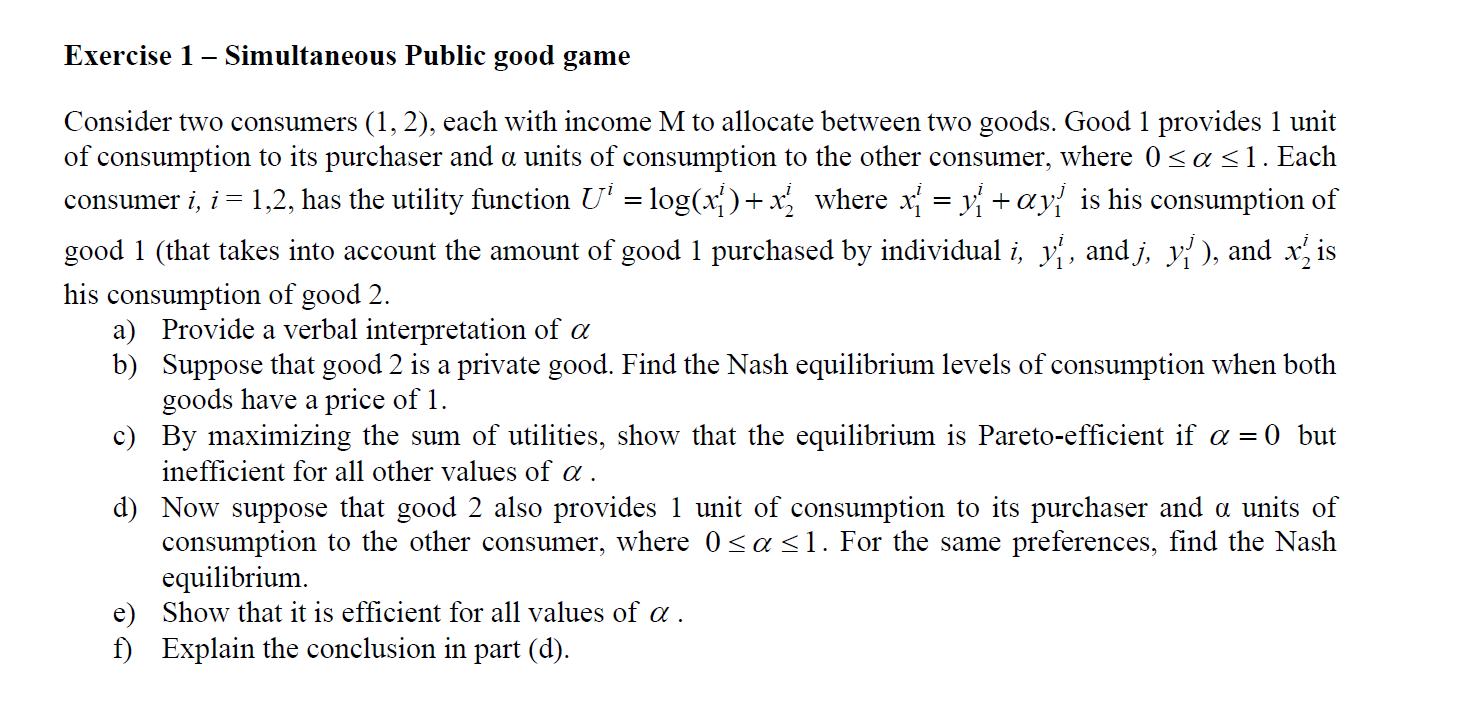
Exercise 1 - Simultaneous Public good game = = Consider two consumers (1, 2), each with income M to allocate between two goods. Good 1 provides 1 unit of consumption to its purchaser and a units of consumption to the other consumer, where 0 sas1. Each consumer i, i= 1,2, has the utility function U` = log(x) + xwhere x = y + ay is his consumption of good 1 (that takes into account the amount of good 1 purchased by individual i, y, andj, y;'), and x; is his consumption of good 2. a) Provide a verbal interpretation of a b) Suppose that good 2 is a private good. Find the Nash equilibrium levels of consumption when both goods have a price of 1. c) By maximizing the sum of utilities, show that the equilibrium is Pareto-efficient if a =0 but inefficient for all other values of a. d) Now suppose that good 2 also provides 1 unit of consumption to its purchaser and a units of consumption to the other consumer, where 0 sa s1. For the same preferences, find the Nash equilibrium. e) Show that it is efficient for all values of a . f) Explain the conclusion in part (d). Exercise 1 - Simultaneous Public good game = = Consider two consumers (1, 2), each with income M to allocate between two goods. Good 1 provides 1 unit of consumption to its purchaser and a units of consumption to the other consumer, where 0 sas1. Each consumer i, i= 1,2, has the utility function U` = log(x) + xwhere x = y + ay is his consumption of good 1 (that takes into account the amount of good 1 purchased by individual i, y, andj, y;'), and x; is his consumption of good 2. a) Provide a verbal interpretation of a b) Suppose that good 2 is a private good. Find the Nash equilibrium levels of consumption when both goods have a price of 1. c) By maximizing the sum of utilities, show that the equilibrium is Pareto-efficient if a =0 but inefficient for all other values of a. d) Now suppose that good 2 also provides 1 unit of consumption to its purchaser and a units of consumption to the other consumer, where 0 sa s1. For the same preferences, find the Nash equilibrium. e) Show that it is efficient for all values of a . f) Explain the conclusion in part (d)
Step by Step Solution
There are 3 Steps involved in it

Get step-by-step solutions from verified subject matter experts
 Study Help