







Question: PLEASE HOW TO THINK ABOUT IT AND SOLVE 2. Consider the following sequential variant of the public goods game u cass. Suppose that there are
PLEASE HOW TO THINK ABOUT IT AND SOLVE 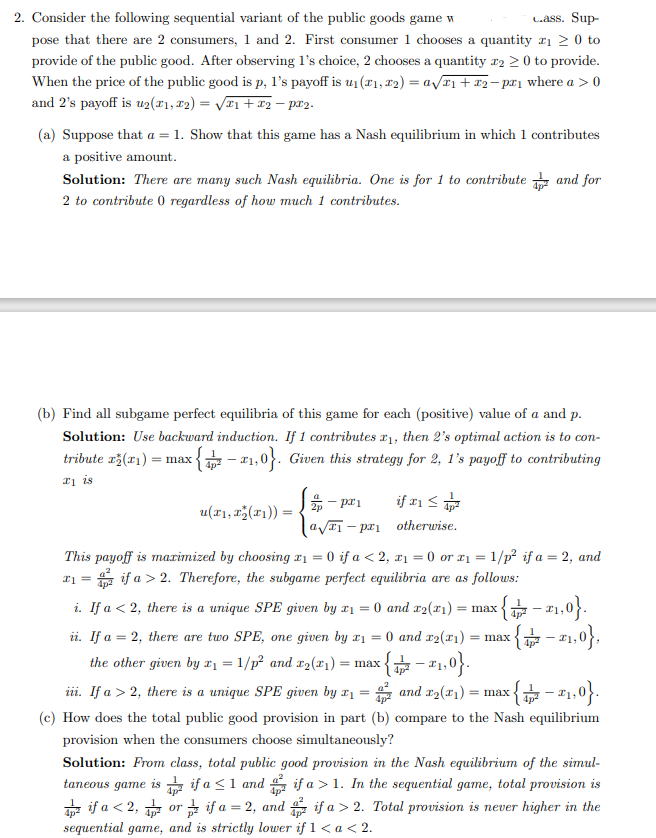
2. Consider the following sequential variant of the public goods game u cass. Suppose that there are 2 consumers, 1 and 2. First consumer 1 chooses a quantity x10 to provide of the public good. After observing 1 's choice, 2 chooses a quantity x20 to provide. When the price of the public good is p,1 's payoff is u1(x1,x2)=ax1+x2px1 where a>0 and 2's payoff is u2(x1,x2)=x1+x2px2. (a) Suppose that a=1. Show that this game has a Nash equilibrium in which 1 contributes a positive amount. Solution: There are many such Nash equilibria. One is for 1 to contribute 4p21 and for 2 to contribute 0 regardless of how much 1 contributes. (b) Find all subgame perfect equilibria of this game for each (positive) value of a and p. Solution: Use backward induction. If 1 contributes x1, then 2 's optimal action is to contribute x2(x1)=max{4p21x1,0}. Given this strategy for 2,1 's payoff to contributing x1 is u(x1,x2(x1))={2papx1ax1px1ifx14p21otherwise. This payoff is maximized by choosing x1=0 if a2. Therefore, the subgame perfect equilibria are as follows: i. If a2, there is a unique SPE given by x1=4p2a2 and x2(x1)=max{4p21x1,0}. (c) How does the total public good provision in part (b) compare to the Nash equilibrium provision when the consumers choose simultaneously? Solution: From class, total public good provision in the Nash equilibrium of the simultaneous game is 4p21 if a1 and 4p2a2 if a>1. In the sequential game, total provision is 4p21 if a2. Total provision is never higher in the sequential game, and is strictly lower if 1
Step by Step Solution
There are 3 Steps involved in it

Get step-by-step solutions from verified subject matter experts
 Study Help