







Question: Exercise 1 ( ( Wo ) Man - in - the - Middle ) Work in teams ^ ( 1 ) of 3 . One
Exercise WoManintheMiddle
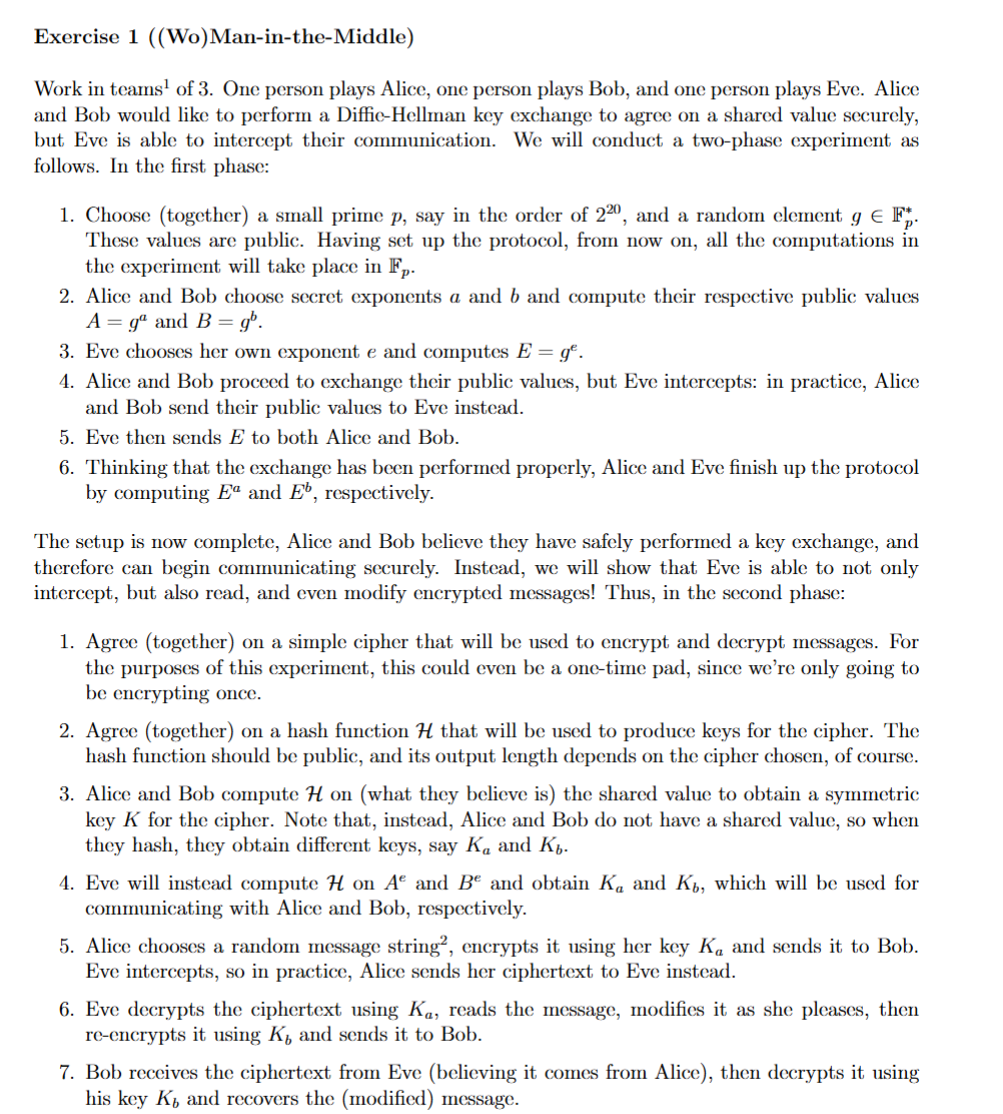
Work in teams of One person plays Alice, one person plays Bob, and one person plays Eve. Alice
and Bob would like to perform a DiffieHellman key exchange to agree on a shared value securely
but Eve is able to intercept their communication. We will conduct a twophase experiment as
follows. In the first phase:
Choose together a small prime p say in the order of and a random element g inFp
These values are public. Having set up the protocol, from now on all the computations in
the experiment will take place in Fp
Alice and Bob choose secret exponents a and b and compute their respective public values
Aga and Bgb
Eve chooses her own exponent e and computes Ege
Alice and Bob proceed to exchange their public values, but Eve intercepts: in practice, Alice
and Bob send their public values to Eve instead.
Eve then sends E to both Alice and Bob.
Thinking that the exchange has been performed properly, Alice and Eve finish up the protocol
by computing Ea and Eb respectively.
The setup is now complete, Alice and Bob believe they have safely performed a key exchange, and
therefore can begin communicating securely Instead, we will show that Eve is able to not only
intercept, but also read, and even modify encrypted messages! Thus, in the second phase:
Agree together on a simple cipher that will be used to encrypt and decrypt messages. For
the purposes of this experiment, this could even be a onetime pad, since we're only going to
be encrypting once.
Agree together on a hash function H that will be used to produce keys for the cipher. The
hash function should be public, and its output length depends on the cipher chosen, of course.
Alice and Bob compute H on what they believe is the shared value to obtain a symmetric
key K for the cipher. Note that, instead, Alice and Bob do not have a shared value, so when
they hash, they obtain different keys, say Ka and Kb
Eve will instead compute H on Ae and Be and obtain Ka and Kb which will be used for
communicating with Alice and Bob, respectively.
Alice chooses a random message string encrypts it using her key Ka and sends it to Bob.
Eve intercepts, so in practice, Alice sends her ciphertext to Eve instead.
Eve decrypts the ciphertext using Ka reads the message, modifies it as she pleases, then
reencrypts it using Kb and sends it to Bob.
Bob receives the ciphertext from Eve believing it comes from Alice then decrypts it using
his key Kb and recovers the modified message. We have just shown that an adversary that is able to intercept messages is able to perform a very
dangerous and insidious attack. The adversary is able to read and modify messages as she pleases.
Even worse, without any means of authentication, the legitimate parties have no way to even
notice that communication was tampered with! We have just shown that an adversary that is able to intercept messages is able to perform a very dangerous and insidious attack. The adversary is able to read and modify messages as she pleases. Even worse, without any means of authentication, the legitimate parties have no way to even notice that communication was tampered with!
Step by Step Solution
There are 3 Steps involved in it
1 Expert Approved Answer
Step: 1 Unlock

Question Has Been Solved by an Expert!
Get step-by-step solutions from verified subject matter experts
Step: 2 Unlock
Step: 3 Unlock
 Study Help