



Question: Exercise 10.4: Radioactive decay again Redo the calculation from Example 10.1, but this time using the faster method described in the preceding section. Using the
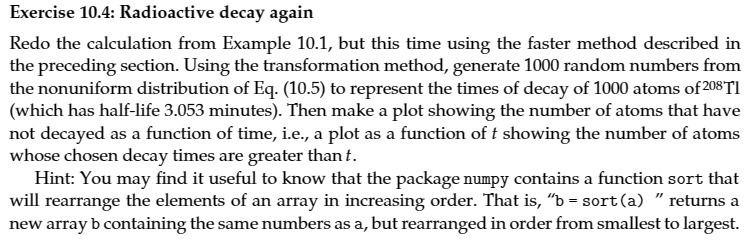
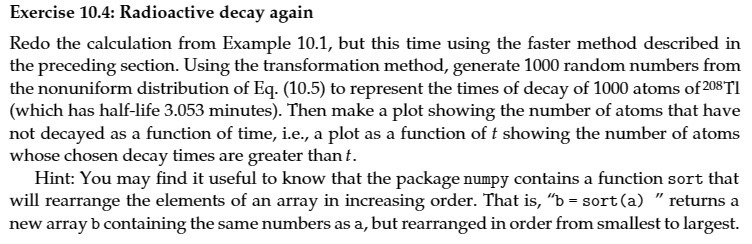
Exercise 10.4: Radioactive decay again Redo the calculation from Example 10.1, but this time using the faster method described in the preceding section. Using the transformation method, generate 1000 random numbers from the nonuniform distribution of Eq. (10.5) to represent the times of decay of 1000 atoms of208T] (which has half-life 3.053 minutes). Then make a plot showing the number of atoms that have not decayed as a function of time, i.e., a plot as a function of { showing the number of atoms whose chosen decay times are greater than f. Hint: You may find it useful to know that the package numpy contains a function sort that will rearrange the elements of an array in increasing order. That is, \"b = sort(a) " returns a new array b containing the same numbers as a, but rearranged in order from smallest to largest
Step by Step Solution
There are 3 Steps involved in it

Get step-by-step solutions from verified subject matter experts