







Question: A small block on a frictionless, horizontal surface has a mass of 2.60x10⁻² kg. It is attached to a massless cord passing through a
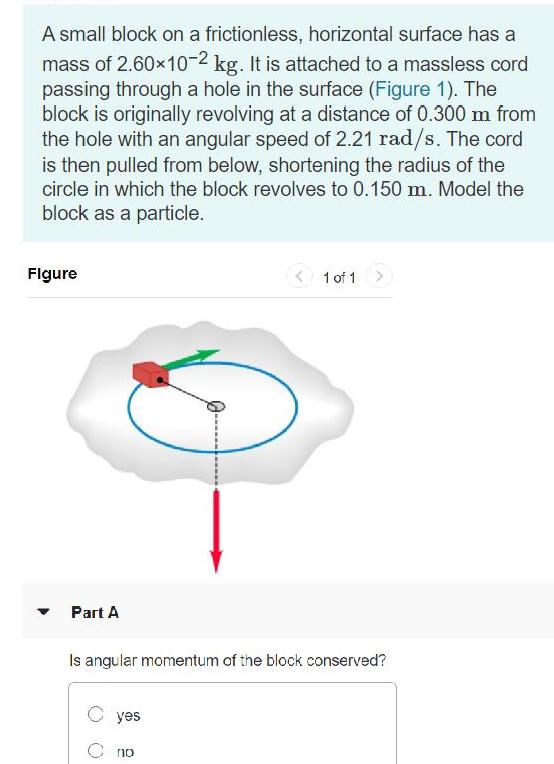
A small block on a frictionless, horizontal surface has a mass of 2.60x10⁻² kg. It is attached to a massless cord passing through a hole in the surface (Figure 1). The block is originally revolving at a distance of 0.300 m from the hole with an angular speed of 2.21 rad/s. The cord is then pulled from below, shortening the radius of the circle in which the block revolves to 0.150 m. Model the block as a particle. Flgure 1 of 1 Part A Is angular momentum of the block conserved? C yes C no Part B What is the new angular speed? Express your answer in radians per second. ? W2 = rad/s Part C Find the change in kinetic energy of the block. Express your answer with the appropriate units. H AK = Value Units Part D How much work was done in pulling the cord? Express your answer with the appropriate units. ? W = Value Units
Step by Step Solution
3.50 Rating (157 Votes )
There are 3 Steps involved in it
The detail... View full answer

Get step-by-step solutions from verified subject matter experts
 Study Help