







Question: You are testing a small flywheel (radius 0.166 m) that will be used to store a small amount of energy. The flywheel is pivoted
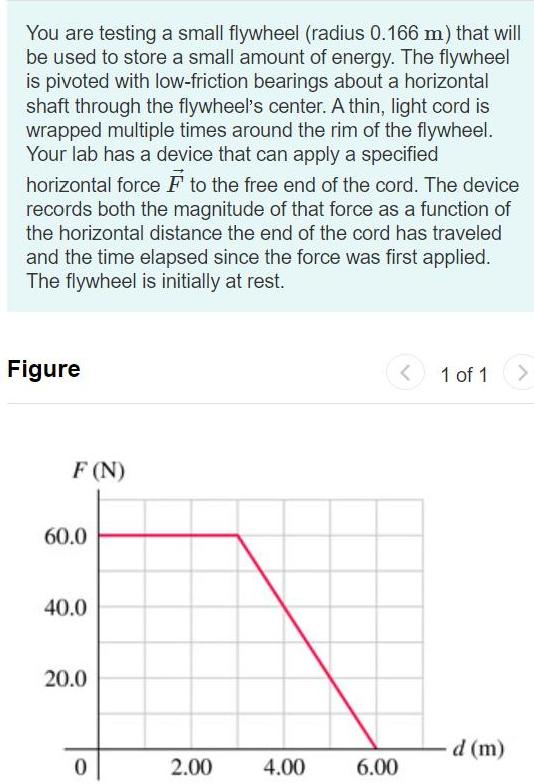
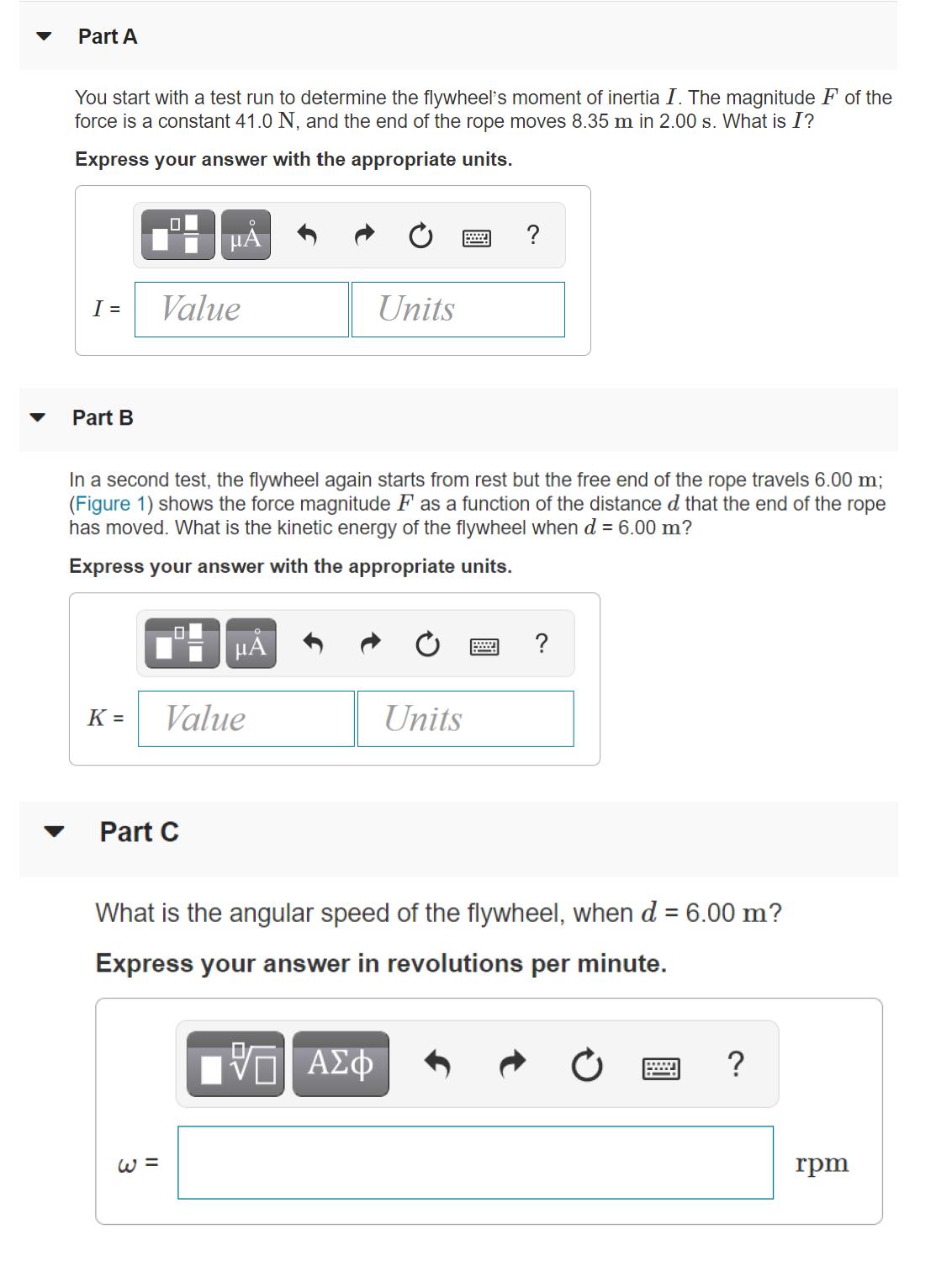
You are testing a small flywheel (radius 0.166 m) that will be used to store a small amount of energy. The flywheel is pivoted with low-friction bearings about a horizontal shaft through the flywheel's center. A thin, light cord is wrapped multiple times around the rim of the flywheel. Your lab has a device that can apply a specified horizontal force F to the free end of the cord. The device records both the magnitude of that force as a function of the horizontal distance the end of the cord has traveled and the time elapsed since the force was first applied. The flywheel is initially at rest. Figure 1 of 1 F (N) 60.0 40.0 20.0 d (m) 2.00 4.00 6.00 Part A You start with a test run to determine the flywheel's moment of inertia I. The magnitude F of the force is a constant 41.0 N, and the end of the rope moves 8.35 m in 2.00 s. What is I? Express your answer with the appropriate units. H ? I = Value Units Part B In a second test, the flywheel again starts from rest but the free end of the rope travels 6.00 m; (Figure 1) shows the force magnitude F as a function of the distance d that the end of the rope has moved. What is the kinetic energy of the flywheel when d = 6.00 m? Express your answer with the appropriate units. A ? Value |Units K = Part C What is the angular speed of the flywheel, when d = 6.00 m? Express your answer in revolutions per minute. ? W = rpm
Step by Step Solution
3.39 Rating (149 Votes )
There are 3 Steps involved in it

Get step-by-step solutions from verified subject matter experts
 Study Help