







Question: Exercise 12.3 Measure any three variables on an interval or ratio scale. Exercise 12.4. Mention one variable for each of the four scales in the
Exercise 12.3 Measure any three variables on an interval or ratio scale.
Exercise 12.4. Mention one variable for each of the four scales in the context of a market survey, and explain how or why it would fit into the scale.
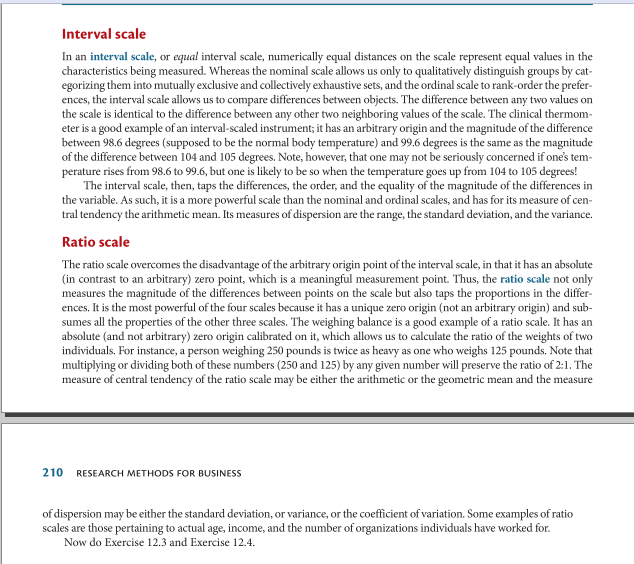
Interval scale In an interval scale, or equal interval scale, numerically equal distances on the scale represent equal values in the characteristics being measured. Whereas the nominal scale allows us only to qualitatively distinguish groups by cat- egorizing them into mutually exclusive and collectively exhaustive sets, and the ordinal scale to rank-order the prefer- ences, the interval scale allows us to compare differences between objects. The difference between any two values on the scale is identical to the difference between any other two neighboring values of the scale. The clinical thermom- eter is a good example of an interval-scaled instrument; it has an arbitrary origin and the magnitude of the difference between 98.6 degrees (supposed to be the normal body temperature) and 99.6 degrees is the same as the magnitude of the difference between 104 and 105 degrees. Note, however, that one may not be seriously concerned if one's tem- perature rises from 98.6 to 99.6, but one is likely to be so when the temperature goes up from 104 to 105 degrees! The interval scale, then, taps the differences, the order, and the equality of the magnitude of the differences in the variable. As such, it is a more powerful scale than the nominal and ordinal scales, and has for its measure of cen- tral tendency the arithmetic mean. Its measures of dispersion are the range, the standard deviation, and the variance. Ratio scale The ratio scale overcomes the disadvantage of the arbitrary origin point of the interval scale, in that it has an absolute (in contrast to an arbitrary) zero point, which is a meaningful measurement point. Thus, the ratio scale not only measures the magnitude of the differences between points on the scale but also taps the proportions in the differ- ences. It is the most powerful of the four scales because it has a unique zero origin (not an arbitrary origin) and sub- sumes all the properties of the other three scales. The weighing balance is a good example of a ratio scale. It has an absolute (and not arbitrary) zero origin calibrated on it, which allows us to calculate the ratio of the weights of two individuals. For instance, a person weighing 250 pounds is twice as heavy as one who weighs 125 pounds. Note that multiplying or dividing both of these numbers (250 and 125) by any given number will preserve the ratio of 2:1. The measure of central tendency of the ratio scale may be either the arithmetic or the geometric mean and the measure 210 RESEARCH METHODS FOR BUSINESS of dispersion may be either the standard deviation, or variance, or the coefficient of variation. Some examples of ratio scales are those pertaining to actual age, income, and the number of organizations individuals have worked for. Now do Exercise 12.3 and Exercise 12.4Step by Step Solution
There are 3 Steps involved in it
1 Expert Approved Answer
Step: 1 Unlock

Question Has Been Solved by an Expert!
Get step-by-step solutions from verified subject matter experts
Step: 2 Unlock
Step: 3 Unlock
 Study Help