







Question: Exercise 12.3 (Sudden Stops With Downward Wage Rigidity) Consider a two-period, small, open economy. Households are endowed with 10 units of tradables in period 1
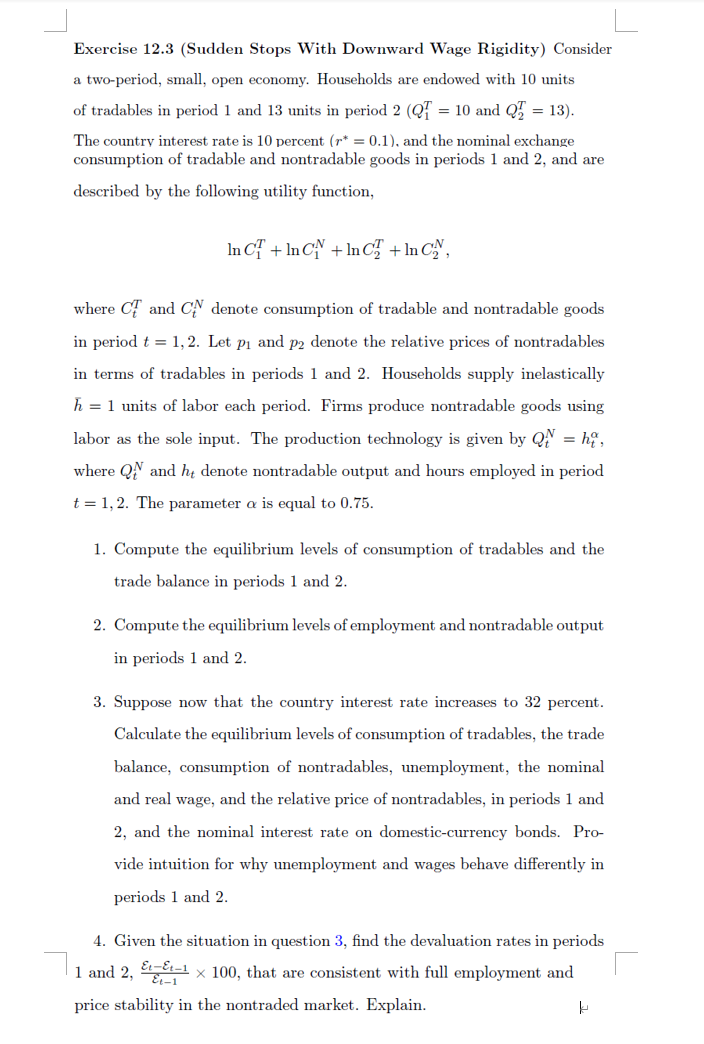
Exercise 12.3 (Sudden Stops With Downward Wage Rigidity) Consider a two-period, small, open economy. Households are endowed with 10 units of tradables in period 1 and 13 units in period 2 (Q1 = 10 and Q? = 13). The country interest rate is 10 percent (r* = 0.1). and the nominal exchange consumption of tradable and nontradable goods in periods 1 and 2, and are described by the following utility function, In CI + InCN + InCT + In CN, where Of and C denote consumption of tradable and nontradable goods in period t = 1, 2. Let pi and p2 denote the relative prices of nontradables in terms of tradables in periods 1 and 2. Households supply inelastically h = 1 units of labor each period. Firms produce nontradable goods using labor as the sole input. The production technology is given by Qf = hi, where Qu and he denote nontradable output and hours employed in period t = 1, 2. The parameter o is equal to 0.75. 1. Compute the equilibrium levels of consumption of tradables and the trade balance in periods 1 and 2. 2. Compute the equilibrium levels of employment and nontradable output in periods 1 and 2. 3. Suppose now that the country interest rate increases to 32 percent. Calculate the equilibrium levels of consumption of tradables, the trade balance, consumption of nontradables, unemployment, the nominal and real wage, and the relative price of nontradables, in periods 1 and 2, and the nominal interest rate on domestic-currency bonds. Pro- vide intuition for why unemployment and wages behave differently in periods 1 and 2. 4. Given the situation in question 3, find the devaluation rates in periods 1 and 2, Et-2-1 x 100, that are consistent with full employment and price stability in the nontraded market. Explain
Step by Step Solution
There are 3 Steps involved in it

Get step-by-step solutions from verified subject matter experts
 Study Help