







Question: Exercise 1.3. Let A[1..n] e R be an array of n numbers. Let k e N be an input parameter where k s n. (We
![Exercise 1.3. Let A[1..n] e R be an array of n](https://dsd5zvtm8ll6.cloudfront.net/si.experts.images/questions/2024/09/66fa69632bda5_01066fa6962b57df.jpg)
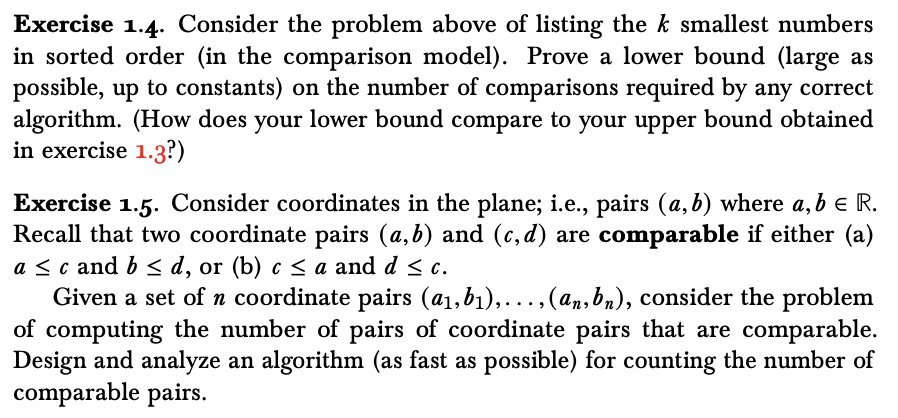
Exercise 1.3. Let A[1..n] e R be an array of n numbers. Let k e N be an input parameter where k s n. (We are particularly interested in the case where k is much smaller than n). Design and analyze an algorithm (as fast as possible) that returns the first k smallest numbers in A in sorted order. Exercise 1.4. Consider the problem above of listing the k smallest numbers in sorted order (in the comparison model). Prove a lower bound (large as possible, up to constants) on the number of comparisons required by any correct algorithm. (How does your lower bound compare to your upper bound obtained in exercise 1.3?) Exercise 1.5. Consider coordinates in the plane; i.e., pairs (a,b) where a, b e R. Recall that two coordinate pairs (a,b) and (c,d) are comparable if either (a) a
Step by Step Solution
There are 3 Steps involved in it

Get step-by-step solutions from verified subject matter experts
 Study Help