







Question: Exercise 14-36 (Algo) Comparing Business Units Using Economic Value Added (EVA) (LO 14-4) Lauderdale Corporation is organized in three geographical divisions (regions) with managers
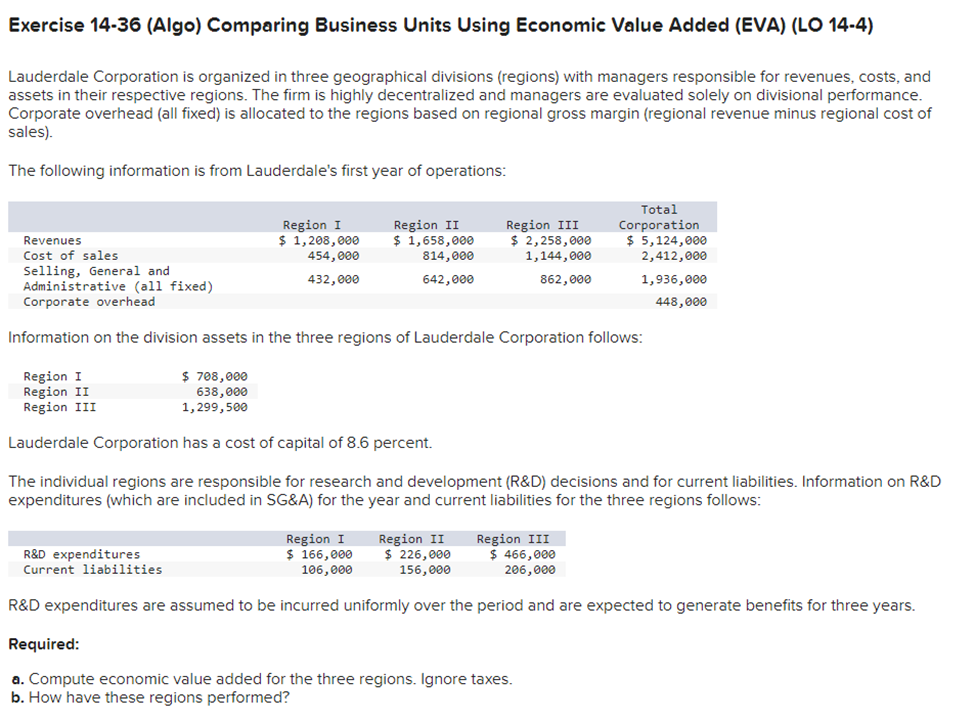
Exercise 14-36 (Algo) Comparing Business Units Using Economic Value Added (EVA) (LO 14-4) Lauderdale Corporation is organized in three geographical divisions (regions) with managers responsible for revenues, costs, and assets in their respective regions. The firm is highly decentralized and managers are evaluated solely on divisional performance. Corporate overhead (all fixed) is allocated to the regions based on regional gross margin (regional revenue minus regional cost of sales). The following information is from Lauderdale's first year of operations: Revenues Cost of sales Selling, General and Administrative (all fixed) Corporate overhead Region I $ 1,208,000 454,000 432,000 Region II $ 1,658,000 Region III Total Corporation 814,000 642,000 $ 2,258,000 1,144,000 $ 5,124,000 2,412,000 862,000 1,936,000 448,000 Information on the division assets in the three regions of Lauderdale Corporation follows: Region I Region II Region III $ 708,000 638,000 1,299,500 Lauderdale Corporation has a cost of capital of 8.6 percent. The individual regions are responsible for research and development (R&D) decisions and for current liabilities. Information on R&D expenditures (which are included in SG&A) for the year and current liabilities for the three regions follows: R&D expenditures Current liabilities Region I $ 166,000 106,000 Region II $ 226,000 156,000 Region III $ 466,000 206,000 R&D expenditures are assumed to be incurred uniformly over the period and are expected to generate benefits for three years. Required: a. Compute economic value added for the three regions. Ignore taxes. b. How have these regions performed?
Step by Step Solution
There are 3 Steps involved in it
To compute the Economic Value Added EVA for the three regions we will use the following steps StepbyStep Solution Step 1 Calculate the Net Operating P... View full answer

Get step-by-step solutions from verified subject matter experts
 Study Help