







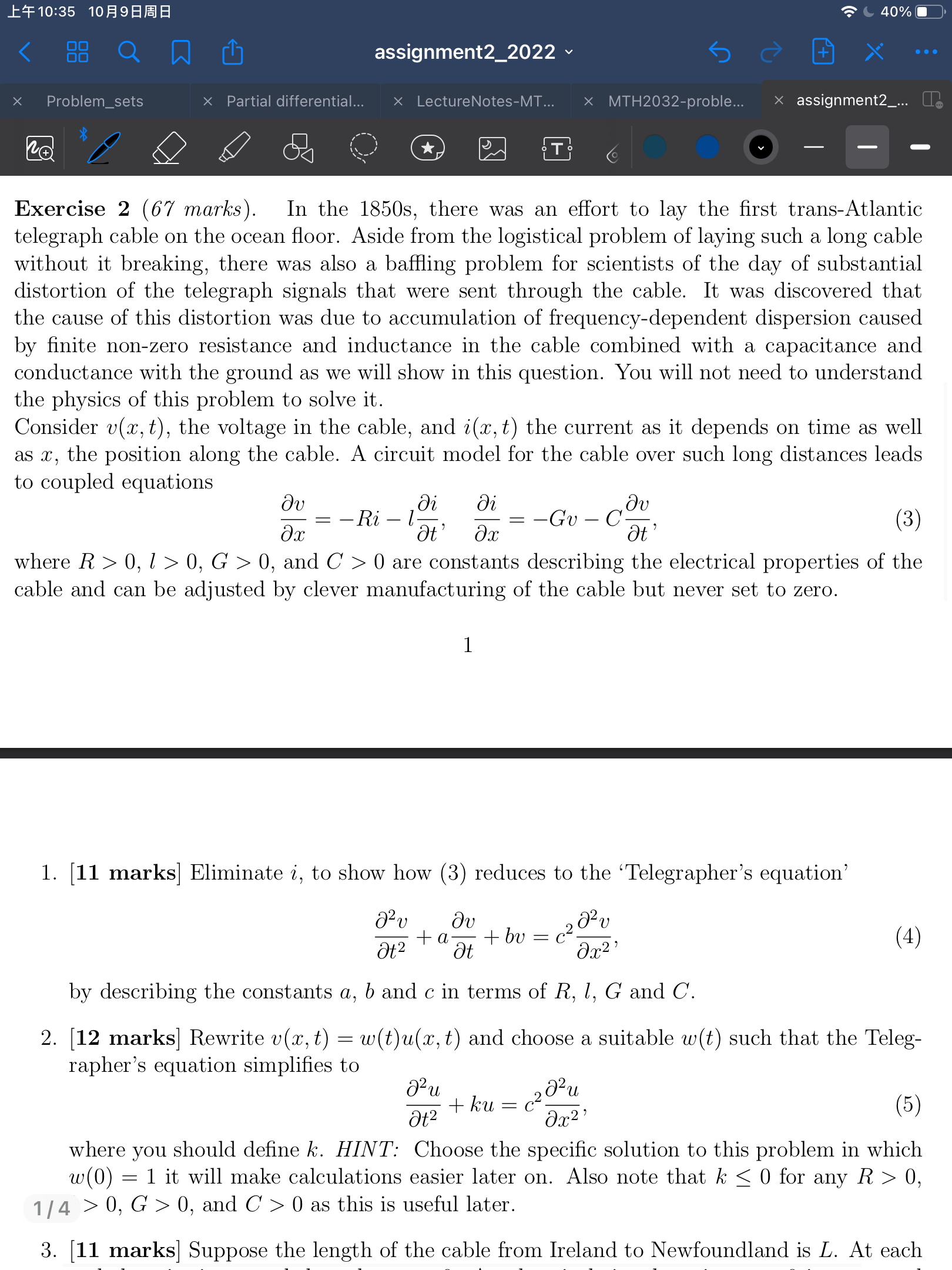
Question: Exercise 2 (67 marks). In the 1850s, there was an effort to lay the first trans-Atlantic telegraph cable on the ocean floor. Aside from the
Exercise 2 (67 marks). In the 1850s, there was an effort to lay the first trans-Atlantic telegraph cable on the ocean floor. Aside from the logistical problem of laying such a long cable without it breaking, there was also a baffling problem for scientists of the day of substantial distortion of the telegraph signals that were sent through the cable. It was discovered that the cause of this distortion was due to accumulation of frequency-dependent dispersion caused by finite non-zero resistance and inductance in the cable combined with a capacitance and conductance with the ground as we will show in this question. You will not need to understand the physics of this problem to solve it. Consider v(x, t), the voltage in the cable, and i(x, t) the current as it depends on time as well as x, the position along the cable. A circuit model for the cable over such long distances leads to coupled equations ?v =?Ri?l?i, ?i =?Gv?C?v, (3)
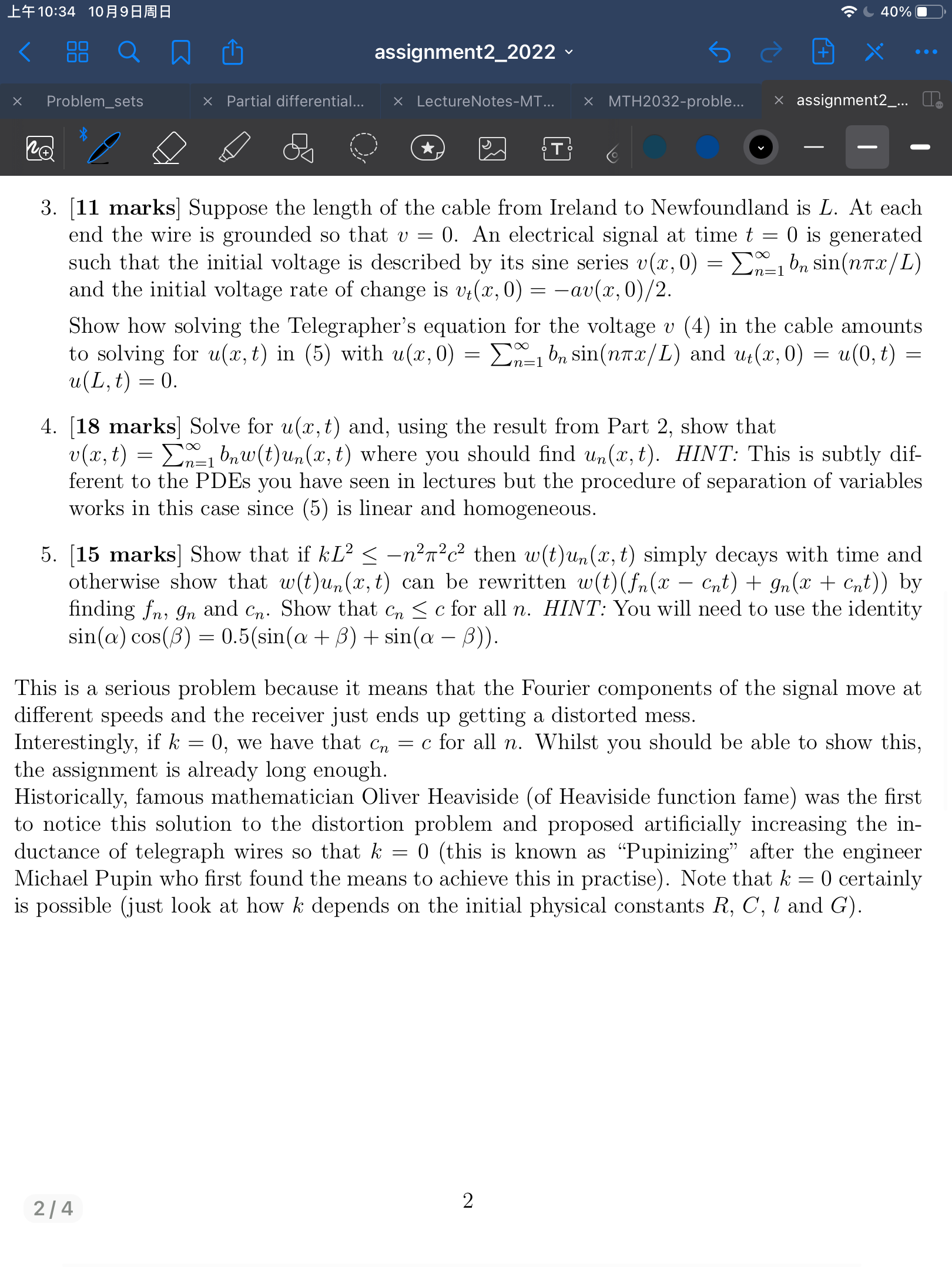
where R > 0, l > 0, G > 0, and C > 0 are constants describing the electrical properties of the cable and can be adjusted by clever manufacturing of the cable but never set to zero. 3. [11 marks] Suppose the length of the cable from Ireland to Newfoundland is L. At each end the wire is grounded so that v = 0. An electrical signal at time t = 0 is generated such that the initial voltage is described by its sine series v(x, 0) = ??n=1 bn sin(n?x/L) and the initial voltage rate of change is vt(x, 0) = ?av(x, 0)/2. Show how solving the Telegrapher's equation for the voltage v (4) in the cable amounts to solving for u(x, t) in (5) with u(x, 0) = ??n=1 bn sin(n?x/L) and ut(x, 0) = u(0, t) = u(L, t) = 0. 4. [18 marks] Solve for u(x, t) and, using the result from Part 2, show that v(x, t) = ??n=1 bnw(t)un(x, t) where you should find un(x, t). HINT: This is subtly dif- ferent to the PDEs you have seen in lectures but the procedure of separation of variables works in this case since (5) is linear and homogeneous. 5. [15 marks] Show that if kL2 ? ?n2?2c2 then w(t)un(x, t) simply decays with time and otherwise show that w(t)un(x, t) can be rewritten w(t)(fn(x ? cnt) + gn(x + cnt)) by finding fn, gn and cn. Show that cn ? c for all n. HINT: You will need to use the identity sin(?) cos(?) = 0.5(sin(? + ?) + sin(? ? ?)).
Step by Step Solution
There are 3 Steps involved in it

Get step-by-step solutions from verified subject matter experts
 Study Help