







Question: Exercise 2 Suppose there are N countries. In this exercise we extend the Krugman (1980) model to N countries, derive a gravity equation, and solve
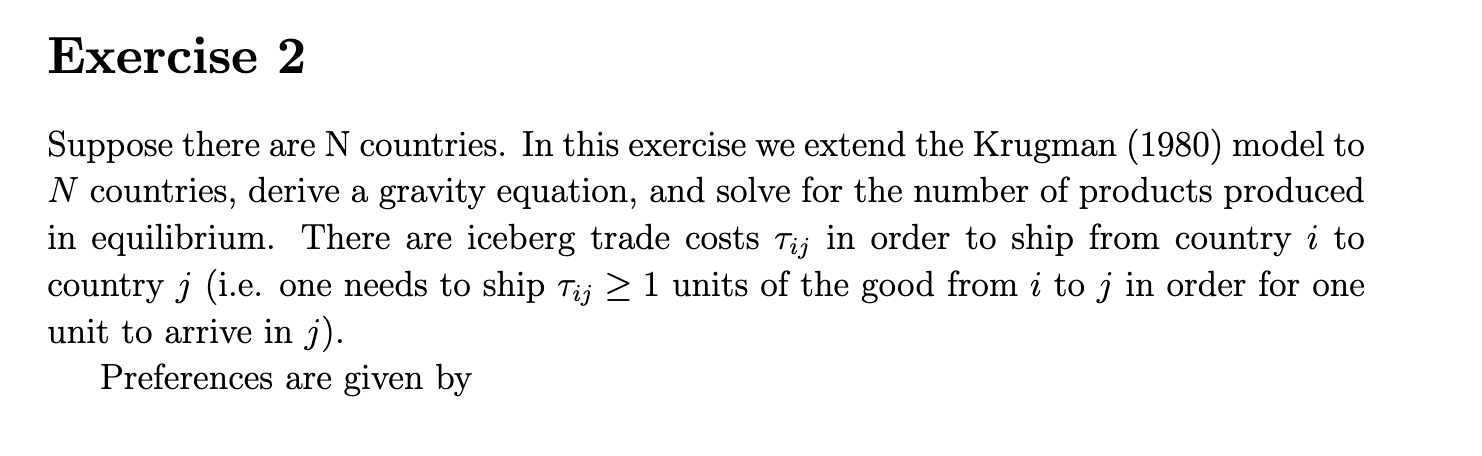
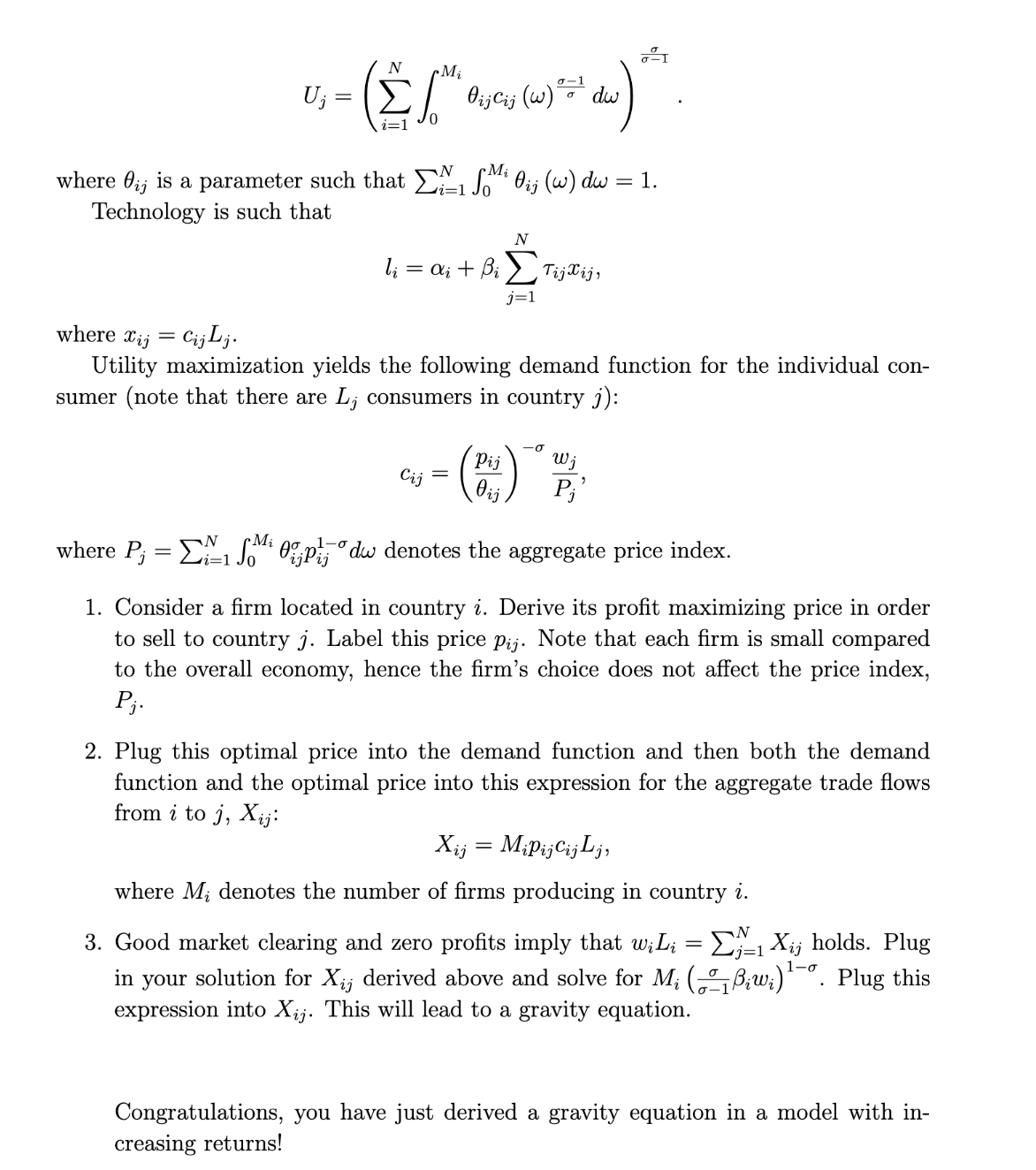
Exercise 2 Suppose there are N countries. In this exercise we extend the Krugman (1980) model to N countries, derive a gravity equation, and solve for the number of products produced in equilibrium. There are iceberg trade costs 7;; in order to ship from country i to country j (i.e. one needs to ship 7;; > 1 units of the good from to j in order for one unit to arrive in j). Preferences are given by o a1 a8 M\" o1 Uj = (Z]; Oiici (w)\"dw) i=1 where 0;; is a parameter such that Ef\\; 1 OM\" 0 (w) dw = 1. Technology is such that N li = o; + B; Zj-'j: j=1 where Ti; = Cz'ij. Utility maximization yields the following demand function for the individual con- sumer (note that there are L; consumers in country j): (P T w \" ('%') By where P; = Ef\\;] fo : B%pij_\"dw denotes the aggregate price index. 1. Consider a firm located in country i. Derive its profit maximizing price in order to sell to country j. Label this price p;;. Note that each firm is small compared to the overall economy, hence the firm's choice does not affect the price index, P 2. Plug this optimal price into the demand function and then both the demand function and the optimal price into this expression for the aggregate trade flows from 7 to j, Xj;: Xij = Mipijci; Lj, where M; denotes the number of firms producing in country i. 3. Good market clearing and zero profits imply that w;L; = Z:;V:l Xi; holds. Plug in your solution for X;; derived above and solve for M; ( iwi)l_d. Plug this expression into X;;. This will lead to a gravity equation. Congratulations, you have just derived a gravity equation in a model with in- creasing returns
Step by Step Solution
There are 3 Steps involved in it

Get step-by-step solutions from verified subject matter experts
 Study Help