







Question: Exercise 2: Voting (35 points) Three students are holding a vote to see which economist they should read in their study group Here are their
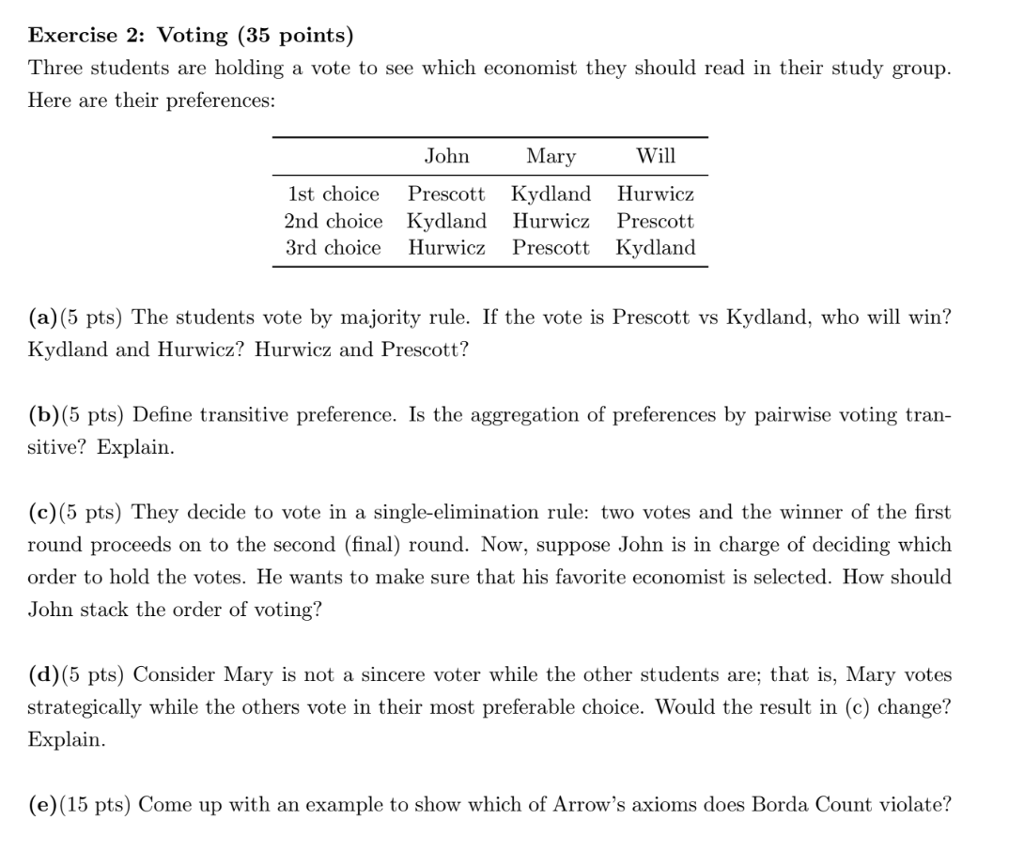
Exercise 2: Voting (35 points) Three students are holding a vote to see which economist they should read in their study group Here are their preferences: John ar Will 1st choice Prescott Kydland Hurwicz 2nd choice Kydland Hurwicz Prescott 3rd choice Hurwicz Prescott Kydland (a) (5 pts) The students vote by majority rule. If the vote is Prescott vs Kydland, who will win? Kydland and Hurwicz? Hurwicz and Prescott'? (b)(5 pts) Define transitive preference. Is the aggregation of preferences by pairwise voting tran- sitive? Explain (c) (5 pts) They decide to vote in a single-elimination rule: two votes and the winner of the first round proceeds on to the second (final) round. Now, suppose John is in charge of deciding which order to hold the votes. He wants to make sure that his favorite economist is selected. How should John stack the order of voting? (d)(5 pts) Consider Mary is not a sincere voter while the other students are; that is, Mary votes strategically while the others vote in their most preferable choice. Would the result in (c) change? Explain. (e)(15 pts) Come up with an example to show which of Arrow's axioms does Borda Count violate? Exercise 2: Voting (35 points) Three students are holding a vote to see which economist they should read in their study group Here are their preferences: John ar Will 1st choice Prescott Kydland Hurwicz 2nd choice Kydland Hurwicz Prescott 3rd choice Hurwicz Prescott Kydland (a) (5 pts) The students vote by majority rule. If the vote is Prescott vs Kydland, who will win? Kydland and Hurwicz? Hurwicz and Prescott'? (b)(5 pts) Define transitive preference. Is the aggregation of preferences by pairwise voting tran- sitive? Explain (c) (5 pts) They decide to vote in a single-elimination rule: two votes and the winner of the first round proceeds on to the second (final) round. Now, suppose John is in charge of deciding which order to hold the votes. He wants to make sure that his favorite economist is selected. How should John stack the order of voting? (d)(5 pts) Consider Mary is not a sincere voter while the other students are; that is, Mary votes strategically while the others vote in their most preferable choice. Would the result in (c) change? Explain. (e)(15 pts) Come up with an example to show which of Arrow's axioms does Borda Count violate
Step by Step Solution
There are 3 Steps involved in it

Get step-by-step solutions from verified subject matter experts
 Study Help