







Question: exercise 3. Activity-based vs. Traditional costing Exercise 3. Activity-based vs. traditional costing Please use table 12.4 on page 355 of the Richards book for this
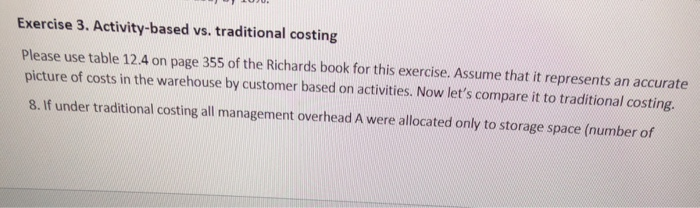
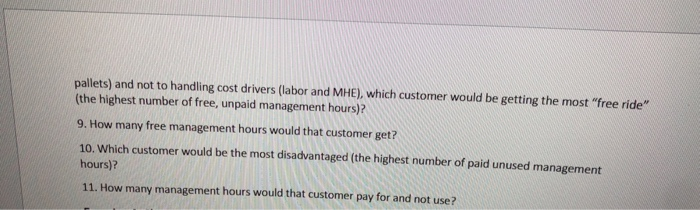
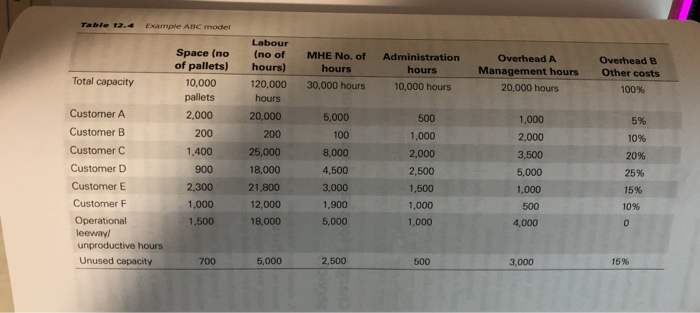
Exercise 3. Activity-based vs. traditional costing Please use table 12.4 on page 355 of the Richards book for this exercise. Assume that it represents an accurate picture of costs in the warehouse by customer based on activities. Now let's compare it to traditional costing. 8. If under traditional costing all management overhead A were allocated only to storage space (number of pallets) and not to handling cost drivers (labor and MHE), which customer would be getting the most "free ride" (the highest number of free, unpaid management hours)? 9. How many free management hours would that customer get? 10. Which customer would be the most disadvantaged (the highest number of paid unused management hours)? 11. How many management hours would that customer pay for and not use? Table 12.4 Example ABC model MHE No. of hours 30,000 hours Administration hours 10,000 hours Overhead A Management hours 20,000 hours Overhead B Other costs 100% Total capacity 5% Space (no of pallets) 10,000 pallets 2.000 200 1,400 900 2,300 1,000 1,500 Customer A Customer B Customer C Customer D Customer E Customer F Operational leeway! unproductive hours Unused capacity Labour (no of hours) 120,000 hours 20,000 200 25,000 18,000 21,800 12,000 18,000 5,000 100 8,000 4,500 3,000 1,900 5,000 500 1.000 2,000 2,500 1,500 1,000 1,000 1,000 2,000 3,500 5,000 1,000 500 4,000 10% 20% 25% 15% 109 700 5,000 2,500 500 3,000 15% Exercise 3. Activity-based vs. traditional costing Please use table 12.4 on page 355 of the Richards book for this exercise. Assume that it represents an accurate picture of costs in the warehouse by customer based on activities. Now let's compare it to traditional costing. 8. If under traditional costing all management overhead A were allocated only to storage space (number of pallets) and not to handling cost drivers (labor and MHE), which customer would be getting the most "free ride" (the highest number of free, unpaid management hours)? 9. How many free management hours would that customer get? 10. Which customer would be the most disadvantaged (the highest number of paid unused management hours)? 11. How many management hours would that customer pay for and not use? Table 12.4 Example ABC model MHE No. of hours 30,000 hours Administration hours 10,000 hours Overhead A Management hours 20,000 hours Overhead B Other costs 100% Total capacity 5% Space (no of pallets) 10,000 pallets 2.000 200 1,400 900 2,300 1,000 1,500 Customer A Customer B Customer C Customer D Customer E Customer F Operational leeway! unproductive hours Unused capacity Labour (no of hours) 120,000 hours 20,000 200 25,000 18,000 21,800 12,000 18,000 5,000 100 8,000 4,500 3,000 1,900 5,000 500 1.000 2,000 2,500 1,500 1,000 1,000 1,000 2,000 3,500 5,000 1,000 500 4,000 10% 20% 25% 15% 109 700 5,000 2,500 500 3,000 15%
Step by Step Solution
There are 3 Steps involved in it

Get step-by-step solutions from verified subject matter experts
 Study Help