







Question: Exercise 5. Charging for storage and handling Please use table 12.5 on p. 288 of the Richards book for this exercise without any changes given
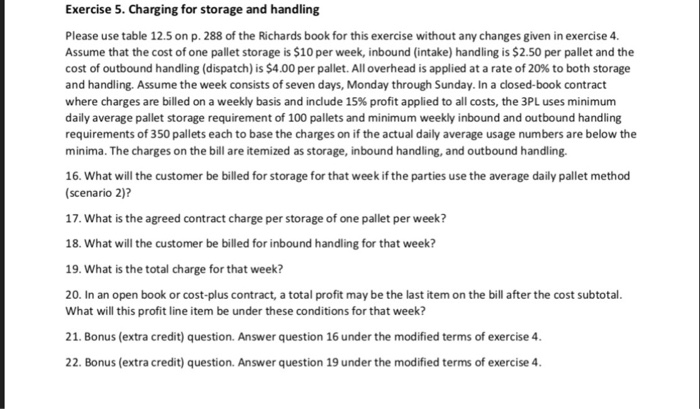
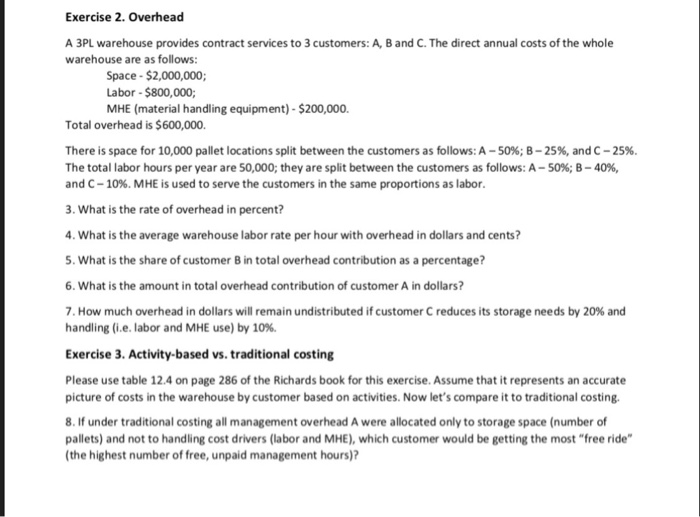
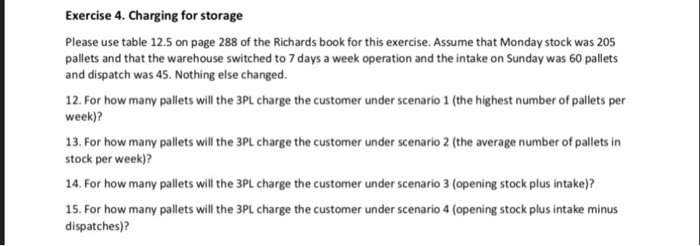
Exercise 5. Charging for storage and handling Please use table 12.5 on p. 288 of the Richards book for this exercise without any changes given in exercise 4 Assume that the cost of one pallet storage is $10 per week, inbound (intake) handling is $2.50 per pallet and the cost of outbound handling (dispatch) is $4.00 per pallet. All overhead is applied at a rate of 20% to both storage and handling. Assume the week consists of seven days, Monday through Sunday. In a closed-book contract where charges are billed on a weekly basis and include 15% profit applied to all costs, the 3PL uses minimum daily average pallet storage requirement of 100 pallets and minimum weekly inbound and outbound handling requirements of 350 pallets each to base the charges on if the actual daily average usage numbers are below the minima. The charges on the bill are itemized as storage, inbound handling, and outbound handling. 16. What will the customer be billed for storage for that week if the parties use the average daily pallet method (scenario 2)? 17. What is the agreed contract charge per storage of one pallet per week? 18. What will the customer be billed for inbound handling for that week? 19. What is the total charge for that week? 20. In an open book or cost-plus contract, a total profit may be the last item on the bill after the cost subtotal What will this profit line item be under these conditions for that week? 21. Bonus (extra credit) question. Answer question 16 under the modified terms of exercise 4 22. Bonus (extra credit) question. Answer question 19 under the modified terms of exercise 4 Exercise 2. Overhead A 3PL warehouse provides contract services to 3 customers: A, B and C. The direct annual costs of the whole warehouse are as follows Space $2,000,000 Labor $800,000; MHE (material handling equipment)-$200,000. Total overhead is $600,000. There is space for 10,000 pallet locations split between the customers as follows: A-50%,8-25%, and C-25%. The total labor hours per year are 50,000; they are split between the customers as follows: A-50%; B-40%, and C-1096. MHE is used to serve the customers in the same proportions as labor. . What is the rate of overhead in percent? . What is the average warehouse labor rate per hour with overhead in dollars and cents? 5. What is the share of customer 8 in total overhead contribution as a percentage? 6. What is the amount in total overhead contribution of customer A in dollars? 7, How much overhead in dollars will remain undistributed if customer C reduces its storage needs by 20% and handling (i.e. labor and MHE use) by 10%. Exercise 3. Activity-based vs. traditional costing Please use table 12.4 on page 286 of the Richards book for this exercise. Assume that it represents an accurate picture of costs in the warehouse by customer based on activities. Now let's compare it to traditional costing. 8. If under traditional costing all management overhead A were allocated only to storage space (number of pallets) and not to handling cost drivers (labor and MHE), which customer would be getting the most "free ride (the highest number of free, unpaid management hours)? Exercise 4. Charging for storage Please use table 12.5 on page 288 of the Richards book for this exercise. Assume that Monday stock was 205 pallets and that the warehouse switched to 7 days a week operation and the intake on Sunday was 60 pallets and dispatch was 45. Nothing else changed 12. For how many pallets will the 3PL charge the customer under scenario 1 (the highest number of pallets per week)? 13. For how many pallets will the 3PL charge the customer under scenario 2 (the average number of pallets in stock per week)? 14. For how many pallets will the 3PL charge the customer under scenario 3 (opening stock plus intake)? 15. For how many pallets will the 3PL charge the customer under scenario 4 (opening stock plus intake minus dispatches)? Exercise 5. Charging for storage and handling Please use table 12.5 on p. 288 of the Richards book for this exercise without any changes given in exercise 4 Assume that the cost of one pallet storage is $10 per week, inbound (intake) handling is $2.50 per pallet and the cost of outbound handling (dispatch) is $4.00 per pallet. All overhead is applied at a rate of 20% to both storage and handling. Assume the week consists of seven days, Monday through Sunday. In a closed-book contract where charges are billed on a weekly basis and include 15% profit applied to all costs, the 3PL uses minimum daily average pallet storage requirement of 100 pallets and minimum weekly inbound and outbound handling requirements of 350 pallets each to base the charges on if the actual daily average usage numbers are below the minima. The charges on the bill are itemized as storage, inbound handling, and outbound handling. 16. What will the customer be billed for storage for that week if the parties use the average daily pallet method (scenario 2)? 17. What is the agreed contract charge per storage of one pallet per week? 18. What will the customer be billed for inbound handling for that week? 19. What is the total charge for that week? 20. In an open book or cost-plus contract, a total profit may be the last item on the bill after the cost subtotal What will this profit line item be under these conditions for that week? 21. Bonus (extra credit) question. Answer question 16 under the modified terms of exercise 4 22. Bonus (extra credit) question. Answer question 19 under the modified terms of exercise 4 Exercise 2. Overhead A 3PL warehouse provides contract services to 3 customers: A, B and C. The direct annual costs of the whole warehouse are as follows Space $2,000,000 Labor $800,000; MHE (material handling equipment)-$200,000. Total overhead is $600,000. There is space for 10,000 pallet locations split between the customers as follows: A-50%,8-25%, and C-25%. The total labor hours per year are 50,000; they are split between the customers as follows: A-50%; B-40%, and C-1096. MHE is used to serve the customers in the same proportions as labor. . What is the rate of overhead in percent? . What is the average warehouse labor rate per hour with overhead in dollars and cents? 5. What is the share of customer 8 in total overhead contribution as a percentage? 6. What is the amount in total overhead contribution of customer A in dollars? 7, How much overhead in dollars will remain undistributed if customer C reduces its storage needs by 20% and handling (i.e. labor and MHE use) by 10%. Exercise 3. Activity-based vs. traditional costing Please use table 12.4 on page 286 of the Richards book for this exercise. Assume that it represents an accurate picture of costs in the warehouse by customer based on activities. Now let's compare it to traditional costing. 8. If under traditional costing all management overhead A were allocated only to storage space (number of pallets) and not to handling cost drivers (labor and MHE), which customer would be getting the most "free ride (the highest number of free, unpaid management hours)? Exercise 4. Charging for storage Please use table 12.5 on page 288 of the Richards book for this exercise. Assume that Monday stock was 205 pallets and that the warehouse switched to 7 days a week operation and the intake on Sunday was 60 pallets and dispatch was 45. Nothing else changed 12. For how many pallets will the 3PL charge the customer under scenario 1 (the highest number of pallets per week)? 13. For how many pallets will the 3PL charge the customer under scenario 2 (the average number of pallets in stock per week)? 14. For how many pallets will the 3PL charge the customer under scenario 3 (opening stock plus intake)? 15. For how many pallets will the 3PL charge the customer under scenario 4 (opening stock plus intake minus dispatches)
Step by Step Solution
There are 3 Steps involved in it

Get step-by-step solutions from verified subject matter experts
 Study Help