







Question: Exercise 3 Consider a simple 2-D model of atomic hydrogen: an electron of mass me orbits a proton in a circular path dened by the
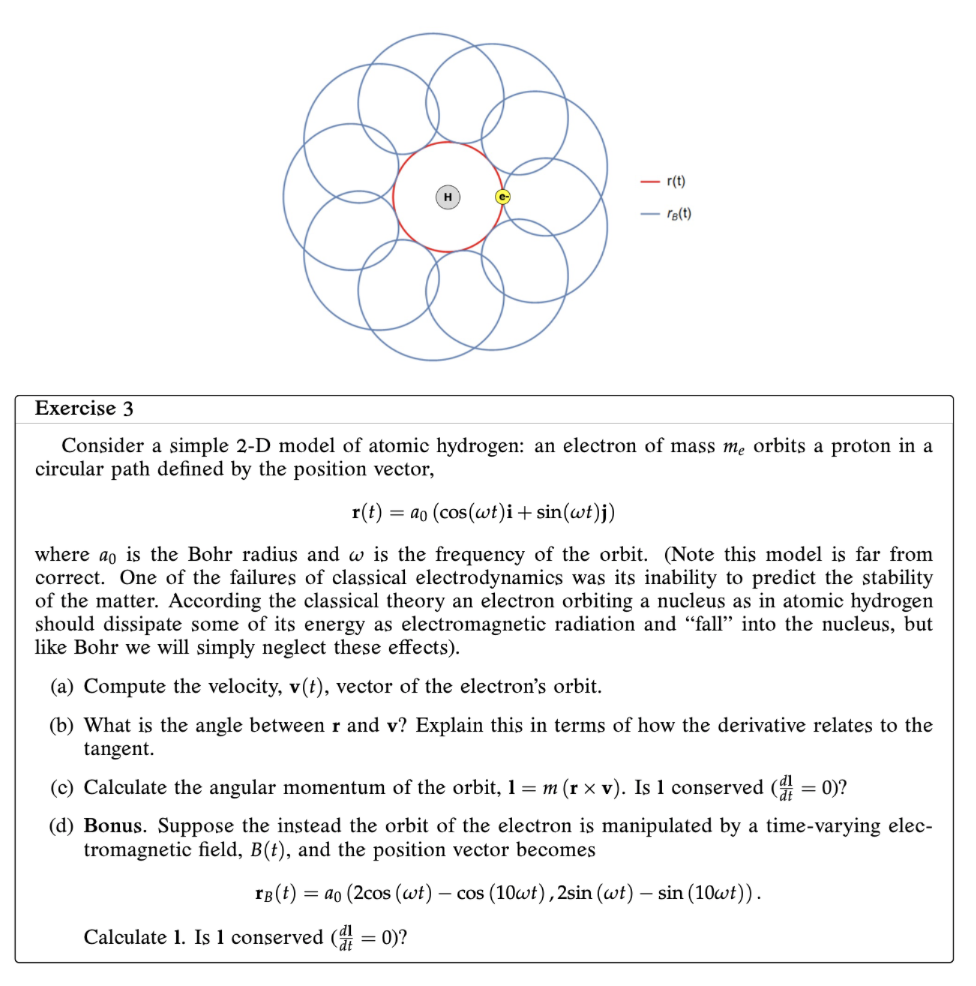
Exercise 3 Consider a simple 2-D model of atomic hydrogen: an electron of mass me orbits a proton in a circular path dened by the position vector, TU) = an (606(w)i+sin(wf)i) where an is the Bohr radius and w is the frequency of the orbit. (Note this model is far from correct. One of the failures of classical electrodynamics was its inability to predict the stability of the matter. According the classical theory an electron orbiting a nucleus as in atomic hydrogen should dissipate some of its energy as electromagnetic radiation and \"fall\" into the nucleus, but like Bohr we will simply neglect these effects). (a) Compute the velocity, v(t), vector of the electron's orbit. (b) What is the angle between r and v? Explain this in terms of how the derivative relates to the tangent. (0) Calculate the angular momentum of the orbit, l = m (r x v). 15 l conserved (5% = 0)? (d) Bonus. Suppose the instead the orbit of the electron is manipulated by a time-varying elec- tromagnetic eld, BO), and the position vector becomes r}; (t) = a0 (Zoos (wt) cos (10w!) , 23in (wt) sin (lOth. Calculate 1. Is 1 conserved (% = 0)
Step by Step Solution
There are 3 Steps involved in it

Get step-by-step solutions from verified subject matter experts
 Study Help