







Question: Exercise 3 Let x be a real number. Solve the equation 3 2x -2(3 x )+1=0. Exercise 4 Prove the following identities, where p, q,
Exercise 3
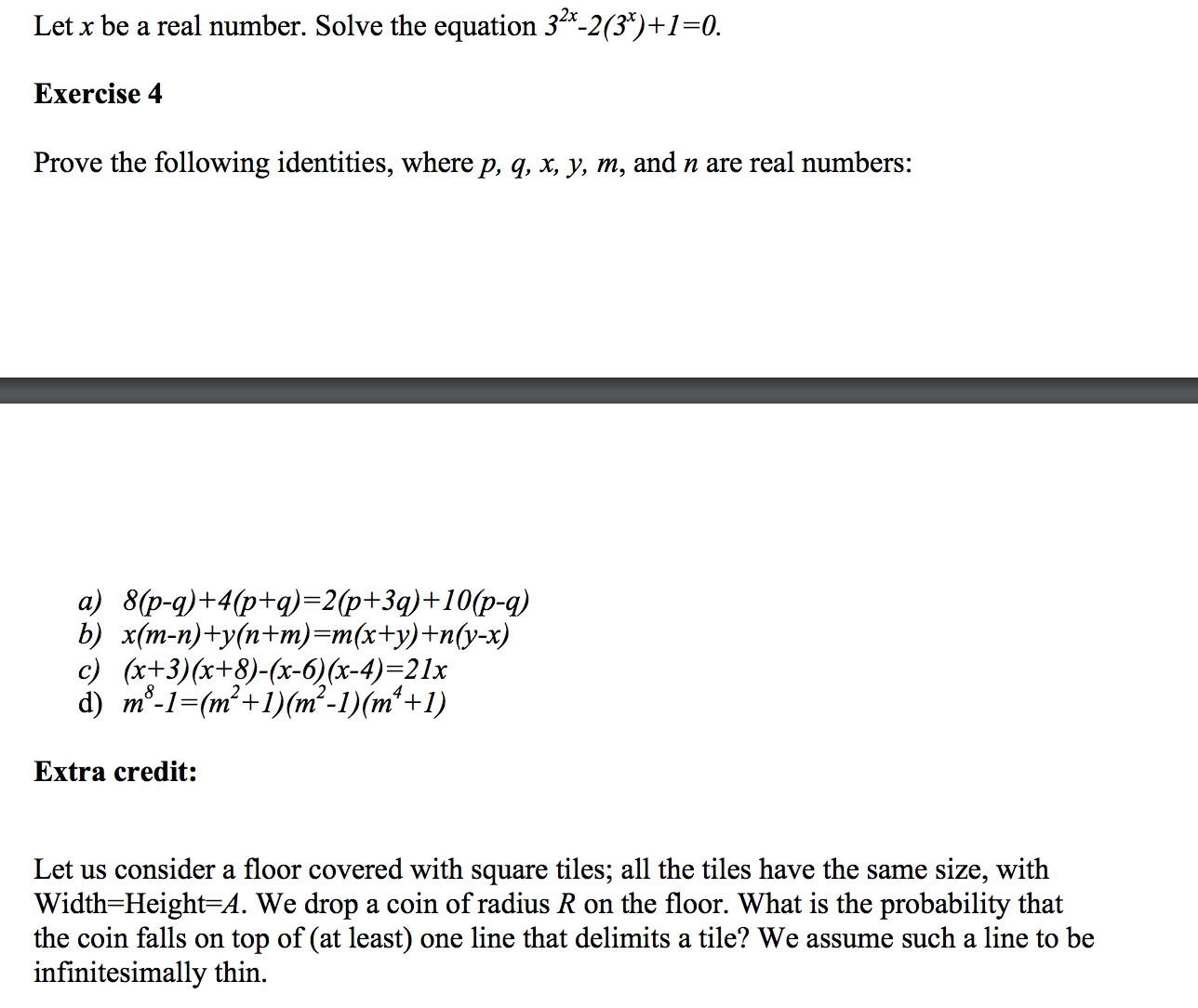
Let x be a real number. Solve the equation 32x-2(3x)+1=0.
Exercise 4
Prove the following identities, where p, q, x, y, m, and n are real numbers:
8(p-q)+4(p+q)=2(p+3q)+10(p-q)
x(m-n)+y(n+m)=m(x+y)+n(y-x)
(x+3)(x+8)-(x-6)(x-4)=21x
m8-1=(m2+1)(m2-1)(m4+1)
Extra credit:
Let us consider a floor covered with square tiles; all the tiles have the same size, with Width=Height=A. We drop a coin of radius R on the floor. What is the probability that the coin falls on top of (at least) one line that delimits a tile? We assume such a line to be infinitesimally thin.
Let x be a real number. Solve the equation 32x-2(3")+1 =0. Exercise 4 Prove the following identities, where p, q, x, y, m, and n are real numbers: a) 8(p-q)+4(p+q)=2(p+3q)+10(pq) 5) x(m-n)+y(n+m)=m(x+y)+n(y-x) c) (x+3)(x+8)(x6)(x4)=21x d) m8-1=(m2+1)(m2-1)(m4+1) Extra credit: Let us consider a oor covered with square tiles; all the tiles have the same size, with Width=Height=A. We drop a coin of radius R on the oor. What is the probability that the coin falls on top of (at least) one line that deliInits a tile? We assume such a line to be innitesimally thin
Step by Step Solution
There are 3 Steps involved in it

Get step-by-step solutions from verified subject matter experts
 Study Help