



Question: Exercise 3.5 In Exercise 3.4, suppose that the supply and demand describe an agricultural market rather than a labour market, and the government implements a
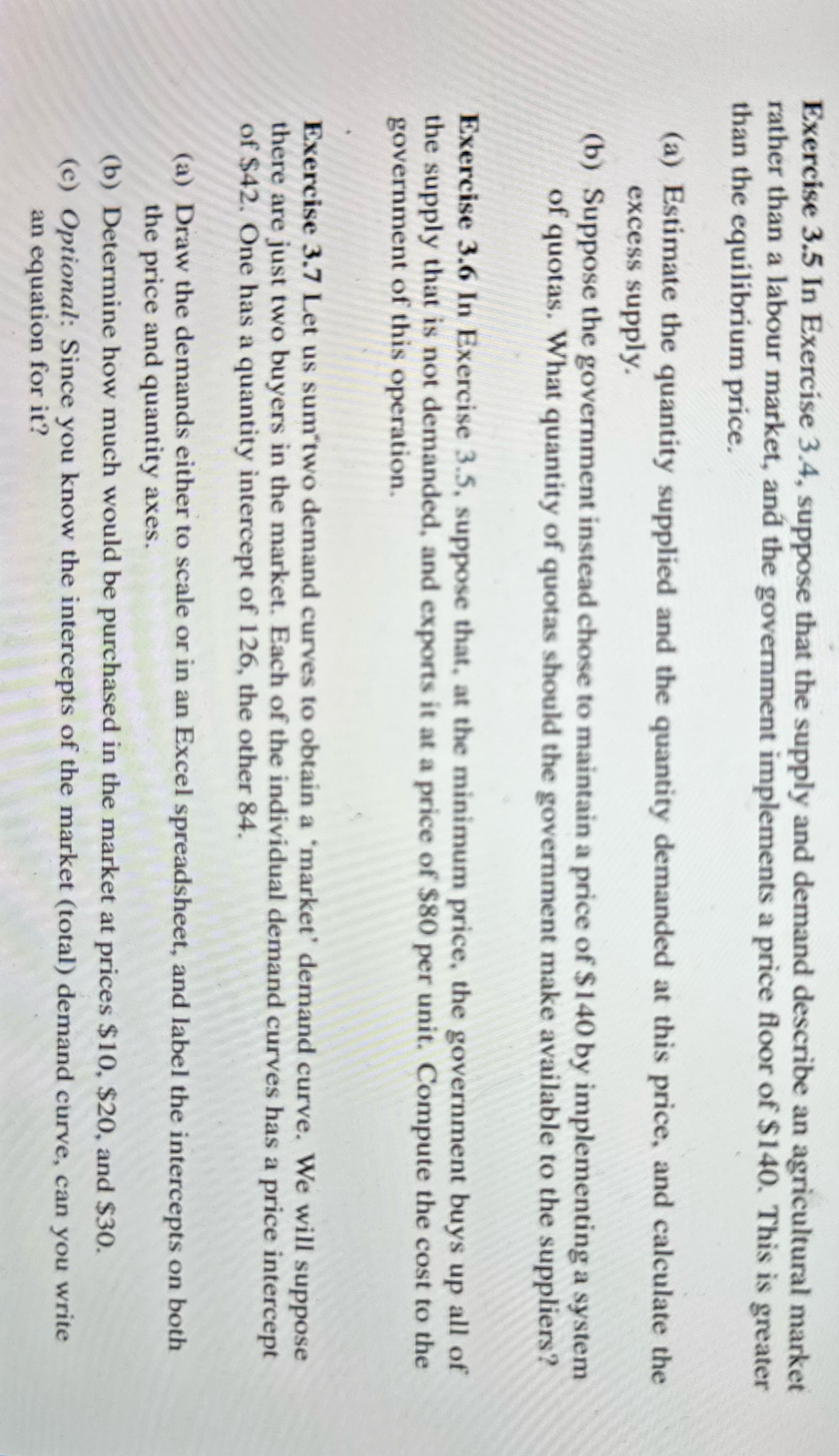
Exercise 3.5 In Exercise 3.4, suppose that the supply and demand describe an agricultural market rather than a labour market, and the government implements a price floor of $140. This is greater than the equilibrium price. (a) Estimate the quantity supplied and the quantity demanded at this price, and calculate the excess supply. (b) Suppose the government instead chose to maintain a price of $140 by implementing a system of quotas. What quantity of quotas should the government make available to the suppliers? Exercise 3.6 In Exercise 3.5, suppose that, at the minimum price, the government buys up all of the supply that is not demanded, and exports it at a price of $80 per unit. Compute the cost to the government of this operation. Exercise 3.7 Let us sum two demand curves to obtain a 'market' demand curve. We will suppose there are just two buyers in the market. Each of the individual demand curves has a price intercept of $42. One has a quantity intercept of 126, the other 84. (a) Draw the demands either to scale or in an Excel spreadsheet, and label the intercepts on both the price and quantity axes. (b) Determine how much would be purchased in the market at prices $10, $20, and $30. (c) Optional: Since you know the intercepts of the market (total) demand curve, can you write an equation for it
Step by Step Solution
There are 3 Steps involved in it

Get step-by-step solutions from verified subject matter experts