







Question: Exercise 4.1 Amy and Bill simultaneously write a bid on a piece of paper. The bid can only be either 2 or 3. A referee
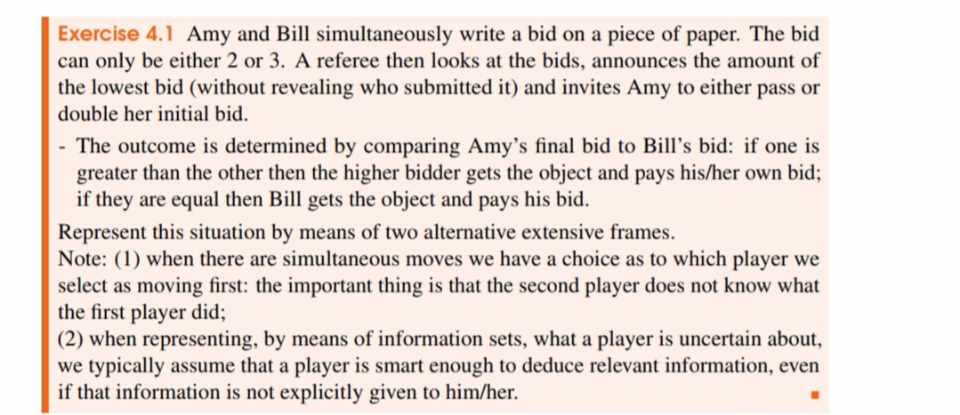
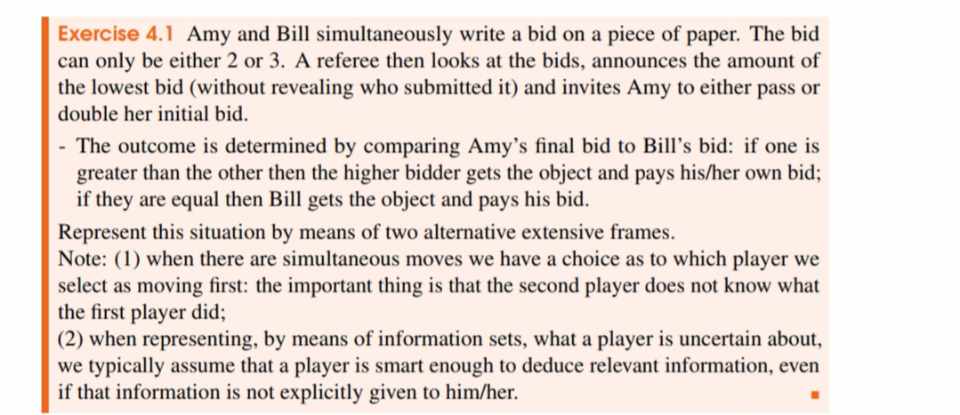
Exercise 4.1 Amy and Bill simultaneously write a bid on a piece of paper. The bid can only be either 2 or 3. A referee then looks at the bids, announces the amount of the lowest bid (without revealing who submitted it) and invites Amy to either pass or double her initial bid. - The outcome is determined by comparing Amy's final bid to Bill's bid: if one is greater than the other then the higher bidder gets the object and pays his/her own bid; if they are equal then Bill gets the object and pays his bid. Represent this situation by means of two alternative extensive frames. Note: (1) when there are simultaneous moves we have a choice as to which player we select as moving first: the important thing is that the second player does not know what the first player did; (2) when representing, by means of information sets, what a player is uncertain about, we typically assume that a player is smart enough to deduce relevant information, even if that information is not explicitly given to him/her
Step by Step Solution
There are 3 Steps involved in it

Get step-by-step solutions from verified subject matter experts
 Study Help