







Question: Exercise 4.14 (Option on an option). Let us study the call option on a call option, although there are obviously many other combinations. These come
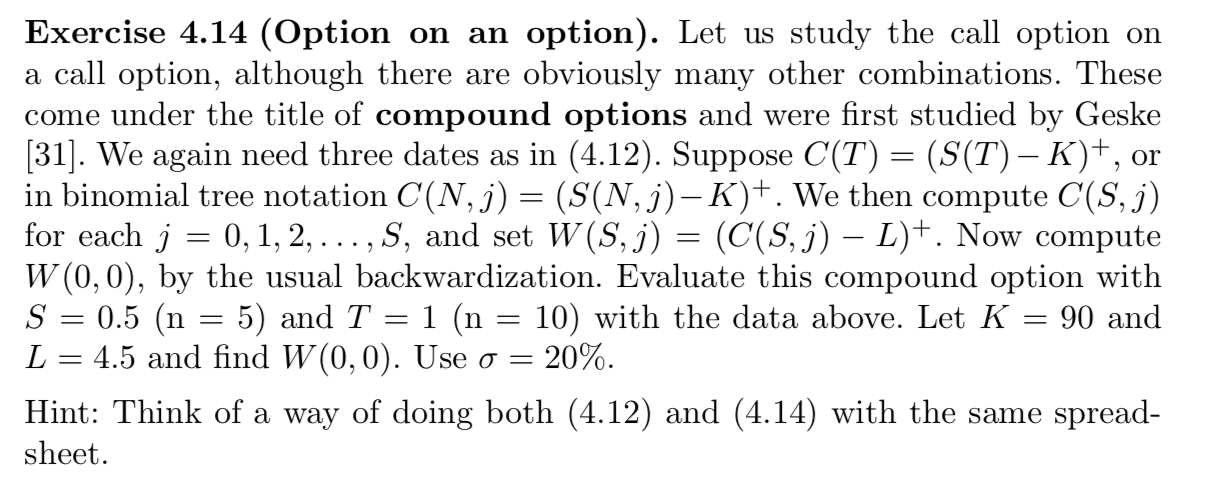
Exercise 4.14 (Option on an option). Let us study the call option on a call option, although there are obviously many other combinations. These come under the title of compound options and were first studied by Geske [31]. We again need three dates as in (4.12). Suppose C(T) = (S(T) K)+, or in binomial tree notation C(N, j) = (S(N, j) K)+. We then compute C(S, j). for each j = 0, 1, 2, ..., S, and set W(S,j) = (C(S,j) L)+. Now compute W(0,0), by the usual backwardization. Evaluate this compound option with S = 0.5 (n = 5) and T = 1 (n = 10) with the data above. Let K = 90 and L = 4.5 and find W(0,0). Use o = 20%. Hint: Think of a way of doing both (4.12) and (4.14) with the same spread- sheet. Exercise 4.14 (Option on an option). Let us study the call option on a call option, although there are obviously many other combinations. These come under the title of compound options and were first studied by Geske [31]. We again need three dates as in (4.12). Suppose C(T) = (S(T) K)+, or in binomial tree notation C(N, j) = (S(N, j) K)+. We then compute C(S, j). for each j = 0, 1, 2, ..., S, and set W(S,j) = (C(S,j) L)+. Now compute W(0,0), by the usual backwardization. Evaluate this compound option with S = 0.5 (n = 5) and T = 1 (n = 10) with the data above. Let K = 90 and L = 4.5 and find W(0,0). Use o = 20%. Hint: Think of a way of doing both (4.12) and (4.14) with the same spread- sheet
Step by Step Solution
There are 3 Steps involved in it

Get step-by-step solutions from verified subject matter experts
 Study Help