







Question: Exercise 5.4 Consider the problem in Example 5.1, with a;; changed from 3 to 3+ 6. Let us keep 1 and z2 as the basic
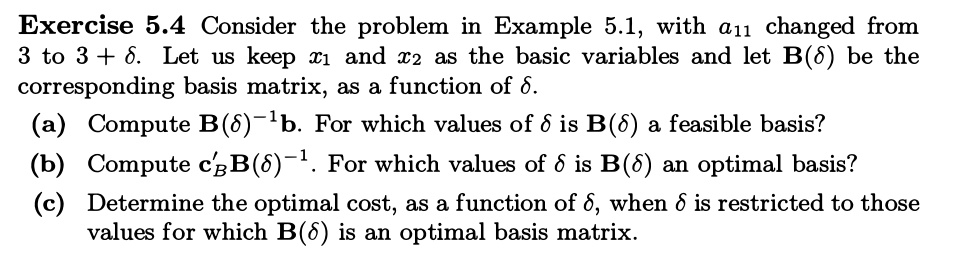
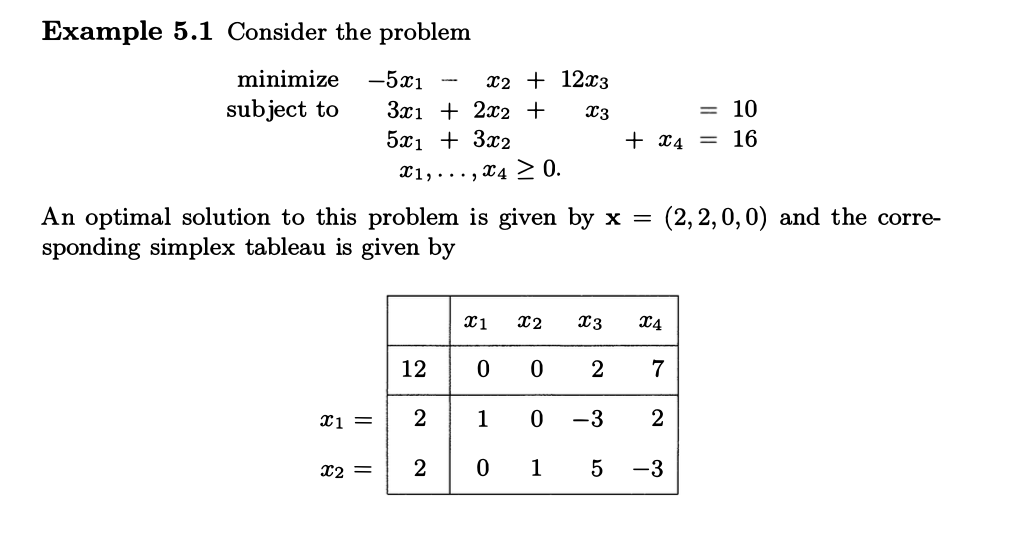
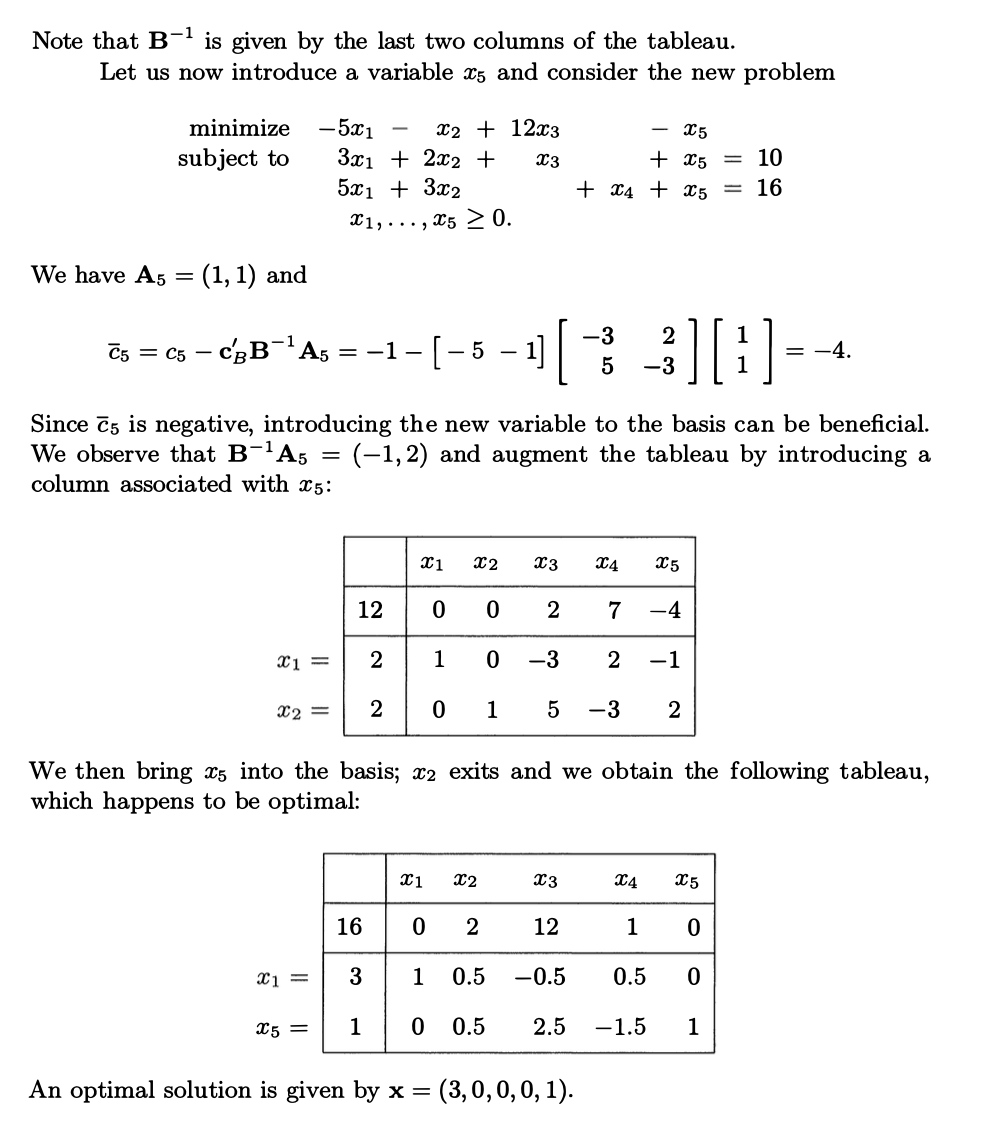
Exercise 5.4 Consider the problem in Example 5.1, with a;; changed from 3 to 3+ 6. Let us keep 1 and z2 as the basic variables and let B(6) be the corresponding basis matrix, as a function of 6. (a) Compute B(6)~'b. For which values of is B() a feasible basis? (b) Compute czB(6)~". For which values of is B() an optimal basis? (c) Determine the optimal cost, as a function of , when is restricted to those values for which B(6) is an optimal basis matrix. Example 5.1 Consider the problem minimize -5x1 - x2 + 123 subject to 3x1 + 2x2 + = 10 5x1 + 3x2 + 4 = 16 C1, . . .,4 2 0. An optimal solution to this problem is given by x = (2, 2, 0,0) and the corre- sponding simplex tableau is given by C1 2 X3 12 0 0 2 7 C1 = 2 1 -3 2 2 0 1 5 -3Note that B! is given by the last two columns of the tableau. Let us now introduce a variable s and consider the new problem minimize -5x; x2 + 12z3 Zs subject to 3z1 + 2z2 + x3 + x5 = 10 521 + 3x2 4+ x4 + x5 = 16 T1y...,T5 20. We have As = (1,1) and e o[ 2 2][ ] Since 5 is negative, introducing the new variable to the basis can be beneficial. We observe that B"'As = (1,2) and augment the tableau by introducing a column associated with zs: We then bring zs into the basis; z2 exits and we obtain the following tableau, which happens to be optimal: An optimal solution is given by x = (3,0,0,0,1)
Step by Step Solution
There are 3 Steps involved in it

Get step-by-step solutions from verified subject matter experts
 Study Help