







Question: Exercise 6 EXERCISE # 6 DO YOU KNOW THE BASICS? Test your understanding of Chapter 6 by answering the following questions: 1. Why is the
Exercise 6
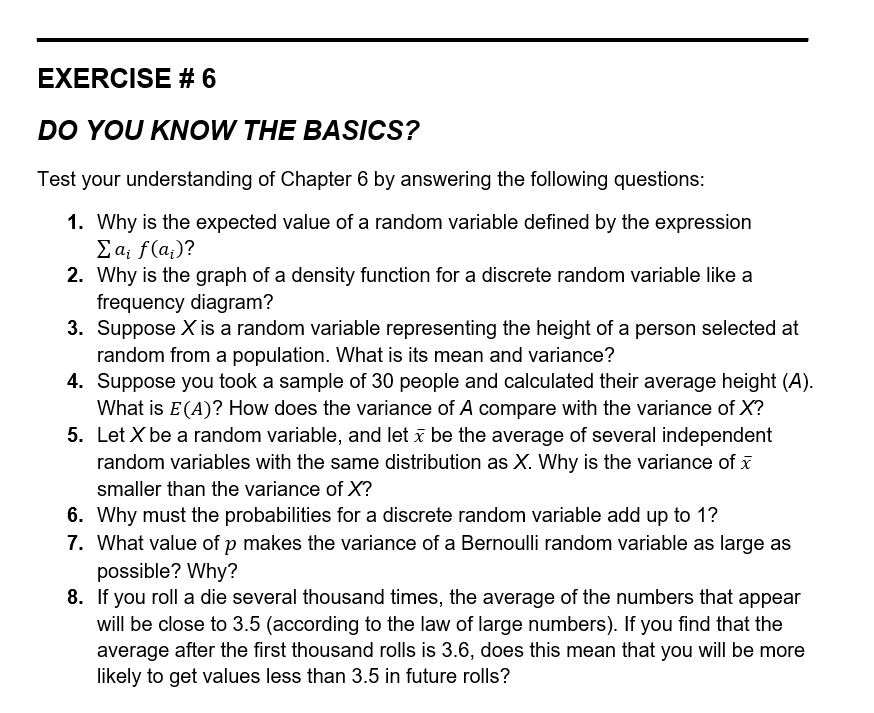
EXERCISE # 6 DO YOU KNOW THE BASICS? Test your understanding of Chapter 6 by answering the following questions: 1. Why is the expected value of a random variable defined by the expression Cai f(a;)? 2. Why is the graph of a density function for a discrete random variable like a frequency diagram? 3. Suppose X is a random variable representing the height of a person selected at random from a population. What is its mean and variance? 4. Suppose you took a sample of 30 people and calculated their average height (A). What is E(A)? How does the variance of A compare with the variance of X? 5. Let X be a random variable, and let x be the average of several independent random variables with the same distribution as X. Why is the variance of x smaller than the variance of X? 6. Why must the probabilities for a discrete random variable add up to 1? 7. What value of p makes the variance of a Bernoulli random variable as large as possible? Why? 8. If you roll a die several thousand times, the average of the numbers that appear will be close to 3.5 (according to the law of large numbers). If you find that the average after the first thousand rolls is 3.6, does this mean that you will be more likely to get values less than 3.5 in future rolls
Step by Step Solution
There are 3 Steps involved in it

Get step-by-step solutions from verified subject matter experts
 Study Help