







Question: Exercise 8 . 1 Exercise 8 . 1 Skycell, a major European cell phone manufacturer, is making production plans for the coming year. Skycell has
Exercise Exercise
Skycell, a major European cell phone manufacturer, is making production plans for the coming year.
Skycell has worked with its customers the service providers to come up with forecasts of monthly
requirements in thousands of phones as shown in the table below. Manufacturing is primarily an
assembly operation, and capacity is governed by the number of people on the hours each day. One
person can assemble a phone every minutes. Workers are paid euros per hour and a percent
premium for overtime. The plant currently employs workers. Component costs for each cell
phone total euros. Given the rapid decline in component and finishedproduct prices, carrying
inventory from one month to the next incurs a cost of euros per phone per month. Skycell currently
has a nolayoff policy in place. Overtime is limited to a maximum of hours per month per employee.
Assume that Skycell has a starting inventory of units and wants to end the year with the same
level of inventory.
a Assuming no backlogs, no subcontracting, and no new hires, what is the optimum production
schedule?
b What is the annual cost of this schedule?
c Is there any value for management to negotiate an increase of allowed overtime per employee
per month from hours to
d Reconsider parts a and b if Skycell starts with only employees. Reconsider parts a and
b if Skycell starts with employees. What happens to the value of additional overtime as
the workforce size decreases?
e Consider part a for the case in which Skycell aims for a level production schedule such that the
quantity produced each month does not exceed the average demand over the next months
by units. Thus, monthly production, including overtime, should be no more
than What would be the cost of this level production schedule?
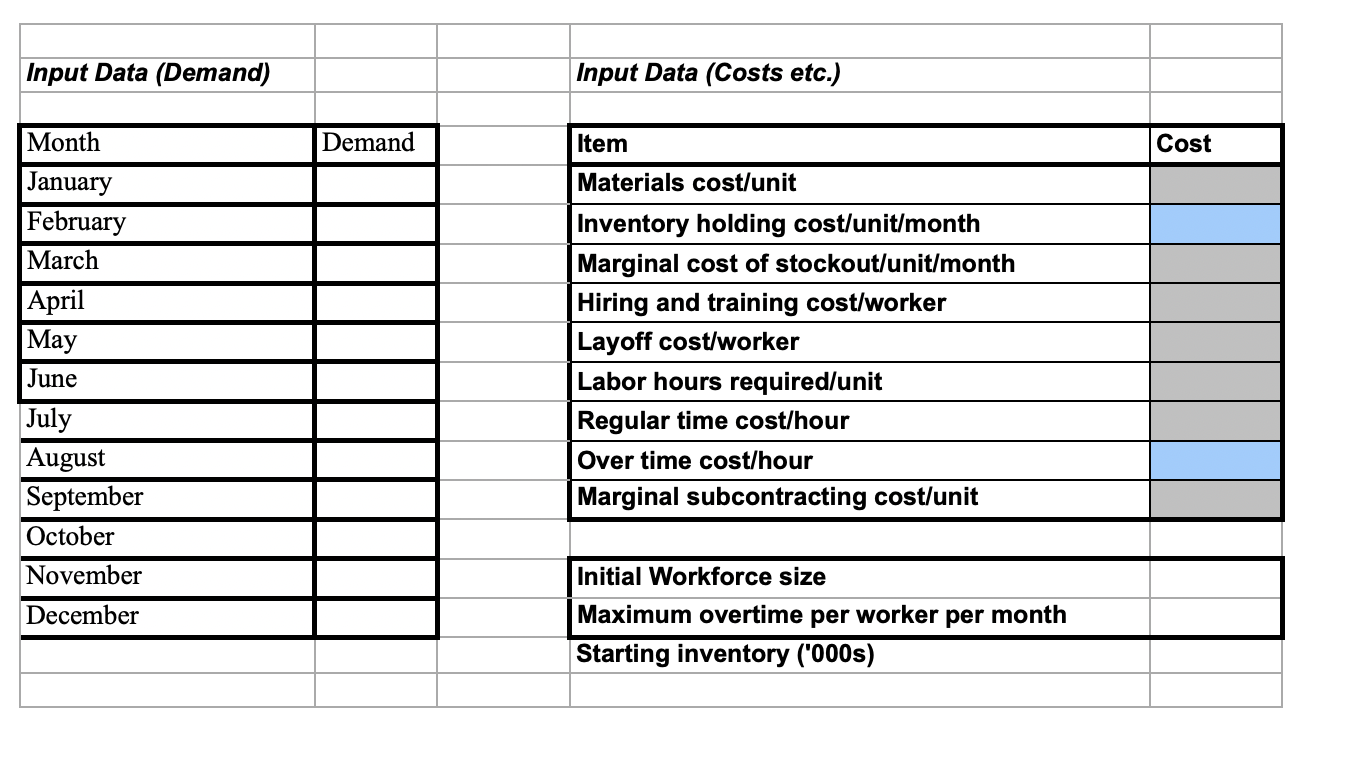
Monthly Demand for Cell Phones, in Thousands
Skycell, a major European cell phone manufacturer, is making production plans for the coming year.
Skycell has worked with its customers the service providers to come up with forecasts of monthly
requirements in thousands of phones as shown in the table below. Manufacturing is primarily an
assembly operation, and capacity is governed by the number of people on the hours each day. One
person can assemble a phone every minutes. Workers are paid euros per hour and a percent
premium for overtime. The plant currently employs workers. Component costs for each cell
phone total euros. Given the rapid decline in component and finishedproduct prices, carrying
inventory from one month to the next incurs a cost of euros per phone per month. Skycell currently
has a nolayoff policy in place. Overtime is limited to a maximum of hours per month per employee.
Assume that Skycell has a starting inventory of units and wants to end the year with the same
level of inventory.
a Assuming no backlogs, no subcontracting, and no new hires, what is the optimum production
schedule?
b What is the annual cost of this schedule?
c Is there any value for management to negotiate an increase of allowed overtime per employee
per month from hours to
d Reconsider parts a and b if Skycell starts with only employees. Reconsider parts a and
b if Skycell starts with employees. What happens to the value of additional overtime as
the workforce size decreases?
e Consider part a for the case in which Skycell aims for a level production schedule such that the
quantity produced each month does not exceed the average demand over the next months
by units. Thus, monthly production, including overtime, should be no more
than What would be the cost of this level production schedule?
Monthly Demand for Cell Phones, in Thousands
Month Demand
January
February
March
April
May
June
July
August
September
October
November
December
tableInput Data DemandInput Data Costs etc.Cost,MonthDemand,,Item,JanuaryMaterials costunitFebruaryInventory holding costunitmonthMarchMarginal cost of stockoutunitmonthAprilHiring and training costworkerMayLayoff costworkerJuneLabor hours requiredunitJulyRegular time costhourAugustOver time costhourSeptemberMarginal subcontracting costunitOctoberNovemberDecemberInitial Workforce size,Maximum overtime per worker per month,
Step by Step Solution
There are 3 Steps involved in it
1 Expert Approved Answer
Step: 1 Unlock

Question Has Been Solved by an Expert!
Get step-by-step solutions from verified subject matter experts
Step: 2 Unlock
Step: 3 Unlock
 Study Help