







Question: Exercise C: Practice with null-terminated strings Read This First As explained in lectures, a string in C is a sequence of character codes stored
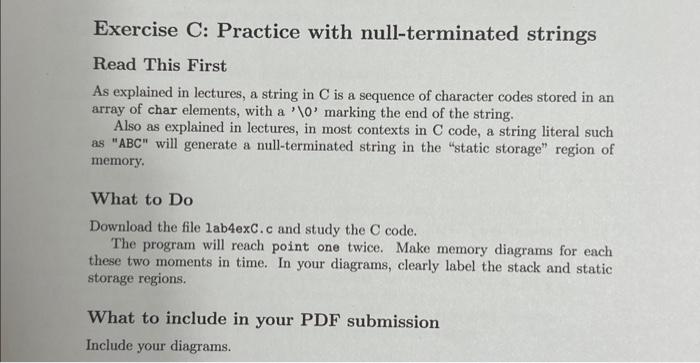
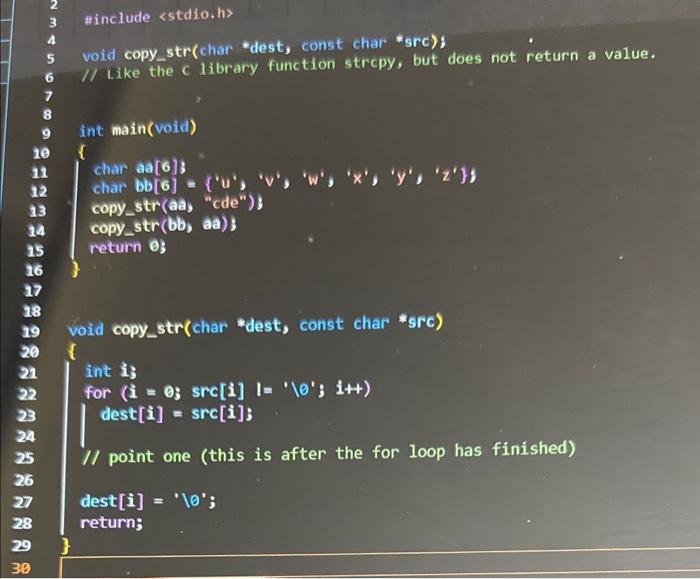
Exercise C: Practice with null-terminated strings Read This First As explained in lectures, a string in C is a sequence of character codes stored in an array of char elements, with a '\0' marking the end of the string. Also as explained in lectures, in most contexts in C code, a string literal such as "ABC" will generate a null-terminated string in the "static storage" region of memory. What to Do Download the file lab4exC.c and study the C code. The program will reach point one twice. Make memory diagrams for each these two moments in time. In your diagrams, clearly label the stack and static storage regions. What to include in your PDF submission Include your diagrams. 10 11 12 13 14 15 16 17 18 19 20 21 22 2 3 #include 4 5 6 8 9 23 24 25 26 27 28 29 30 void copy_str(char *dest, const char *src); // Like the c library function strcpy, but does not return a value. } int main(void) { char aa[6]; char bb[6] ('u's 'v's 'w's 'x', 'y', 'z'}; copy_str(aa, "cde"); copy_str(bb, aa); return 0; void copy_str(char *dest, const char *src) { int i; for (i = 0; src[i] != '\0'; i++) dest[i] = src[i]; // point one (this is after the for loop has finished) dest[i] = '\0'; return;
Step by Step Solution
There are 3 Steps involved in it
You have provided a task from an exercise that asks to practice with nullterminated strings in C along with an image showing the source code of a C pr... View full answer

Get step-by-step solutions from verified subject matter experts
 Study Help