







Question: Exercise Design a four-bit function unit that has two four-bit operand inputs. A and B. There is an additional single-bit data input Co which is
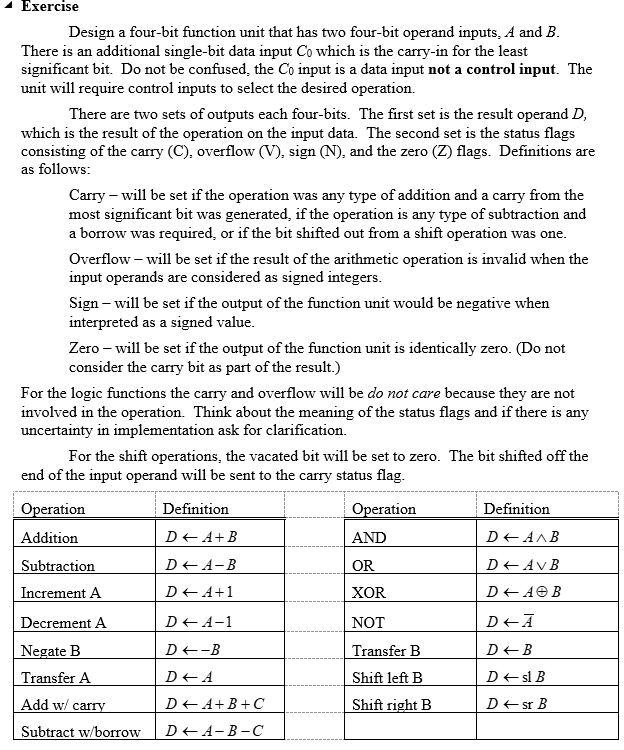
Exercise Design a four-bit function unit that has two four-bit operand inputs. A and B. There is an additional single-bit data input Co which is the carry-in for the least significant bit. Do not be confused the Co input is a data input not a control input. The unit will require control inputs to select the desired operation. There are two sets of outputs each four-bits. The first set is the result operand D, which is the result of the operation on the input data. The second set is the status flags consisting of the carry (C), overflow (V), sign (N), and the zero (2) flags. Definitions are as follows: Carry - will be set if the operation was any type of addition and a carry from the most significant bit was generated if the operation is any type of subtraction and a borrow was required, or if the bit shifted out from a shift operation was one. Overflow will be set if the result of the arithmetic operation is invalid when the input operands are considered as signed integers. Sign - will be set if the output of the function unit would be negative when interpreted as a signed value. Zero - will be set if the output of the function unit is identically zero. (Do not consider the carry bit as part of the result.) For the logic functions the carry and overflow will be do not care because they are not involved in the operation. Think about the meaning of the status flags and if there is any uncertainty in implementation ask for clarification. For the shift operations, the vacated bit will be set to zero. The bit shifted off the end of the input operand will be sent to the carry status flag. Operation Definition D+A+B Operation AND OR Definition DAAB Addition Subtraction D4-B DAVB DAB Increment A D+ 4+1 XOR Decrement A DA-1 NOT D Negate B DE-B Transfer B DEB Transfer A D A Shift left B Ds B Add w/ carry Shift right B Dr B D+ A+B+C D A-B-C Subtract w/borrow Exercise Design a four-bit function unit that has two four-bit operand inputs. A and B. There is an additional single-bit data input Co which is the carry-in for the least significant bit. Do not be confused the Co input is a data input not a control input. The unit will require control inputs to select the desired operation. There are two sets of outputs each four-bits. The first set is the result operand D, which is the result of the operation on the input data. The second set is the status flags consisting of the carry (C), overflow (V), sign (N), and the zero (2) flags. Definitions are as follows: Carry - will be set if the operation was any type of addition and a carry from the most significant bit was generated if the operation is any type of subtraction and a borrow was required, or if the bit shifted out from a shift operation was one. Overflow will be set if the result of the arithmetic operation is invalid when the input operands are considered as signed integers. Sign - will be set if the output of the function unit would be negative when interpreted as a signed value. Zero - will be set if the output of the function unit is identically zero. (Do not consider the carry bit as part of the result.) For the logic functions the carry and overflow will be do not care because they are not involved in the operation. Think about the meaning of the status flags and if there is any uncertainty in implementation ask for clarification. For the shift operations, the vacated bit will be set to zero. The bit shifted off the end of the input operand will be sent to the carry status flag. Operation Definition D+A+B Operation AND OR Definition DAAB Addition Subtraction D4-B DAVB DAB Increment A D+ 4+1 XOR Decrement A DA-1 NOT D Negate B DE-B Transfer B DEB Transfer A D A Shift left B Ds B Add w/ carry Shift right B Dr B D+ A+B+C D A-B-C Subtract w/borrow
Step by Step Solution
There are 3 Steps involved in it

Get step-by-step solutions from verified subject matter experts
 Study Help