







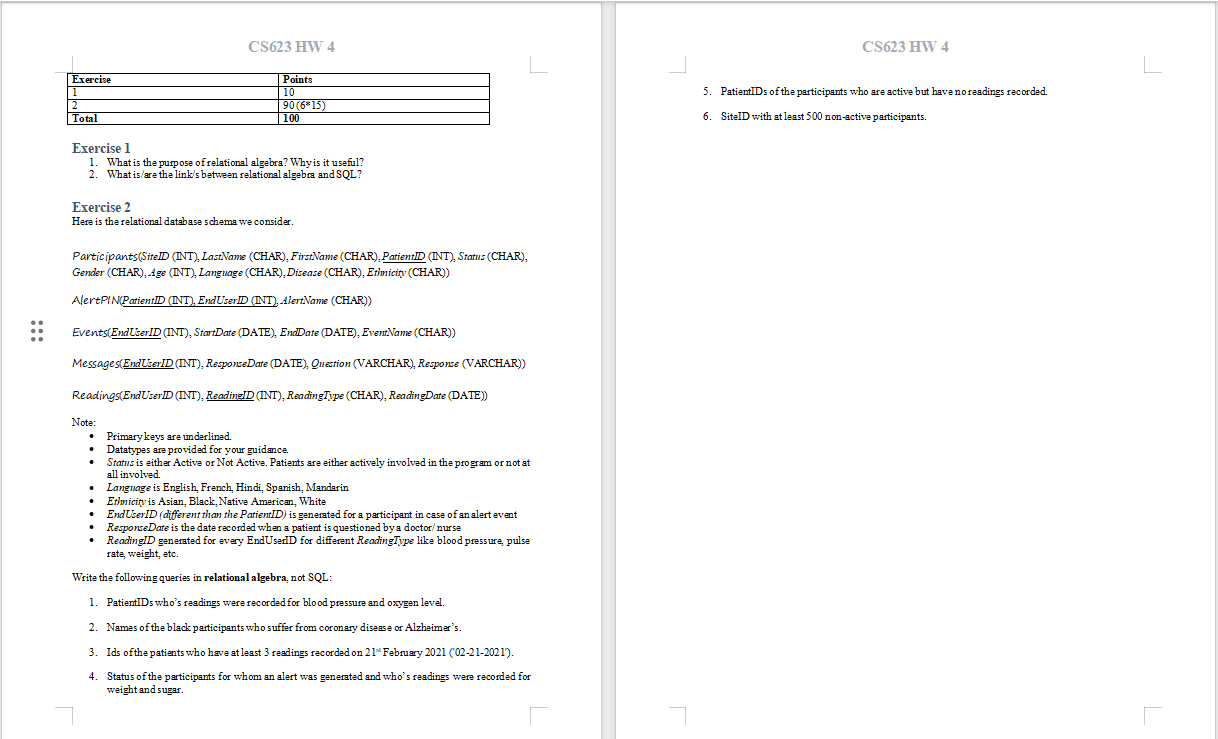
Question: Exercise Points 1 1 0 2 9 0 ( 6 * 1 5 ) Total 1 0 0 Exercise 1 1 . What is the
Exercise
Points
Total
Exercise
What is the purpose of relational algebra? Why is it useful?
What isare the links between relational algebra and SQL
Exercise
Here is the relational database schema we consider.
ParticipantsSiteIDINT LastNameCHAR FirstNameCHAR PatientIDINT StatusCHAR GenderCHAR AgeINT LanguageCHAR Disease CHAR EthnicityCHAR
AlertPINPatientIDINT EndUserIDINT AlertNameCHAR
EventsEndUserIDINT StartDateDATE EndDateDATE EventNameCHAR
MessagesEndUserIDINT ResponseDateDATE QuestionVARCHAR ResponseVARCHAR
ReadingsEndUserIDINT ReadingIDINT ReadingTypeCHAR ReadingDateDATE
Note:
Primary keys are underlined.
Datatypes are provided for your guidance.
Statusis either Active or Not Active. Patients are either actively involved in the program or not at all involved.
Language is English, French, Hindi, Spanish, Mandarin
Ethnicity is Asian, Black, Native American, White
EndUserID different than the PatientID is generated for a participant in case of an alert event
ResponseDate is the date recorded when a patient is questioned by a doctor nurse
ReadingID generated for every EndUserID for different ReadingType like blood pressure, pulse rate, weight, etc.
Write the following queries in relational algebra, not SQL:
PatientIDs whos readings were recorded for blood pressure and oxygen level.
Names of the black participants who suffer from coronary disease or Alzheimers
Ids of the patients who have at least readings recorded on stFebruary
Status of the participants for whom an alert was generated and whos readings were recorded for weight and sugar.
PatientIDs of the participants who are active but have no readings recorded.
SiteID with at least nonactive participants. CS HW
Exercise
What is the purpose of relational algebra? Why is it useful?
What isare the links between relational algebra and SQL
Exercise
Here is the relational database schema we consider.
ParticipantsSiteID INT LastName CHAR FirstName CHAR PatientID INT Status CHAR Gender CHAR Age INT Language CHAR Disease CHAR Ethnicity CHAR
AlertPINPatientID INT EndUserID INT AlertName CHAR
because quad EventsEndUserID INT StartDate DATE EndDate DATE EventName CHAR
MessagesEndUserID INT ResponseDate DATE Question VARCHAR Response VARCHAR
ReadingsEndUserID INT ReadingID INT ReadingType CHAR ReadingDate DATE
Note:
Primarykeys are underlined.
Datatypes are provided for your guidance.
Status is either Active or Not Active. Patients are either actively involved in the program or not at all involved.
Language is English, French, Hindi, Spanish, Mandarin
Ethnicity is Asian, Black, Native American, White
EndUserID different than the PatientID is generated for a participant in case of an alert event
ResponseDate is the date recorded when a patient is questioned by a doctor nurse
ReadingID generated for every EndUserID for different ReadingType like blood pressure, pulse rate, weight, etc.
Write the following queries in relational algebra, not SQL:
PatientIDs who's readings were recorded for blood pressure and oxygen level.
Names of the black participants who suffer from coronary disease or Alzheimer's.
Ids of the patients who have at least readings recorded on February
Status of the participants for whom an alert was generated and who's readings were recorded for weight and sugar.
CS HW
PatientIDs of the participants who are active but have no readings recorded.
SiteID with at least nonactive participants.
Step by Step Solution
There are 3 Steps involved in it
1 Expert Approved Answer
Step: 1 Unlock

Question Has Been Solved by an Expert!
Get step-by-step solutions from verified subject matter experts
Step: 2 Unlock
Step: 3 Unlock
 Study Help