







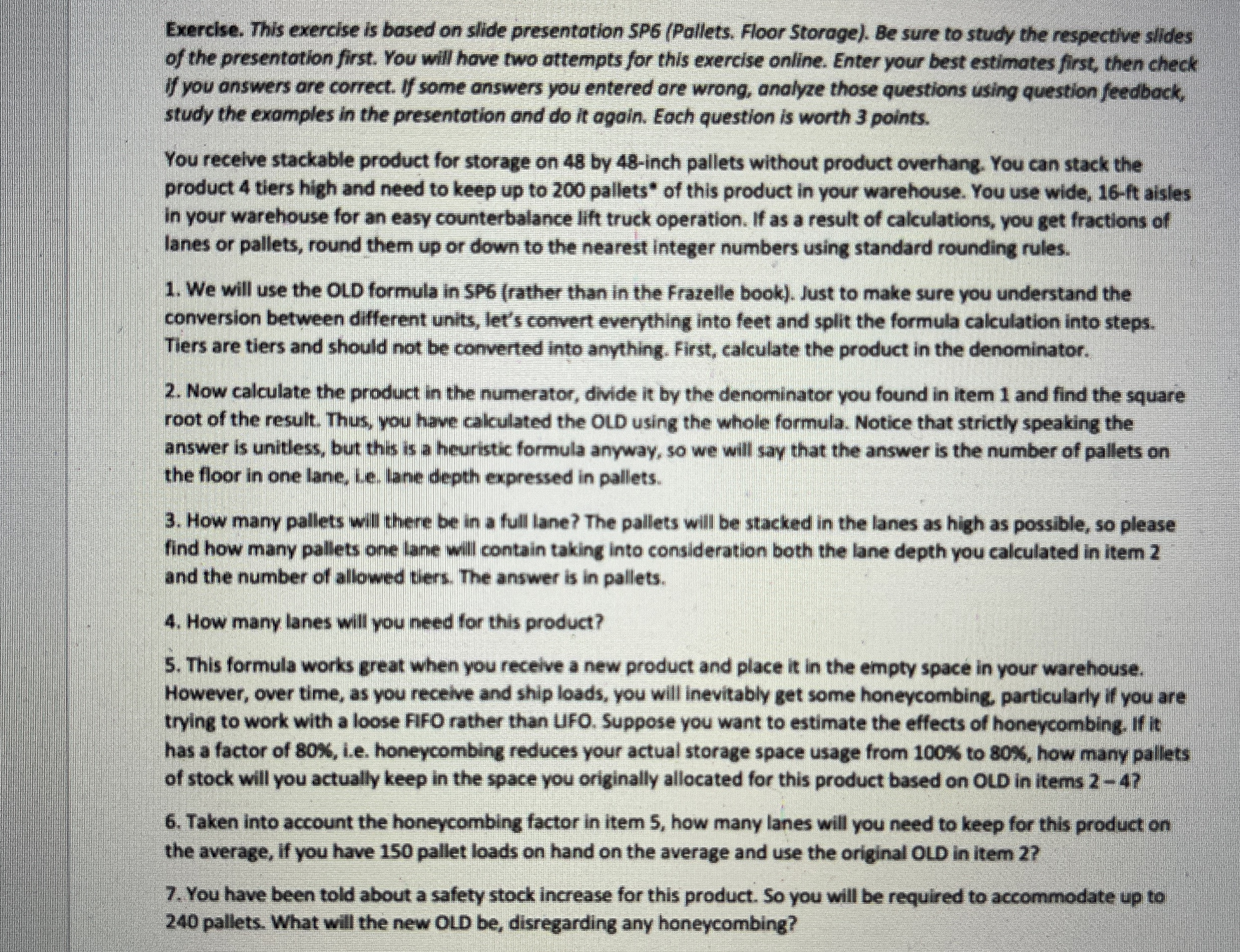
Question: Exercise. This exercise is based on slide presentation SP 6 ( Pallets . Floor Storage ) . Be sure to study the respective slides of
Exercise. This exercise is based on slide presentation SPPallets Floor Storage Be sure to study the respective slides
of the presentation first. You will hove two ottempts for this exercise online. Enter your best estimates first, then check
If you onswers are correct. If some answers you entered are wrong, analyze those questions using question feedback,
study the examples in the presentation and do it again. Each question is worth points.
You recelve stackable product for storage on by inch pallets without product overhang. You can stack the
product tiers high and need to keep up to pallets of this product in your warehouse. You use wide, ft aisles
in your warehouse for an easy counterbalance lift truck operation. If as a result of calculations, you get fractions of
lanes or pallets, round them up or down to the nearest integer numbers using standard rounding rules.
We will use the OLD formula in SPrather than in the Frazelle book Just to make sure you understand the
conversion between different units, let's convert everything into feet and split the formula calculation into steps.
Tiers are tiers and should not be converted into anything. First, calculate the product in the denominator.
Now calculate the product in the numerator, divide it by the denominator you found in item and find the square
root of the result. Thus, you have calculated the OLD using the whole formula. Notice that strictly speaking the
answer is unitless, but this is a heuristic formula anyway, so we will say that the answer is the number of pallets on
the floor in one lane, Le lane depth expressed in pallets.
How many pallets will there be in a full lane? The pallets will be stacked in the lanes as high as possible, so please
find how many pallets one lane will contain taking into consideration both the lane depth you calculated in item
and the number of allowed tiers. The answer is in pallets.
How many lanes will you need for this product?
This formula works great when you recelve a new product and place it in the empty space in your warehouse.
However, over time, as you recelve and ship loads, you will inevitably get some honeycombing, particularly if you are
trying to work with a loose FFO rather than UFO. Suppose you want to estimate the effects of honeycombing. If it
has a factor of ie honeycombing reduces your actual storage space usage from to how many pallets
of stock will you actually keep in the space you originally allocated for this product based on OLD in items
Taken into account the honeycombing factor in item how many lanes will you need to keep for this product on
the average, if you have pallet loads on hand on the average and use the original OLD in item
You have been told about a safety stock increase for this product. So you will be required to accommodate up to
pallets. What will the new OLD be disregarding any honeycombing?
Step by Step Solution
There are 3 Steps involved in it
1 Expert Approved Answer
Step: 1 Unlock

Question Has Been Solved by an Expert!
Get step-by-step solutions from verified subject matter experts
Step: 2 Unlock
Step: 3 Unlock
 Study Help