







Question: exercise2 Exercise 2. (6 points) Consider a consumer with monotonic preferences over the feasible set X = PM that are represented with the utility function
exercise2
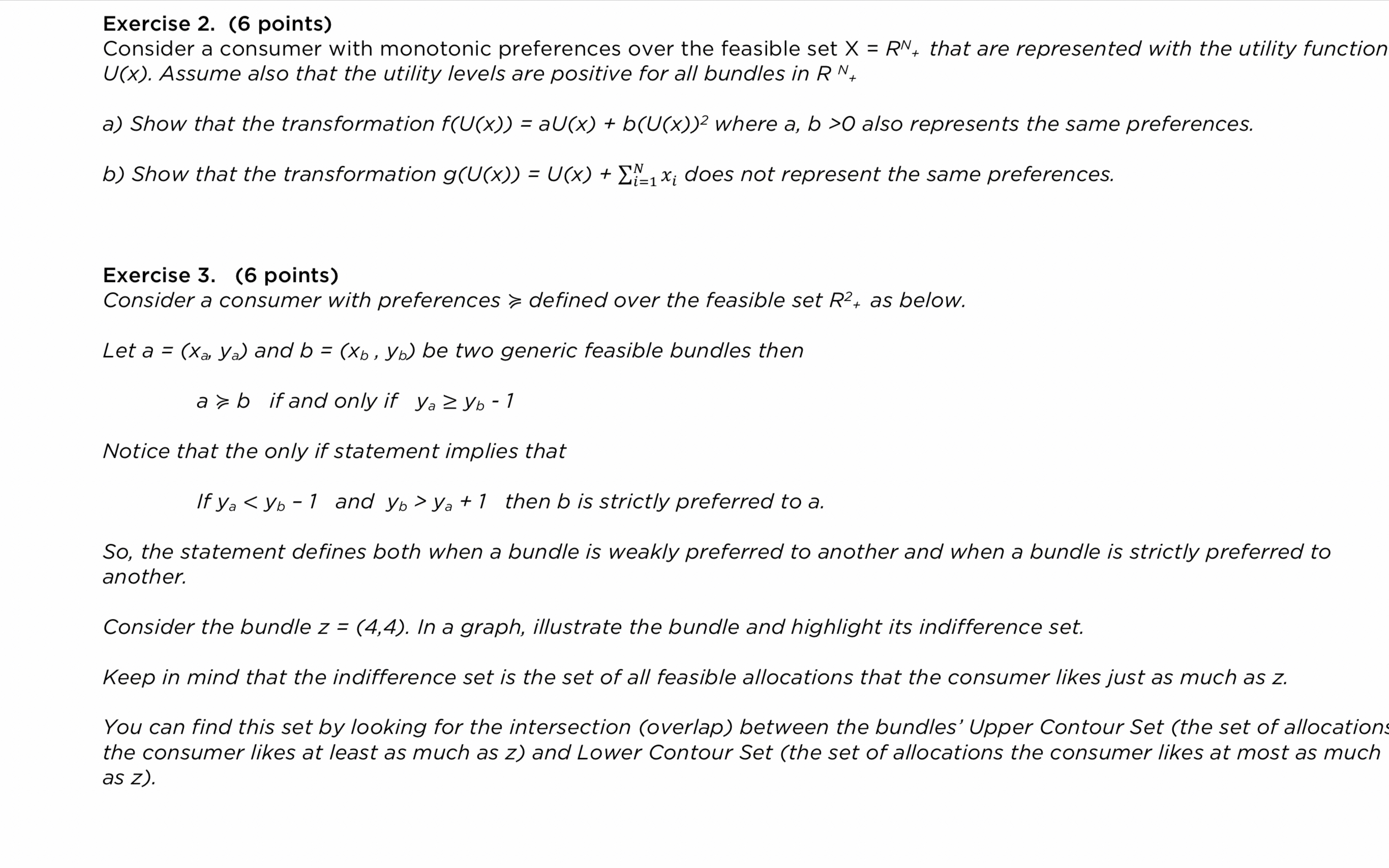
Exercise 2. (6 points) Consider a consumer with monotonic preferences over the feasible set X = PM that are represented with the utility function U(x). Assume also that the utility levels are positive for all bundles in R M. a) Show that the transformation f(U(X)) = aU(X) + b(U(X))2 where a, b >0 also represents the same preferences. b) Show that the transformation g(U(X)) = U(x) + 2?; xi does not represent the same preferences. Exercise 3. (6 points) Consider a consumer with preferences > defined over the feasible set R2+ as below. Let a = (xa, ya) and b = (xb , yb) be two generic feasible bundles then a >b ifandonlyif yazyb-l Notice that the only if statement implies that If ya ya + 7 then b is strictly preferred to a. $0, the statement defines both when a bundle is weakly preferred to another and when a bundle is strictly preferred to another. Consider the bundle z = (4,4). In a graph, illustrate the bundle and highlight its indifference set. Keep in mind that the indifference set is the set of all feasible allocations that the consumer likes just as much as 2. You can find this set by looking for the intersection (overlap) between the bundles' Upper Contour Set (the set of allocation: the consumer likes at least as much as z) and Lower Contour Set (the set of allocations the consumer likes at most as much as z)
Step by Step Solution
There are 3 Steps involved in it

Get step-by-step solutions from verified subject matter experts
 Study Help