







Question: Experiment 3 Pre-Lab Assignment Name Melting Points 1. Relatively pure compounds usually melt over a temperature range of (1 pt) 2. The presence of an
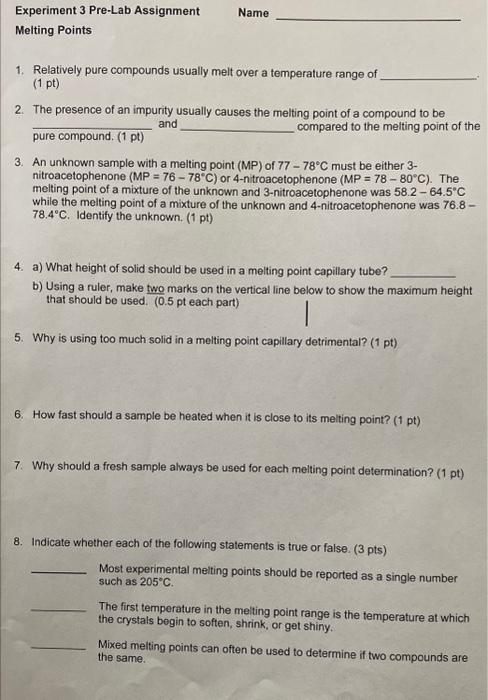
Experiment 3 Pre-Lab Assignment Name Melting Points 1. Relatively pure compounds usually melt over a temperature range of (1 pt) 2. The presence of an impurity usually causes the melting point of a compound to be pure compound. (1 pt) and compared to the melting point of the 3. An unknown sample with a melting point (MP) of 7778C must be either 3 nitroacetophenone (MP=7678C) or 4 -nitroacetophenone (MP=7880C). The melting point of a mixture of the unknown and 3-nitroacetophenone was 58.264.5C while the melting point of a mixture of the unknown and 4-nitroacetophenone was 76.8 78.4C. Identify the unknown. (1 pt) 4. a) What height of solid should be used in a melting point capillary tube? b) Using a ruler, make two marks on the vertical line below to show the maximum height that should be used. ( 0.5pt each part) 5. Why is using too much solid in a melting point capillary detrimental? (1 pt) 6. How fast should a sample be heated when it is close to its melting point? ( 1pt ) 7. Why should a fresh sample always be used for each melting point determination? (1 pt) 8. Indicate whether each of the following statements is true or false. (3 pts) Most experimental melting points should be reported as a single number such as 205C. The first temperature in the meiting point range is the temperature at which the crystals begin to soften, shrink, or get shiny. Mixed melting points can often be used to determine if two compounds are the same
Step by Step Solution
There are 3 Steps involved in it

Get step-by-step solutions from verified subject matter experts
 Study Help