







Question: Explain a, b ,c and d part Q 39. Consider trade relations between Canada and Mexico. Assume that the leaders of the two countries believe
Explain a, b ,c and d part
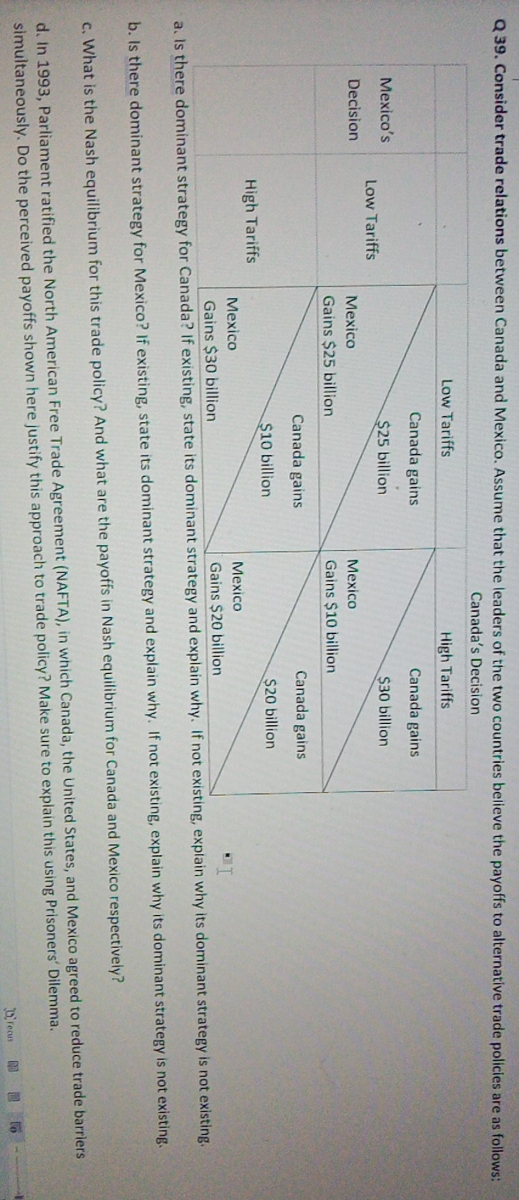
Q 39. Consider trade relations between Canada and Mexico. Assume that the leaders of the two countries believe the payoffs to alternative trade policies are as follows: Canada's Decision Low Tariffs High Tariffs Canada gains Canada gains Mexico's $25 billion $30 billion Low Tariffs Decision Mexico Mexico Gains $25 billion Gains $10 billion Canada gains Canada gains $10 billion $20 billion High Tariffs Mexico Mexico Gains $30 billion Gains $20 billion a. Is there dominant strategy for Canada? If existing, state its dominant strategy and explain why. If not existing, explain why its dominant strategy is not existing. b. Is there dominant strategy for Mexico? If existing, state its dominant strategy and explain why. If not existing, explain why its dominant strategy is not existing. c. What is the Nash equilibrium for this trade policy? And what are the payoffs in Nash equilibrium for Canada and Mexico respectively? d. In 1993, Parliament ratified the North American Free Trade Agreement (NAFTA), in which Canada, the United States, and Mexico agreed to reduce trade barriers simultaneously. Do the perceived payoffs shown here justify this approach to trade policy? Make sure to explain this using Prisoners' Dilemma. Dreams
Step by Step Solution
There are 3 Steps involved in it

Get step-by-step solutions from verified subject matter experts
 Study Help