



Question: Explain all the question in a detail way. Q2) Consider a monopoly that faces a market demand curve given as P = 100 - Q.
Explain all the question in a detail way.
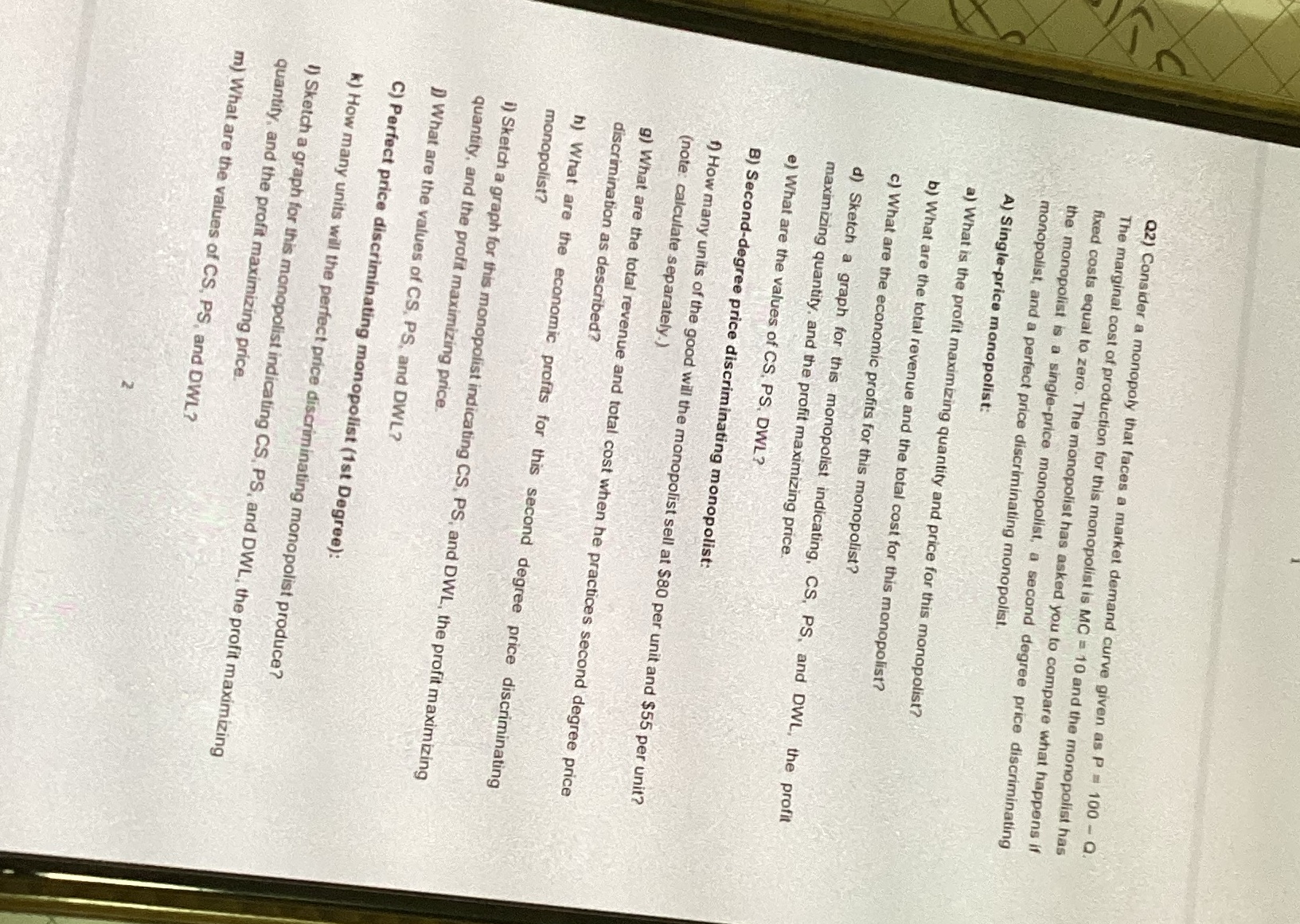
Q2) Consider a monopoly that faces a market demand curve given as P = 100 - Q. The marginal cost of production for this monopolist is MC = 10 and the monopolist has fixed costs equal to zero. The monopolist has asked you to compare what happens if the monopolist is a single-price monopolist, a second degree price discriminating monopolist, and a perfect price discriminating monopolist. A) Single-price monopolist: a) What is the profit maximizing quantity and price for this monopolist? b) What are the total revenue and the total cost for this monopolist? c) What are the economic profits for this monopolist? d) Sketch a graph for this monopolist indicating, CS. PS, and DWL, the profit maximizing quantity, and the profit maximizing price. e) What are the values of CS. PS, DWL? B) Second-degree price discriminating monopolist: () How many units of the good will the monopolist sell at $80 per unit and $55 per unit? (note: calculate separately.) g) What are the total revenue and total cost when he practices second degree price discrimination as described? h) What are the economic profits for this second degree price discriminating monopolist? i) Sketch a graph for this monopolist indicating CS. PS, and DWL, the profit maximizing quantity, and the profit maximizing price. 1) What are the values of CS, PS, and DWL? C) Perfect price discriminating monopolist (1st Degree): k) How many units will the perfect price discriminating monopolist produce? 1) Sketch a graph for this monopolist indicating CS, PS, and DWL, the profit maximizing quantity, and the profit maximizing price. m) What are the values of CS, PS, and DWL
Step by Step Solution
There are 3 Steps involved in it

Get step-by-step solutions from verified subject matter experts