







Question: Explain Assume that you construct a hash table using the separate chaining for the following 7 keys: 31,72,20,14,9,2,32 Assume also that the hash function is
Explain
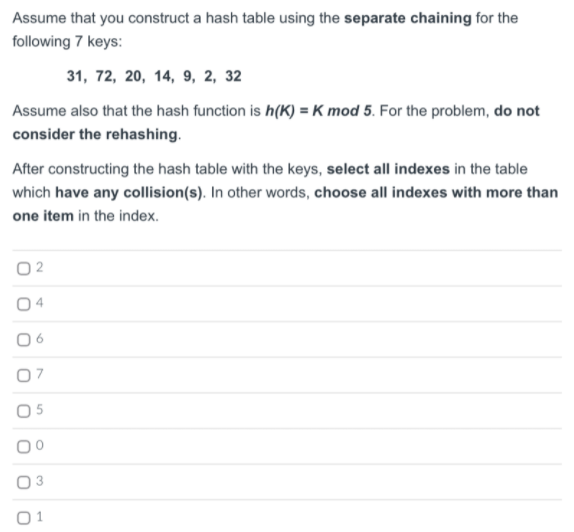
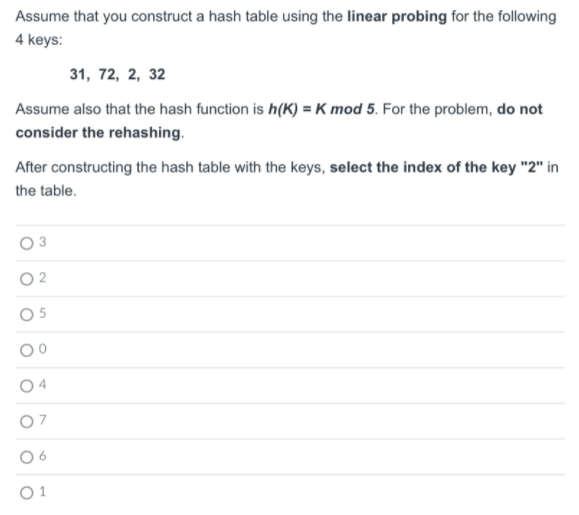
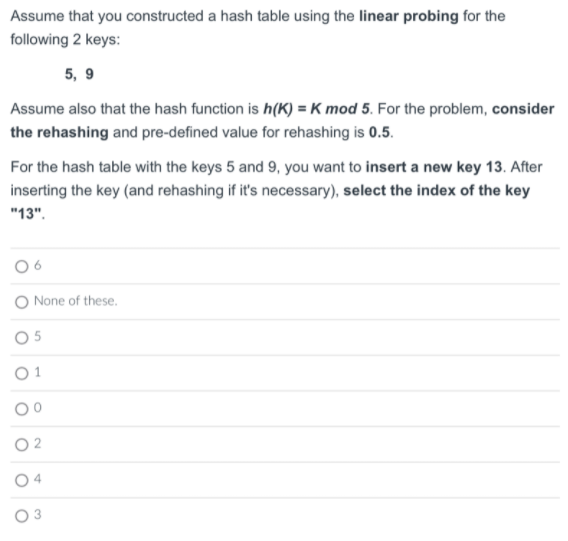
Assume that you construct a hash table using the separate chaining for the following 7 keys: 31,72,20,14,9,2,32 Assume also that the hash function is h(K)=Kmod5. For the problem, do not consider the rehashing. After constructing the hash table with the keys, select all indexes in the table which have any collision(s). In other words, choose all indexes with more than one item in the index. 2 4 6 7 5 0 3 1 Assume that you construct a hash table using the linear probing for the following 4 keys: 31,72,2,32 Assume also that the hash function is h(K)=Kmod5. For the problem, do not consider the rehashing. After constructing the hash table with the keys, select the index of the key "2" in the table. \begin{tabular}{l} 3 \\ \hline 2 \\ \hline 0 \\ \hline 4 \\ \hline 7 \\ \hline 6 \\ \hline \end{tabular} 1 Assume that you constructed a hash table using the linear probing for the following 2 keys: 5,9 Assume also that the hash function is h(K)=Kmod5. For the problem, consider the rehashing and pre-defined value for rehashing is 0.5. For the hash table with the keys 5 and 9, you want to insert a new key 13. After inserting the key (and rehashing if it's necessary), select the index of the key "13". 6 None of these. 5 1 0 2 4 3
Step by Step Solution
There are 3 Steps involved in it

Get step-by-step solutions from verified subject matter experts
 Study Help