







Question: Please explain Assume that you construct a hash table using the linear probing for the following 4 keys: 31,72,2,32 Assume also that the hash function
Please explain 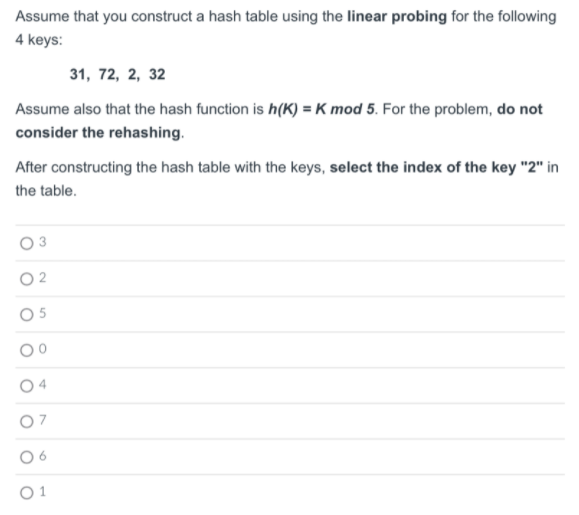
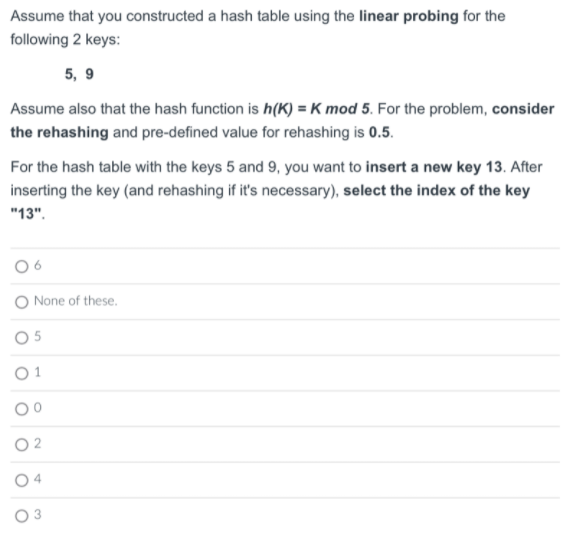
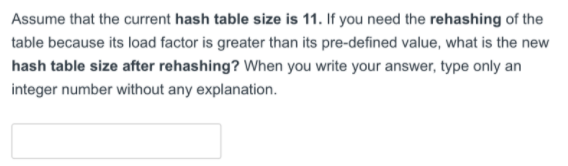
Assume that you construct a hash table using the linear probing for the following 4 keys: 31,72,2,32 Assume also that the hash function is h(K)=Kmod5. For the problem, do not consider the rehashing. After constructing the hash table with the keys, select the index of the key "2" in the table. \begin{tabular}{l} 3 \\ \hline 2 \\ \hline 0 \\ \hline 4 \\ \hline 7 \\ \hline 6 \\ \hline \end{tabular} 1 Assume that you constructed a hash table using the linear probing for the following 2 keys: 5,9 Assume also that the hash function is h(K)=Kmod5. For the problem, consider the rehashing and pre-defined value for rehashing is 0.5. For the hash table with the keys 5 and 9, you want to insert a new key 13. After inserting the key (and rehashing if it's necessary), select the index of the key "13". 6 None of these. 5 1 0 2 4 3 Assume that the current hash table size is 11 . If you need the rehashing of the table because its load factor is greater than its pre-defined value, what is the new hash table size after rehashing? When you write your answer, type only an integer number without any explanation
Step by Step Solution
There are 3 Steps involved in it

Get step-by-step solutions from verified subject matter experts
 Study Help