



Question: Explain each situations and give a complete and comprehensive explanation on each situation. Underline the type of charge and provide a detailed explanation based on
Explain each situations and give a complete and comprehensive explanation on each situation. Underline the type of charge and provide a detailed explanation based on the concepts of charging by friction, conduction, and induction. Always provide explanation.
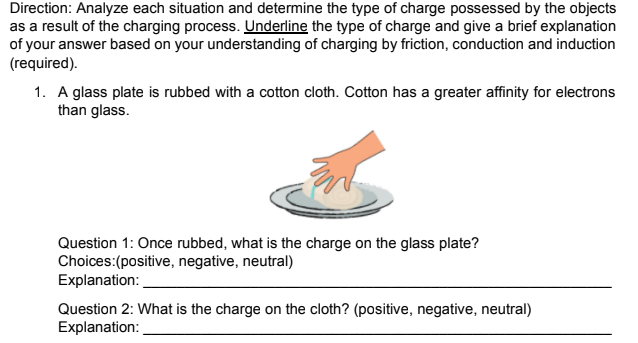
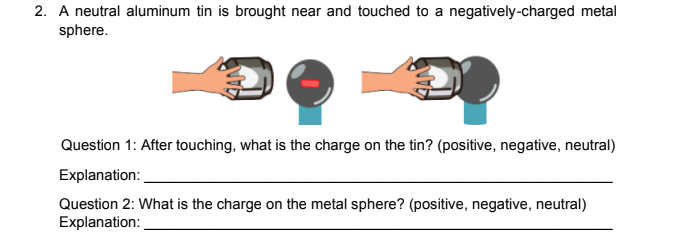
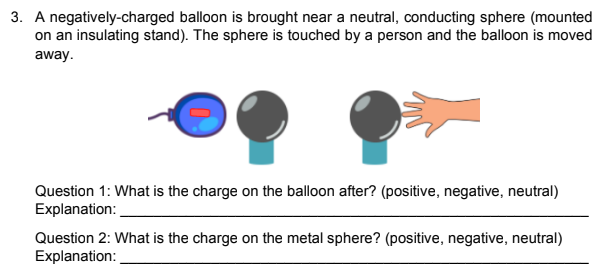
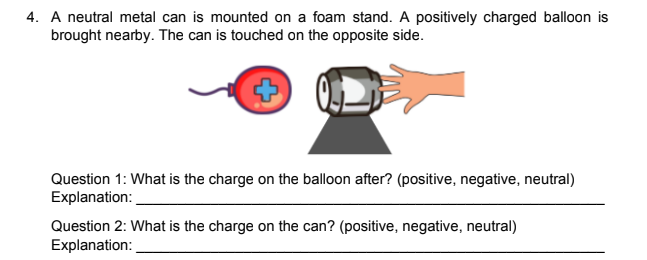
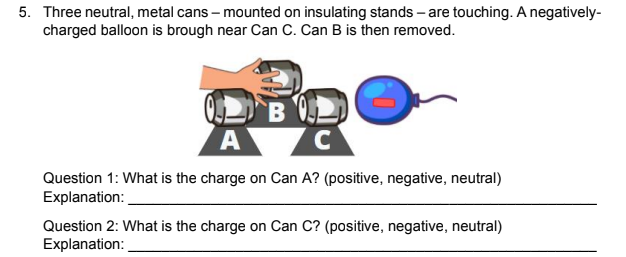
Direction: Analyze each situation and determine the type of charge possessed by the objects as a result of the charging process. Underline the type of charge and give a brief explanation of your answer based on your understanding of charging by friction, conduction and induction (required). 1. A glass plate is rubbed with a cotton cloth. Cotton has a greater affinity for electrons than glass. Question 1: Once rubbed, what is the charge on the glass plate? Choices:(positive, negative, neutral) Explanation: Question 2: What is the charge on the cloth? (positive, negative, neutral) Explanation:2. A neutral aluminum tin is brought near and touched to a negatively-charged metal sphere. Question 1: After touching, what is the charge on the tin? (positive, negative, neutral) Explanation: Question 2: What is the charge on the metal sphere? (positive, negative, neutral) Explanation:3. A negatively-charged balloon is brought near a neutral, conducting sphere (mounted on an insulating stand). The sphere is touched by a person and the balloon is moved away. Question 1: What is the charge on the balloon after? (positive, negative, neutral) Explanation: Question 2: What is the charge on the metal sphere? (positive, negative, neutral) Explanation:4. A neutral metal can is mounted on a foam stand. A positively charged balloon is brought nearby. The can is touched on the opposite side. Question 1: What is the charge on the balloon after? (positive, negative, neutral) Explanation: Question 2: What is the charge on the can? (positive, negative, neutral) Explanation:5. Three neutral, metal cans - mounted on insulating stands - are touching. A negatively- charged balloon is brough near Can C. Can B is then removed. A C Question 1: What is the charge on Can A? (positive, negative, neutral) Explanation: Question 2: What is the charge on Can C? (positive, negative, neutral) Explanation
Step by Step Solution
There are 3 Steps involved in it

Get step-by-step solutions from verified subject matter experts