







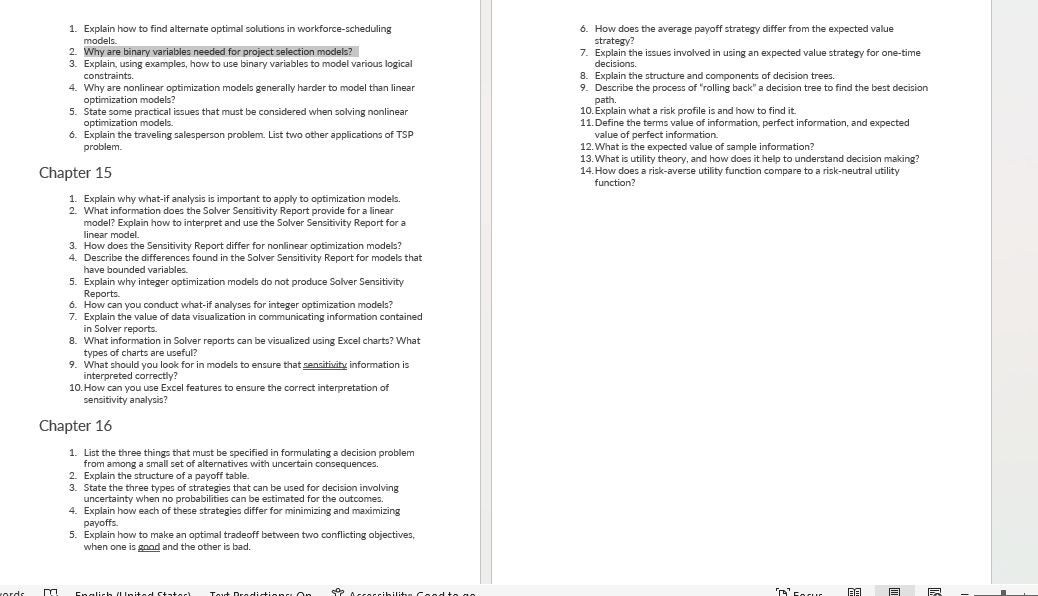
Question: Explain how to find alternate optimal solutions in workforce - scheduling models. Why are binary variables needed for project selection models? Explain, using examples, how
Explain how to find alternate optimal solutions in workforcescheduling
models.
Why are binary variables needed for project selection models?
Explain, using examples, how to use binary variables to model various logical
constraints.
Why are nonlinear optimization models generally harder to model than linear
optimization models?
State some practical issues that must be considered when solving nonlinear
optimization models.
Explain the traveling salesperson problem. List two other applications of TSP
problem.
Chapter
Explain why whatif analysis is important to apply to optimization models.
What information does the Solver Sensitivity Report provide for a linear
model? Explain how to interpret and use the Solver Sensitivity Report for a
linear model.
How does the Sensitivity Report differ for nonlinear optimization models?
Describe the differences found in the Solver Sensitivity Report for models that
have bounded variables.
Explain why integer optimization models do not produce Solver Sensitivity
Reports.
How can you conduct whatif analyses for integer optimization models?
Explain the value of data visualization in communicating information contained
in Solver reports.
What information in Solver reports can be visualized using Excel charts? What
types of charts are useful?
What should you look for in models to ensure that sensitivity information is
interpreted correctly?
How can you use Excel features to ensure the correct interpretation of
sensitivity analysis?
Chapter
List the three things that must be specified in formulating a decision problem
from among a small set of alternatives with uncertain consequences.
Explain the structure of a payoff table.
State the three types of strategies that can be used for decision involving
uncertainty when no probabilities can be estimated for the outcomes.
Explain how each of these strategies differ for minimizing and maximizing
payoffs.
Explain how to make an optimal tradeoff between two conflicting objectives,
when one is gnod and the other is bad.
How does the average payoff strategy differ from the expected value
strategy?
Explain the issues involved in using an expected value strategy for onetime
decisions.
Explain the structure and components of decision trees.
Describe the process of "rolling back" a decision tree to find the best decision
path.
Explain what a risk profile is and how to find it
Define the terms value of information, perfect information, and expected
value of perfect information.
What is the expected value of sample information?
What is utility theory, and how does it help to understand decision making?
How does a riskaverse utility function compare to a riskneutral utility
function?
Step by Step Solution
There are 3 Steps involved in it
1 Expert Approved Answer
Step: 1 Unlock

Question Has Been Solved by an Expert!
Get step-by-step solutions from verified subject matter experts
Step: 2 Unlock
Step: 3 Unlock
 Study Help