







Question: explain part b please A rotating viscometer consists of two concentric cylinders - an inner cylinder of radius Ri rotating at angular velocity (rotation rate)
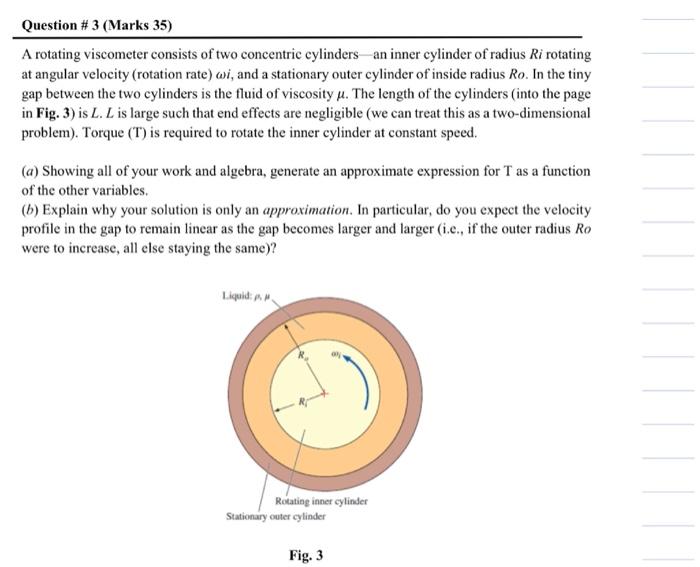
A rotating viscometer consists of two concentric cylinders - an inner cylinder of radius Ri rotating at angular velocity (rotation rate) i, and a stationary outer cylinder of inside radius Ro. In the tiny gap between the two cylinders is the fluid of viscosity . The length of the cylinders (into the page in Fig. 3) is L.L is large such that end effects are negligible (we can treat this as a two-dimensional problem). Torque (T) is required to rotate the inner cylinder at constant speed. (a) Showing all of your work and algebra, generate an approximate expression for T as a function of the other variables. (b) Explain why your solution is only an approximation. In particular, do you expect the velocity profile in the gap to remain linear as the gap becomes larger and larger (i.e., if the outer radius Ro were to increase, all else staying the same)? Fig. 3
Step by Step Solution
There are 3 Steps involved in it

Get step-by-step solutions from verified subject matter experts
 Study Help