







Question: Explain your reason for each one 1. True/False: In Racket, reversing a list lst can be accomplished with a fold: (foldr cons '() lst). 2.
Explain your reason for each one
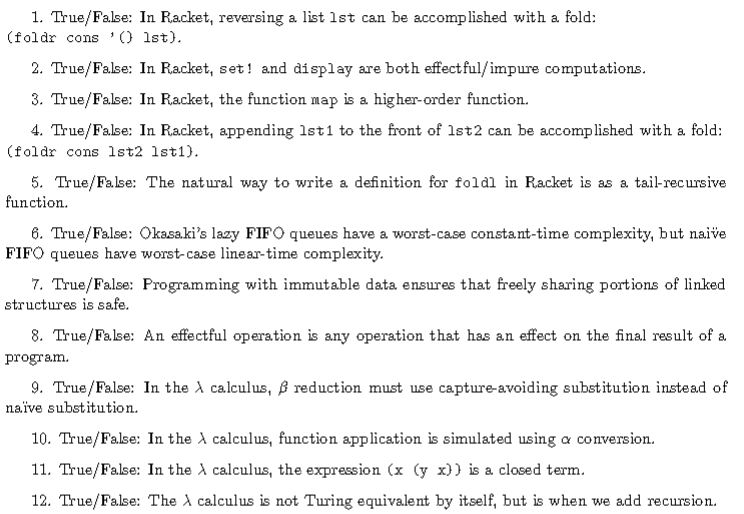
1. True/False: In Racket, reversing a list lst can be accomplished with a fold: (foldr cons '() lst). 2. True/False: In Racket, set! and display are both effectful/impure computations. 3. True/False: In Racket, the function map is a higher-order function. 4. True/False: In Ra.cket, appending lst1 to the front of lst2 can be accomplished with a fold: (foldr cons lst2 lsti). 5. True/False: The natural way to write a definition for foldl in Racket is as a tail-recursive function. 6. True/False: Okasa.ki's lazy FIFO queues have a worst-case constant-time complexity, but naive FIFO queues have worst-case linear-time complexity. 7. True/False: Programming with immutable data ensures that freely sharing portions of linked structures is safe. 8. True/False: An effectful operation is any operation that has an effect on the final result of a. program. 9. True/Fallse: In the calculus, reduction must use capture-avoiding substitution instead of nave substitution. 10. True/False: In the calculus, function application is simulated using conversion. 11. True/Fa.lse: In the calculus, the expression (x(yx) ) is a closed term. 12. True/Fallse: The calculus is not Turing equivalent by itself, but is when we add recursion
Step by Step Solution
There are 3 Steps involved in it

Get step-by-step solutions from verified subject matter experts
 Study Help