







Question: Expression tree and query evaluation plan. (16 points) Consider the following SQL query involving relation r(ABCDE) and s(AFGLN) Select A,F From r, S Where t.A=
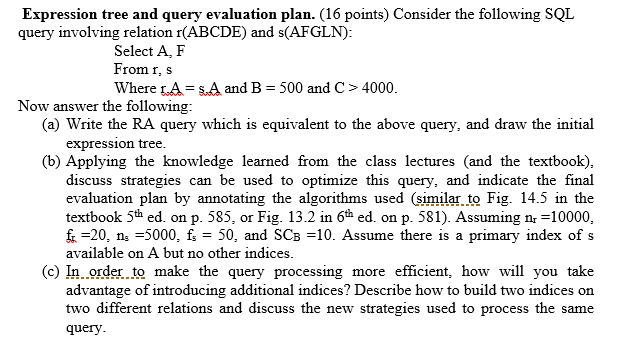
Expression tree and query evaluation plan. (16 points) Consider the following SQL query involving relation r(ABCDE) and s(AFGLN) Select A,F From r, S Where t.A= sA and B-500 and C > 4000 Now answer the following (a) Write the RA query which is equivalent to the above query, and draw the initial expression tree (b) Applying the knowledge learned from the class lectures (and the textbook), and indicate the final evaluation plan by annotating the algorithms used (similar.to Fig. 14.5 in the textbook 5th ed. on p. 585, or Fig. 13.2 in 6th ed. on p. 581). Assuming nr-10000 -20, n.-5000, fs = 50, and SCB-10. Assume there is a primary index of s discuss strategies can be used to optimize this query, available on A but no other indices (c) In..order.to make the query processing more efficient, how will you take advantage of introducing additional indices? Describe how to build two indices on process the same two different relations and discuss the new strategies used to query Expression tree and query evaluation plan. (16 points) Consider the following SQL query involving relation r(ABCDE) and s(AFGLN) Select A,F From r, S Where t.A= sA and B-500 and C > 4000 Now answer the following (a) Write the RA query which is equivalent to the above query, and draw the initial expression tree (b) Applying the knowledge learned from the class lectures (and the textbook), and indicate the final evaluation plan by annotating the algorithms used (similar.to Fig. 14.5 in the textbook 5th ed. on p. 585, or Fig. 13.2 in 6th ed. on p. 581). Assuming nr-10000 -20, n.-5000, fs = 50, and SCB-10. Assume there is a primary index of s discuss strategies can be used to optimize this query, available on A but no other indices (c) In..order.to make the query processing more efficient, how will you take advantage of introducing additional indices? Describe how to build two indices on process the same two different relations and discuss the new strategies used to query
Step by Step Solution
There are 3 Steps involved in it

Get step-by-step solutions from verified subject matter experts
 Study Help