







Question: extra credit answer quick please 4. The following are two different simple Cost-Benefit studies that you are asked to evaluate along different dimensions. a. A
extra credit answer quick please
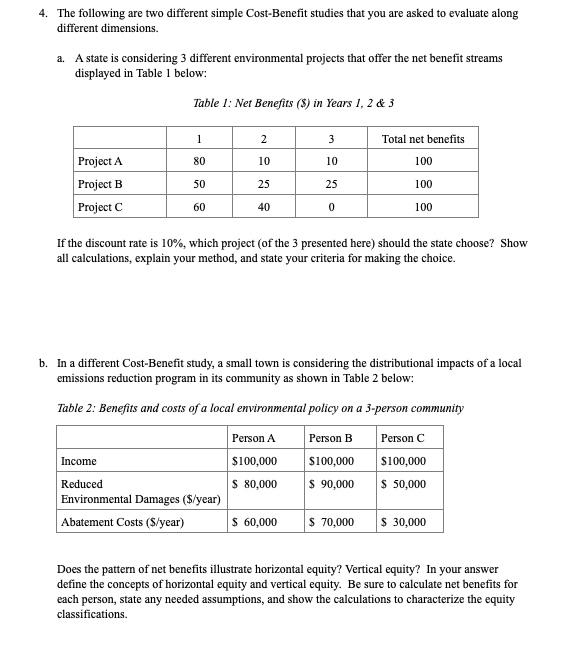
4. The following are two different simple Cost-Benefit studies that you are asked to evaluate along different dimensions. a. A state is considering 3 different environmental projects that offer the net benefit streams displayed in Table 1 below: Table 1: Net Benefits ($) in Years 1, 2 & 3 1 2 3 Total net benefits 80 10 10 100 Project A Project B Project C 50 25 25 100 100 60 40 0 If the discount rate is 10%, which project (of the 3 presented here) should the state choose? Show all calculations, explain your method, and state your criteria for making the choice. b. In a different Cost-Benefit study, a small town is considering the distributional impacts of a local emissions reduction program in its community as shown in Table 2 below: Table 2: Benefits and costs of a local environmental policy on a 3-person community Person A Person B Income $100,000 $ 80,000 $100,000 $ 90,000 Person C $100,000 $ 50,000 Reduced Environmental Damages ($/year) Abatement Costs (S/year) $ 60,000 $ 70,000 $ 30,000 Does the pattern of net benefits illustrate horizontal equity? Vertical equity? In your answer define the concepts of horizontal equity and vertical equity. Be sure to calculate net benefits for each person, state any needed assumptions, and show the calculations to characterize the equity classifications. 4. The following are two different simple Cost-Benefit studies that you are asked to evaluate along different dimensions. a. A state is considering 3 different environmental projects that offer the net benefit streams displayed in Table 1 below: Table 1: Net Benefits ($) in Years 1, 2 & 3 1 2 3 Total net benefits 80 10 10 100 Project A Project B Project C 50 25 25 100 100 60 40 0 If the discount rate is 10%, which project (of the 3 presented here) should the state choose? Show all calculations, explain your method, and state your criteria for making the choice. b. In a different Cost-Benefit study, a small town is considering the distributional impacts of a local emissions reduction program in its community as shown in Table 2 below: Table 2: Benefits and costs of a local environmental policy on a 3-person community Person A Person B Income $100,000 $ 80,000 $100,000 $ 90,000 Person C $100,000 $ 50,000 Reduced Environmental Damages ($/year) Abatement Costs (S/year) $ 60,000 $ 70,000 $ 30,000 Does the pattern of net benefits illustrate horizontal equity? Vertical equity? In your answer define the concepts of horizontal equity and vertical equity. Be sure to calculate net benefits for each person, state any needed assumptions, and show the calculations to characterize the equity classifications
Step by Step Solution
There are 3 Steps involved in it

Get step-by-step solutions from verified subject matter experts
 Study Help