







Question: Extra Credit Assignment for ADMN 210 - Spring 2020 Case study, Starbucks The case study for extra credit deals with Starbucks debit cards. The description
Extra Credit Assignment for ADMN 210 - Spring 2020
Case study, Starbucks
The case study for extra credit deals with Starbucks debit cards. The description of the database is found at the end of chapter 13 (yes, I know we didn't do that chapter...we are just using it for this case). Here is what I would like you to do:
1)As a review of chapter 2, create a frequency distribution for the age of the customer. In other words, form a pivot table for age. Draw the appropriate type of graph to display the data.
2)As a review of chapter 3, calculate descriptive stats for age. In other words, find the measures of central tendency (mean, median, and mode) and measure of spread (standard deviation). Also, find skewness and kurtosis and interpret...are the data skewed (lopsided) or symmetrical, and are they peaked or flat or approximately bell shaped?
3)As a review of chapter 8, find the 95% confidence interval for income, and interpret.
4)Previously, it was known that people put an average of $25 on the pre-paid card. A researcher believes the figure has increased. Do the data indicate that the amount on the debit cards has significantly increased? As a review of chapter 9, perform a hypothesis test using a 5% level of significance.
5) As a review of chapter 12, develop a regression model to study how well the amount of the prepaid card can be predicted by income. Interpret the printout completely (r, r-squared, and the model). Then predict dollar amount for a person earning $40,000.
Starbucks is a resounding restaurant success story. Beginning with its first coffee house in 1971, Starbucks has grown to more than 22,500 stores. Opening up its first international outlet in the mid-1990s, Starbucks now operates in more than 67 countries outside of North America. Besides selling beverages, pastries, confections, and coffee-related accessories and equipment at its retail outlets, Starbucks also purchases and roasts high-quality coffee beans in several locations. The company's objective is to become the most recognized and respected brand in the world. Starbucks maintains a strong environmental orientation and is committed to taking a leadership position environmentally. In addition, the company has won awards for corporate social responsibility through its community-building programs, its strong commitment to its origins (coffee producers, family, community), and the Starbucks Foundation, which is dedicated to creating hope, discovery, and opportunity in the communities where Starbucks resides.
In November 2001, Starbucks launched its prepaid (debit) Starbucks Card. The card, which holds between $5 and $500, can be used at virtually any Starbucks location. The card was so popular when it first was released that many stores ran out. By mid-2002, Starbucks had activated more than 5 million of these cards. The Starbucks Card has surpassed the $25 billion mark for total activations and reloads since its introduction. As customers "reload" the cards, it appears they are placing more money on them than the initial value of the card.
Starbucks has gone on to promote their Starbucks Card as a flexible marketing tool that can be used by individuals as a gift of thanks and appreciation for friendship or service and can beused by companies to reward loyal customers and as an incentive to employees.
Discussion
Starbucks enjoyed considerable success with its debit cards, which they sell for $5 to $500. Suppose Starbucks management wants to study the reasons why some people purchase debit cards with higher prepaid amounts than do other people. Suppose a study of 25 randomly selected prepaid card purchasers is taken. Respondents are asked the amount of the prepaid card, the customer's age, the number of days per month the customer makes a purchase at Starbucks, the number of cups of coffee the customer drinks per day, and the customer's income. The data follow. Using these data, develop a multiple regression model to study how well the amount of the prepaid card can be predicted by the other variables and which variables seem to be more promising in doing the prediction. What sales implications might be evident from this analysis?
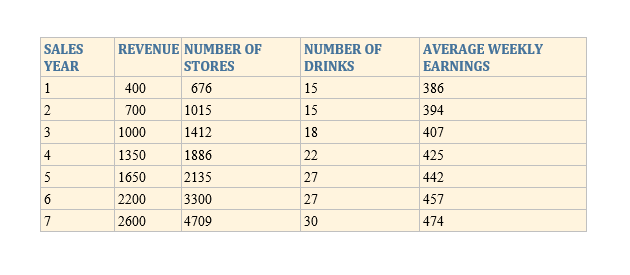
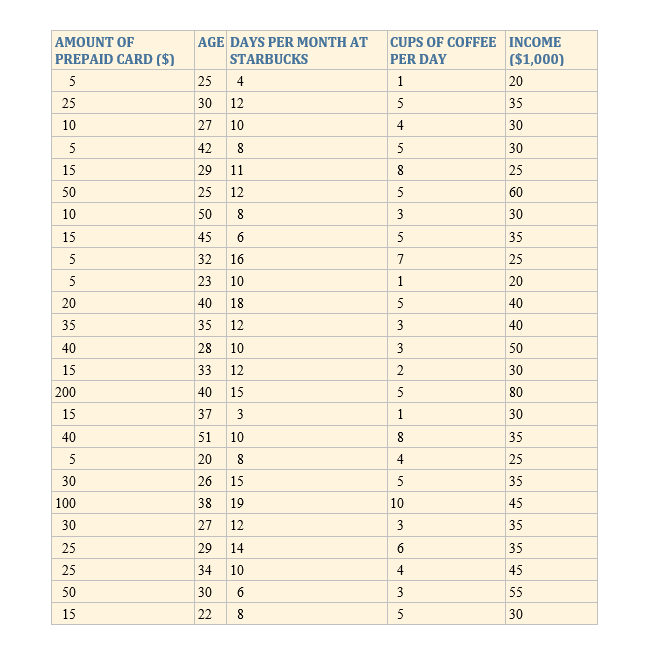
SALES REVENUE NUMBER OF NUMBER OF AVERAGE WEEKLY YEAR STORES DRINKS EARNINGS 400 676 15 386 2 700 1015 15 394 1000 1412 18 407 1350 1886 22 425 1650 2135 27 442 2200 3300 27 457 2600 4709 30 474AMOUNT OF AGE DAYS PER MONTH AT PREPAID CARD ($) CUPS OF COFFEE INCOME STARBUCKS PER DAY ($1,000) 5 25 4 20 25 30 12 35 10 27 10 30 5 42 8 30 15 29 11 25 50 25 12 60 10 50 8 30 15 45 6 35 5 32 16 25 5 23 10 20 20 40 18 40 35 35 12 40 40 28 10 50 15 33 12 30 200 40 15 80 15 37 3 30 40 51 10 35 5 20 25 30 26 15 35 100 38 19 10 45 30 27 12 35 25 29 14 35 25 34 10 45 50 30 6 55 15 22 8 30
Step by Step Solution
There are 3 Steps involved in it

Get step-by-step solutions from verified subject matter experts
 Study Help