







Question: 14 marks) Suppose a random variable X has a binomial distribution with parameters n (the number of independent trials) and 0 (the probability of
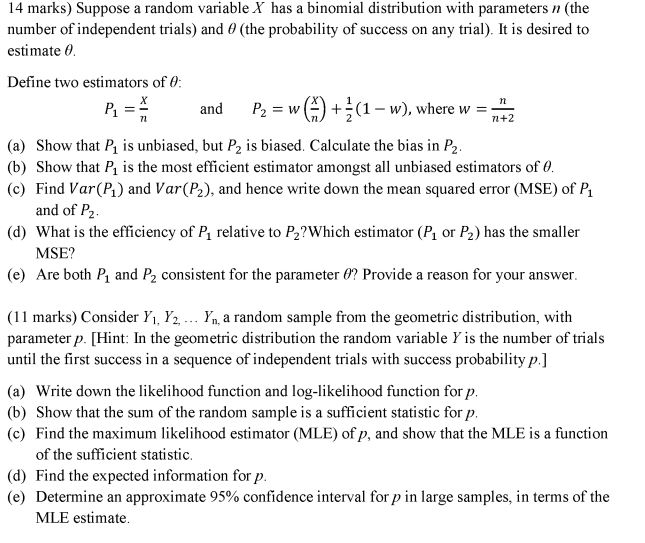
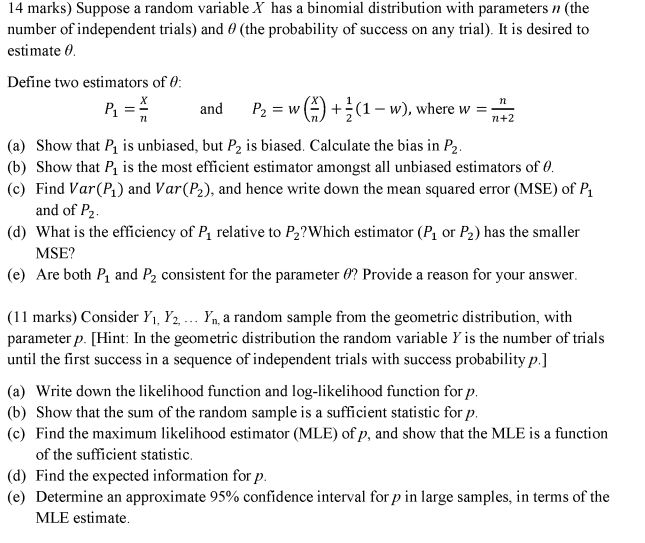
14 marks) Suppose a random variable X has a binomial distribution with parameters n (the number of independent trials) and 0 (the probability of success on any trial). It is desired to estimate O. Define two estimators Of 0: and P2 = w + \ (1 w), where w = 2 (a) (b) (c) (d) (e) Show that P1 is unbiased, but P2 is biased Calculate the bias in P2. Show that P1 is the most efficient estimator amongst all unbiased estimators Of O. Find Var(P1) and Var(P2), and hence write down the mean squared error (MSE) of P1 and Of P2. What is the efficiency of P1 relative to P2P Which estimator (P1 or P2) has the smaller MSE? Are both P1 and P2 consistent for the parameter (P Provide a reason for your answer. (11 marks) Consider Yl Y2, a random sample from the geometric distribution, with parameter p. [Hint: In the geometric distribution the random variable Y is the number Of trials until the first success in a sequence of independent trials with success probability p,] (a) (b) (c) (d) (e) Write down the likelihood function and log-likelihood function for p, Show that the sum of the random sample is a sufficient statistic for p, Find the maximum likelihood estimator (MLE) of p, and show that the MLE is a function of the sufficient statistic. Find the expected information for p. Determine an approximate 95% confidence interval for p in large samples, in terms of the MLE estimate.
Step by Step Solution
There are 3 Steps involved in it

Get step-by-step solutions from verified subject matter experts
 Study Help