







Question: Preference Shocks and Production Shocks. Suppose that firms and consumers co-exist in the static (one-period) consumption-leisure model. The representative firm uses only labor to
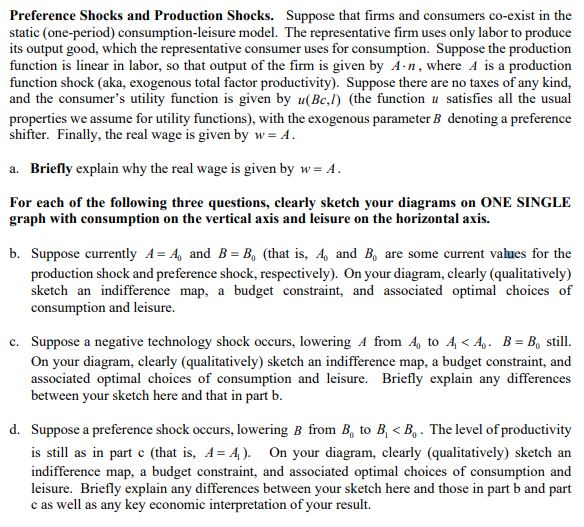
Preference Shocks and Production Shocks. Suppose that firms and consumers co-exist in the static (one-period) consumption-leisure model. The representative firm uses only labor to produce its output good, which the representative consumer uses for consumption. Suppose the production function is linear in labor, so that output of the firm is given by A n , where A is a production function shock (aka, exogenous total factor productivity). Suppose there are no taxes of any kind, and the consumer's utility function is given by (the function u satisfies all the usual properties we assume for utility functions), with the exogenous parameter B denoting a preference shifter. Finally, the real wage is given by w A. a. Briefly explain why the real wage is given by w A. For each of the following three questions, clearly sketch your diagrams on ONE SINGLE graph with consumption on the vertical axis and leisure on the horizontal axis. b. Suppose currently A = Ao and B = Bo (that is, .40 and Bo are some current values for the production shock and preference shock, respectively). On your diagram, clearly (qualitatively) sketch an indifference map, a budget constraint, and associated optimal choices of consumption and leisure. c. Suppose a negative technology shock occurs, lowering A from Ao to A1 < .40. B = Bo still. On your diagram, clearly (qualitatively) sketch an indifference map, a budget constraint, and associated optimal choices of consumption and leisure. Briefly explain any differences between your sketch here and that in part b. d. Suppose a preference shock occurs,lowering B from Bo to Bl < Bo. The level of productivity is still as in part c (that is, = A1). On your diagram, clearly (qualitatively) sketch an indifference map, a budget constraint, and associated optimal choices of consumption and leisure. Briefly explain any differences between your sketch here and those in part b and part c as well as any key economic interpretation of your result.
Step by Step Solution
There are 3 Steps involved in it

Get step-by-step solutions from verified subject matter experts
 Study Help