







Question: Consider a simple 2 x 2 game theory matrix such as this one: Player 2 (P2) Player 1 (Pl) Action 1 Action 2 Action
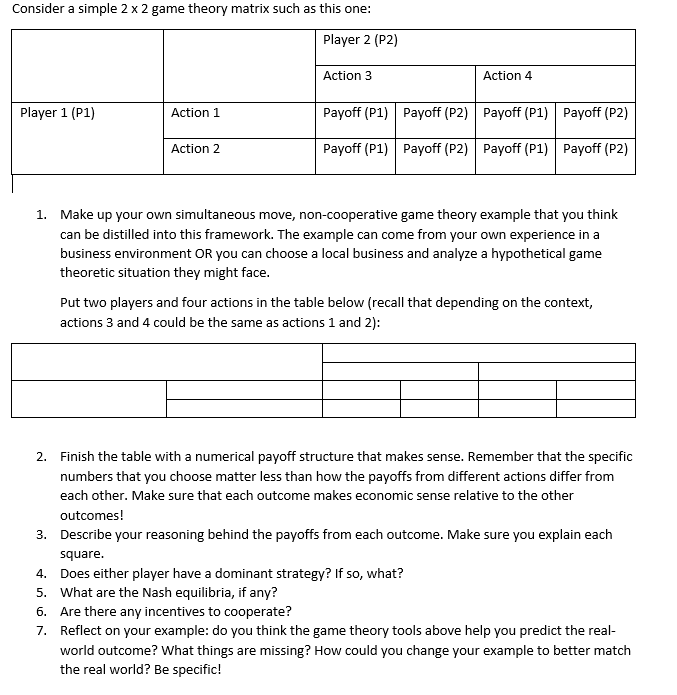
Consider a simple 2 x 2 game theory matrix such as this one: Player 2 (P2) Player 1 (Pl) Action 1 Action 2 Action 3 Payoff (Pl) Payoff (Pl) Payoff (P2) Payoff (P2) Action 4 Payoff (Pl) Payoff (Pl) Payoff (P2) Payoff (P2) 2. 3. 4. 5. 6. 7. Make up your own simultaneous move, non-cooperative game theory example that you think can be distilled into this framework. The example can come from your own experience in a business environment OR you can choose a local business and analyze a hypothetical game theoretic situation they might face. Put two players and four actions in the table below (recall that depending on the context, actions 3 and 4 could be the same as actions 1 and 2): Finish the table with a numerical payoff structure that makes sense. Remember that the specific numbers that you choose matter less than how the payoffs from different actions differ from each other. Make sure that each outcome makes economic sense relative to the other outcomes! Describe your reasoning behind the payoffs from each outcome. Make sure you explain each square. Does either player have a dominant strategy? If so, what? What are the Nash equilibria, if any? Are there any incentives to cooperate? Reflect on pur example: do you think the game theory tools above help you predict the real- world outcome? What things are missing? How could you change your example to better match the real world? Be specific!
Step by Step Solution
There are 3 Steps involved in it

Get step-by-step solutions from verified subject matter experts
 Study Help