







Question: For part (a), Ui represents the dollar amount player i earns from the game, which is player i's payoff. For part (b), player i's payoff
For part (a), Ui represents the dollar amount player i earns from the game, which is player i's payoff.
For part (b), player i's payoff is equal to the dollar amount player i earns from the game (Ui) plus w times the dollar amount player j earns from the game (Uj).
I hope this helps. Thank you!
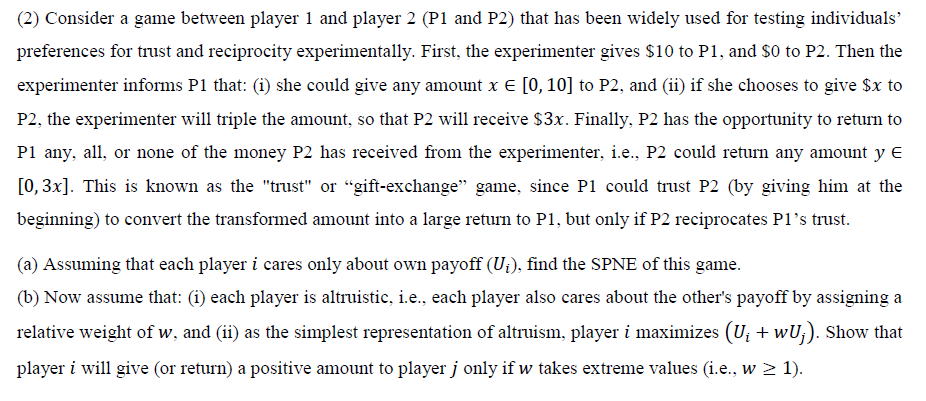
(2) Consider a game between player 1 and player 2 (P1 and P2) that has been widely used for testing individuals' preferences for trust and reciprocity experimentally. First, the experimenter gives $10 to P1, and $0 to P2. Then the experimenter informs P1 that: (1) she could give any amount x [0, 10) to P2, and (ii) if she chooses to give $x to P2, the experimenter will triple the amount, so that P2 will receive $3x. Finally, P2 has the opportunity to return to Pl any, all, or none of the money P2 has received from the experimenter, i.e., P2 could return any amount y e [0,3x]. This is known as the "trust" or gift-exchange game, since P1 could trust P2 (by giving him at the beginning) to convert the transformed amount into a large return to P1, but only if P2 reciprocates Pls trust. (a) Assuming that each player i cares only about own payoff (Ui), find the SPNE of this game. (b) Now assume that: (i) each player is altruistic, i.e., each player also cares about the other's payoff by assigning a relative weight of w, and (ii) as the simplest representation of altruism, player i maximizes (U + wU;). Show that player i will give (or return) a positive amount to player j only if w takes extreme values (i.e., w > 1). (2) Consider a game between player 1 and player 2 (P1 and P2) that has been widely used for testing individuals' preferences for trust and reciprocity experimentally. First, the experimenter gives $10 to P1, and $0 to P2. Then the experimenter informs P1 that: (1) she could give any amount x [0, 10) to P2, and (ii) if she chooses to give $x to P2, the experimenter will triple the amount, so that P2 will receive $3x. Finally, P2 has the opportunity to return to Pl any, all, or none of the money P2 has received from the experimenter, i.e., P2 could return any amount y e [0,3x]. This is known as the "trust" or gift-exchange game, since P1 could trust P2 (by giving him at the beginning) to convert the transformed amount into a large return to P1, but only if P2 reciprocates Pls trust. (a) Assuming that each player i cares only about own payoff (Ui), find the SPNE of this game. (b) Now assume that: (i) each player is altruistic, i.e., each player also cares about the other's payoff by assigning a relative weight of w, and (ii) as the simplest representation of altruism, player i maximizes (U + wU;). Show that player i will give (or return) a positive amount to player j only if w takes extreme values (i.e., w > 1)
Step by Step Solution
There are 3 Steps involved in it

Get step-by-step solutions from verified subject matter experts
 Study Help