







Question: OUESTION 1: If a manager is paid a percentage of profits, does this generate a motive to manipulate profits? Would this be anticipated by
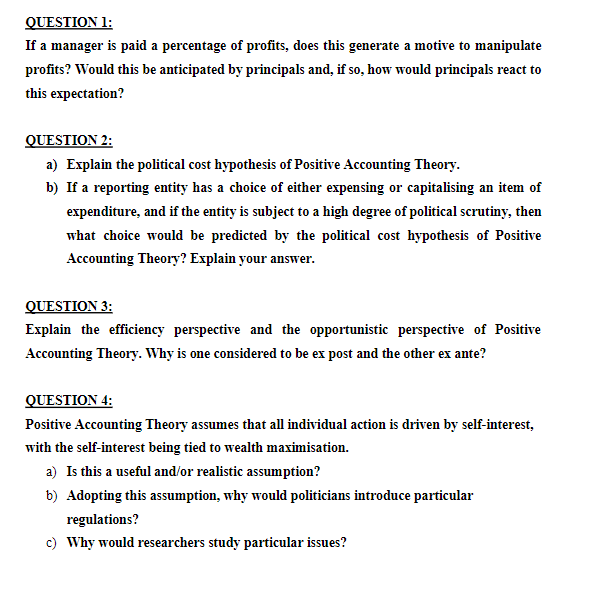
OUESTION 1: If a manager is paid a percentage of profits, does this generate a motive to manipulate profits? Would this be anticipated by principals and, if so, how would principals react to this expectation? OUESTION 2: a) Explain the political cost hypothesis of Positive Accounting Theory. b) If a reporting entity has a choice of either expensing or capitalising an item of expenditure, and if the entity is subject to a high degree of political scrutiny, then what choice would be predicted by the political cost hypothesis of Positive Accounting Themy? Explain your answer. OUESTION 3: Explain the efficiency perspective and the opportunistic perspective of Positive Accounting Theory. is one considered to be ex post and the other ex ante? OUESTION 4: Positive Accounting Themy assumes that all individual action is driven by self-interest, with the self-interest being tied to wealth maximisation. a) Is this a useful and/or realistic assumption? b) Adopting this assumption, why would politicians introduce particular regulations ? c) would researchers study particular issues?
Step by Step Solution
There are 3 Steps involved in it

Get step-by-step solutions from verified subject matter experts
 Study Help