







Question: This question will add taxes to the human capital model discussed in the notes. Specifically, assume the following conditions for the economy: u(ct) k,
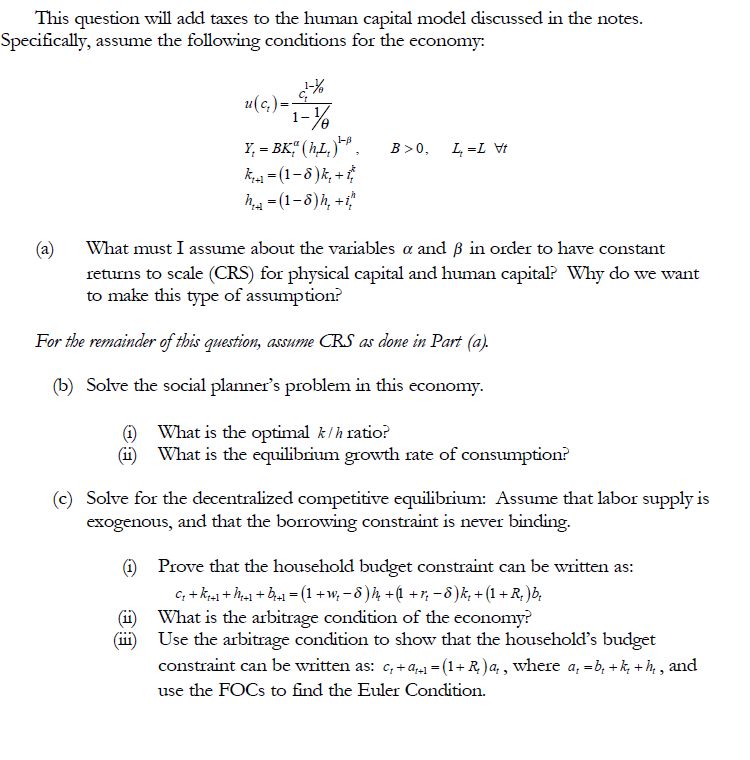
This question will add taxes to the human capital model discussed in the notes. Specifically, assume the following conditions for the economy: u(ct) k, (1 )kr + ht. )hr (a) What must I assume about the variables a and 13 in order to have constant returns to scale (CRS) for physical capital and human capital? Why do we want to make this type of assunmption? For the nmainder of this question, assume GRS as done in Paff (a). (b) Solve the social planner's proble-ln in this economy. @ \X'hat is the optimal k / h ratio? @ \X'hat is the equilibrium growth rate of consumption? (c) Solve for the decentralized competitive equilibrium: Assume that labor supply is exogenous, and that the borrowing constraint is never (i) (iii) Prove that the household budget constraint can be written as: cr+kt*l + (1 rr +Rr)br Nihat is the arbitrage condition of the economy? Use the arbitrage condition to show that the household's budget constraint can be written as: = (1 + where a, and use the FOCs to find the Euler Condin.
Step by Step Solution
There are 3 Steps involved in it

Get step-by-step solutions from verified subject matter experts
 Study Help