







Question: F1. Write a python code that can read in an airfoil geometry and plot it, as F2. Modify your code so it reads in the
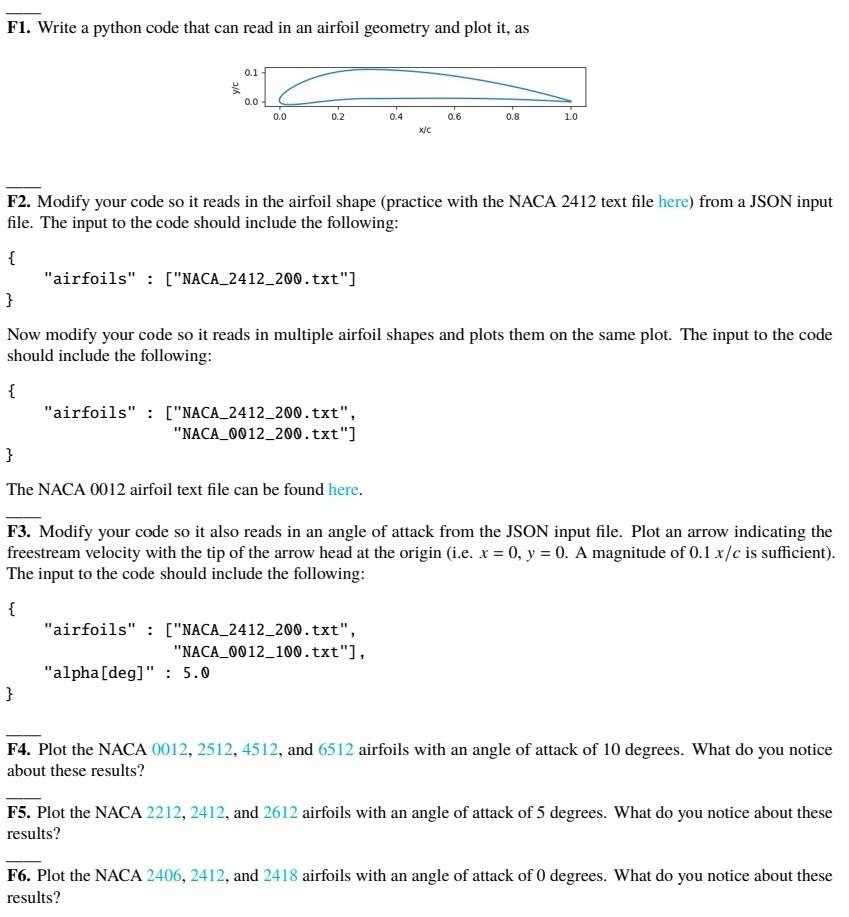
F1. Write a python code that can read in an airfoil geometry and plot it, as F2. Modify your code so it reads in the airfoil shape (practice with the NACA 2412 text file here) from a JSON input file. The input to the code should include the following: { "airfoils" : ["NACA_2412_200.txt"] Now modify your code so it reads in multiple airfoil shapes and plots them on the same plot. The input to the code should include the following: \{ "airfoils" : ["NACA_2412_200.txt", "NACA_Q012_200.txt"] \} The NACA 0012 airfoil text file can be found here. F3. Modify your code so it also reads in an angle of attack from the JSON input file. Plot an arrow indicating the freestream velocity with the tip of the arrow head at the origin (i.e. x=0,y=0. A magnitude of 0.1x/c is sufficient). The input to the code should include the following: { "airfoils" : ["NACA_2412_200.txt", "NACA_O012_100.txt"] \} "alpha [deg]" :5.0 F4. Plot the NACA 0012,2512,4512, and 6512 airfoils with an angle of attack of 10 degrees. What do you notice about these results? F5. Plot the NACA 2212, 2412, and 2612 airfoils with an angle of attack of 5 degrees. What do you notice about these results? F6. Plot the NACA 2406, 2412, and 2418 airfoils with an angle of attack of 0 degrees. What do you notice about these results
Step by Step Solution
There are 3 Steps involved in it

Get step-by-step solutions from verified subject matter experts
 Study Help