



Question: f5 Problem 5 Three conducting spheres with radii 3r, 2r and r are given 6q, 14g and -dg amounts of electric charges respectively. If all
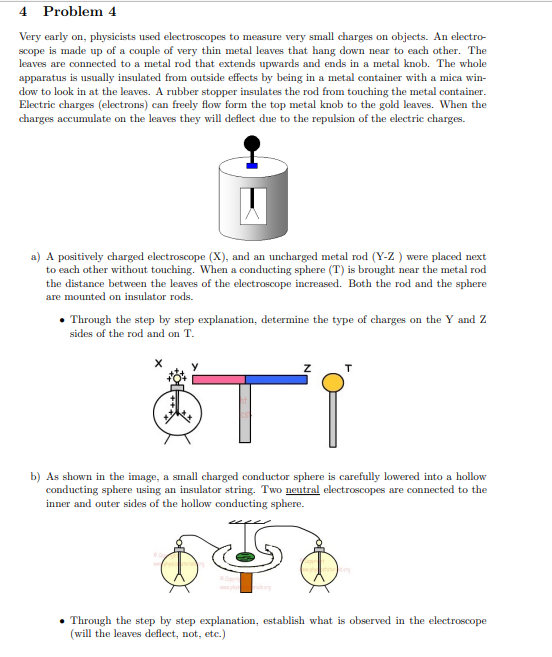
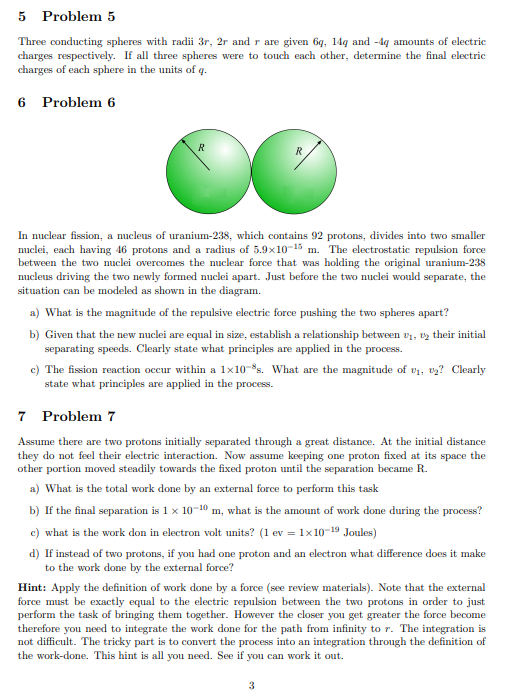
\f5 Problem 5 Three conducting spheres with radii 3r, 2r and r are given 6q, 14g and -dg amounts of electric charges respectively. If all three spheres were to touch each other, determine the final electric charges of each sphere in the units of q. 6 Problem 6 R In nuclear fission, a nucleus of uranium-238, which contains 92 protons, divides into two smaller nuclei, each having 46 protons and a radius of 5.9x10 5 m. The electrostatic repulsion force between the two nuclei overcomes the nuclear force that was holding the original uranium-238 nucleus driving the two newly formed nuclei apart. Just before the two nuclei would separate, the situation can be modeled as shown in the diagram. a) What is the magnitude of the repulsive electric force pushing the two spheres apart? b) Given that the new nuclei are equal in size, establish a relationship between v1, ry their initial separating speeds. Clearly state what principles are applied in the process. c) The fission reaction occur within a 1x10 's. What are the magnitude of v1, ry? Clearly state what principles are applied in the process. 7 Problem 7 Assume there are two protons initially separated through a great distance. At the initial distance they do not feel their electric interaction. Now assume keeping one proton fixed at its space the other portion moved steadily towards the fixed proton until the separation became R. a) What is the total work done by an external force to perform this task b) If the final separation is 1 x 10 m, what is the amount of work done during the process? c) what is the work don in electron volt units? (1 ev = 1x10-19 Joules) d) If instead of two protons, if you had one proton and an electron what difference does it make to the work done by the external force? Hint: Apply the definition of work done by a force (see review materials). Note that the external force must be exactly equal to the electric repulsion between the two protons in order to just perform the task of bringing them together. However the closer you get greater the force become therefore you need to integrate the work done for the path from infinity to r. The integration is not difficult. The tricky part is to convert the process into an integration through the definition of the work-done. This hint is all you need. See if you can work it out. 3
Step by Step Solution
There are 3 Steps involved in it

Get step-by-step solutions from verified subject matter experts