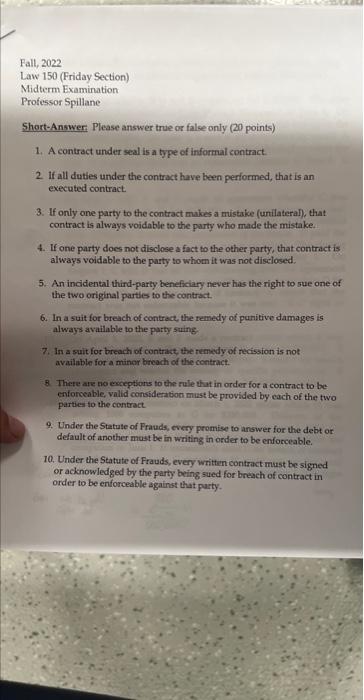
Question: Fall, 2022 Law 150 (Friday Section) Midterm Examination Protessor Spillane Short-Answer Please answer true or false only (20 points) 1. A contract under seal is
Fall, 2022 Law 150 (Friday Section) Midterm Examination Protessor Spillane Short-Answer Please answer true or false only (20 points) 1. A contract under seal is a type of informal contract. 2. If all duties under the contract have been performed, that is an executed contract. 3. If only one party to the contract makes a mistake (unilaterai), that contract is always voidable to the party who made the mistake. 4. If one party does not disclose a fact to the other party, that contract is always voidable to the party to whom it was not disclosed. 5. An incidental third-party beneficiary never has the right to sue one of the two original parties to the contract. 6. In a suit for breach of contract, the remedy of punitive damages is always available to the purty suing. 7. In a suit for breach of contract, the remedy of recission is not available for a minor breach of the contract. 8. There are no esceptions to the rule that in order for a contract to be enforceable, valid consideration must be provided by each of the two parties to the contract. 9. Under the Statute of Frauds, every promise to answer for the debt or default of another must be in writing in order to be enforceable. 10. Unider the Statute of Frauds, every written contract must be signed or acknowledged by the party being sued for breach of contract in order to be enforceable against that party. Fall, 2022 Law 150 (Friday Section) Midterm Examination Protessor Spillane Short-Answer Please answer true or false only (20 points) 1. A contract under seal is a type of informal contract. 2. If all duties under the contract have been performed, that is an executed contract. 3. If only one party to the contract makes a mistake (unilaterai), that contract is always voidable to the party who made the mistake. 4. If one party does not disclose a fact to the other party, that contract is always voidable to the party to whom it was not disclosed. 5. An incidental third-party beneficiary never has the right to sue one of the two original parties to the contract. 6. In a suit for breach of contract, the remedy of punitive damages is always available to the purty suing. 7. In a suit for breach of contract, the remedy of recission is not available for a minor breach of the contract. 8. There are no esceptions to the rule that in order for a contract to be enforceable, valid consideration must be provided by each of the two parties to the contract. 9. Under the Statute of Frauds, every promise to answer for the debt or default of another must be in writing in order to be enforceable. 10. Unider the Statute of Frauds, every written contract must be signed or acknowledged by the party being sued for breach of contract in order to be enforceable against that party