Question: FBA/PMS3393/NOV 21 SECTION A: CASE STUDY QUESTIONS (100 MARKS) ANSWER ALL QUESTIONS World Wildlife Fund for Nature (WWF) 2015 www.worldwildlife.org Headquartered in Glund, Switzerland, the
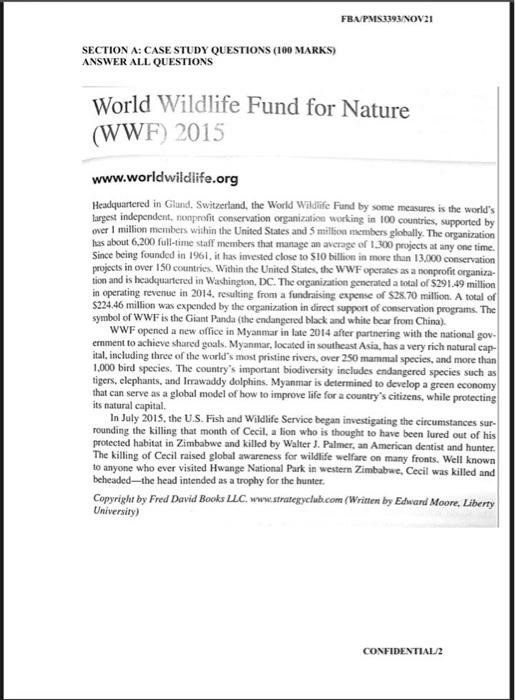
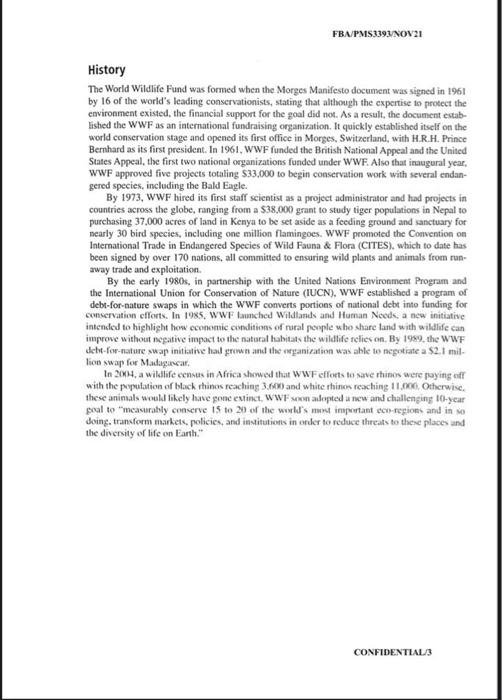
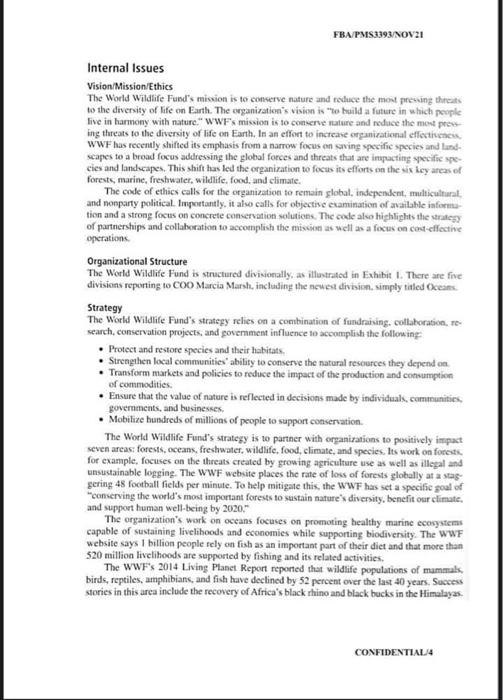
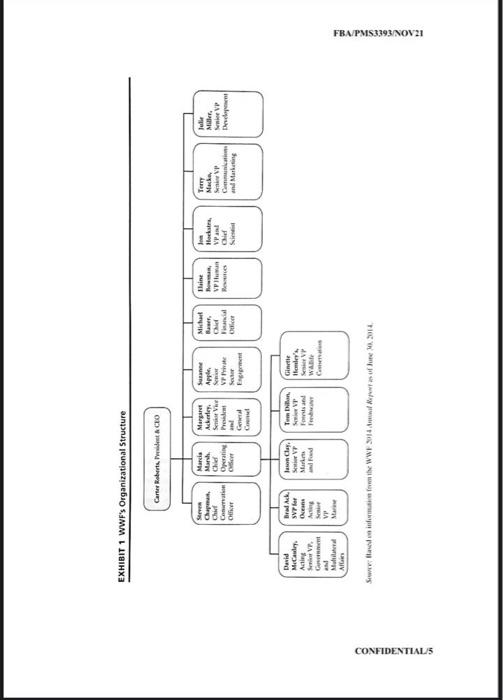
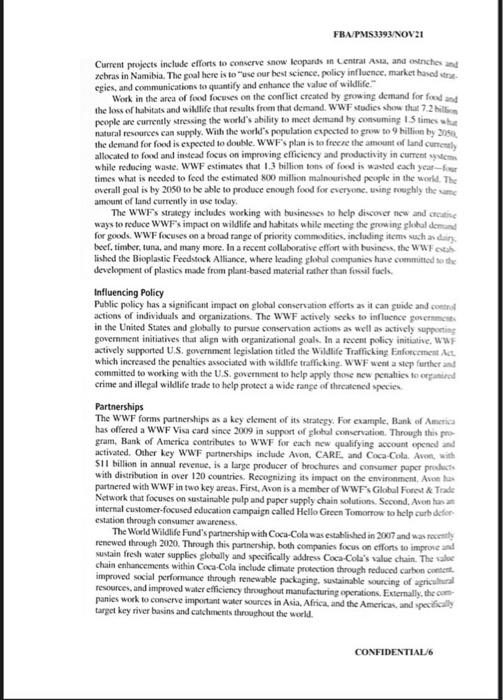
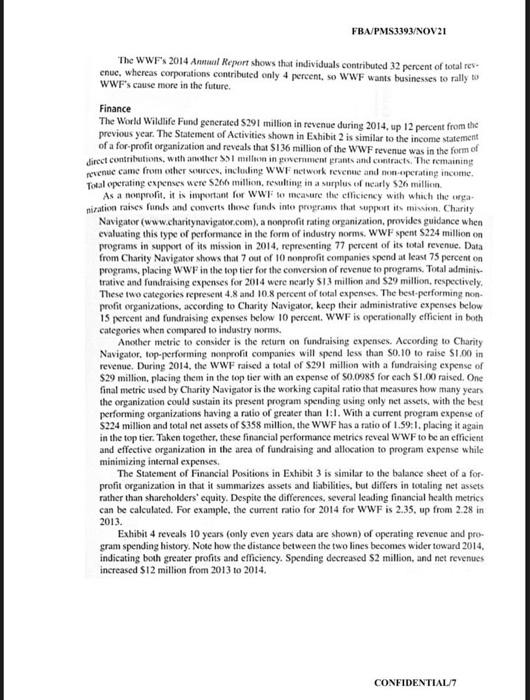
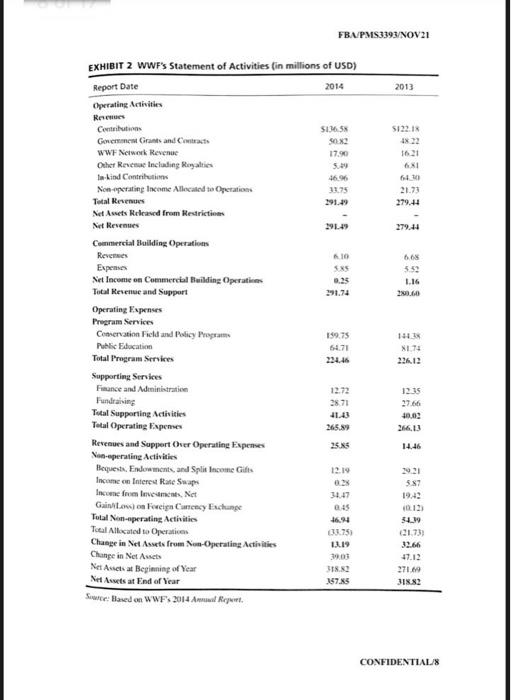
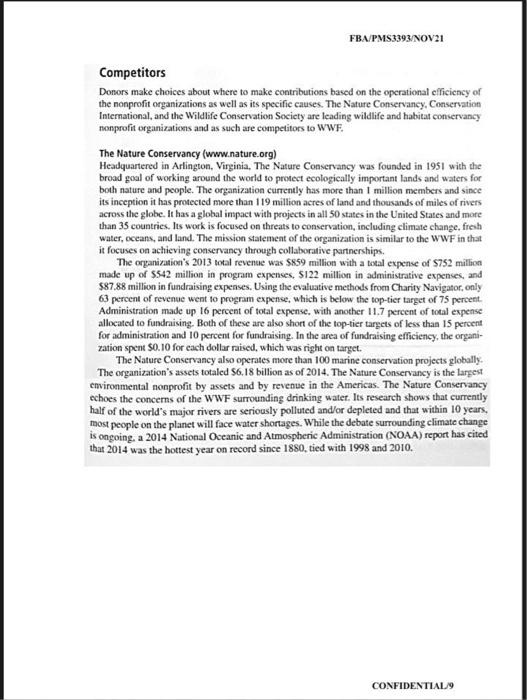
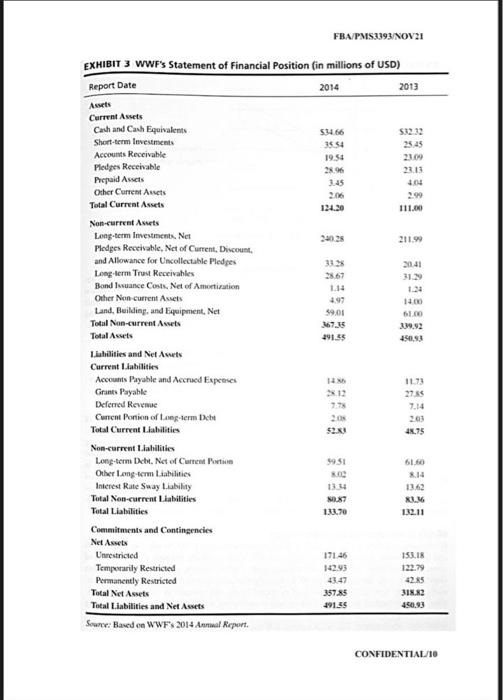
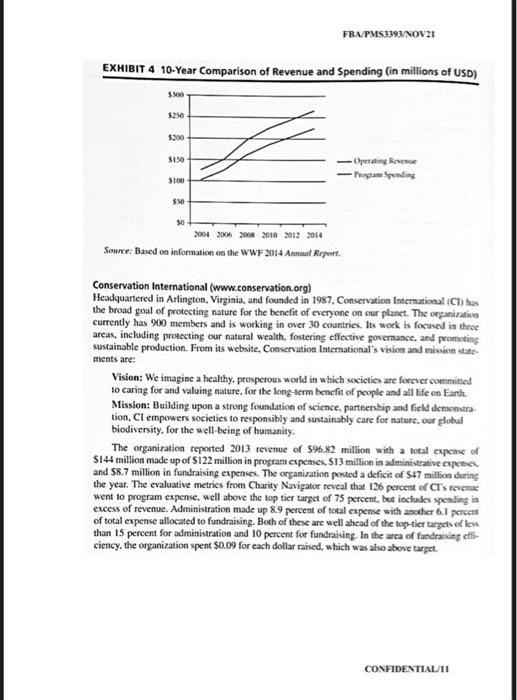
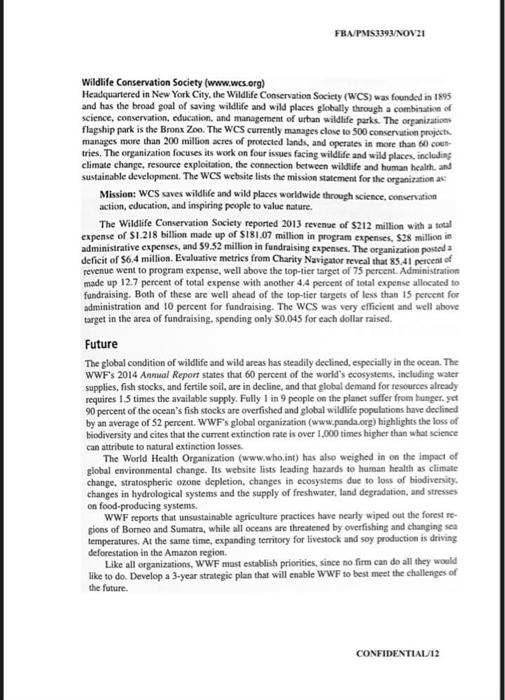
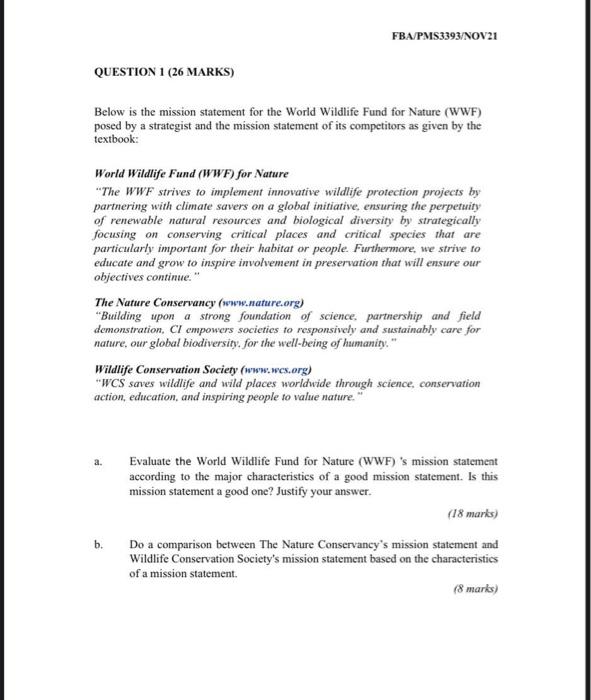
FBA/PMS3393/NOV 21 SECTION A: CASE STUDY QUESTIONS (100 MARKS) ANSWER ALL QUESTIONS World Wildlife Fund for Nature (WWF) 2015 www.worldwildlife.org Headquartered in Glund, Switzerland, the World Wildlife Fund by some measures is the world's largest independent, nonprofit conservation organization working in 100 countries, supported by wver 1 million members within the United States and 5 million members globally. The organization has about 6,200 full-time staff members that manage an average of 1.300 projects at any one time. Since being founded in 1961, it has invested close to S10 billion in more than 13.000 conservation projects in over 150 countries. Within the United States, the WWF operates as a nonprofit organiza- tion and is headquartered in Washington, DC. The organization generated a total of $291.49 million in operating revenue in 2014, resulting from a fundraising expense of $28.70 million. A total of S224.46 million was expended by the organization in direct support of conservation programs. The symbol of WWF is the Giant Panda (the endangered black and white bear from China). WWF opened a new office in Myanmar in late 2014 after partnering with the national gov. ernment to achieve shared goals. Myanmar, located in southeast Asia, has a very rich natural cap- ital, including three of the world's most pristine rivers, over 250 mammal species, and more than 1,000 bird species. The country's important biodiversity includes endangered species such as tigers, elephants, and Irrawaddy dolphins. Myanmar is determined to develop a green economy that can serve as a global model of how to improve life for a country's citizens, while protecting its natural capital. In July 2015, the U.S. Fish and Wildlife Service began investigating the circumstances sur rounding the killing that month of Cecil, a lion who is thought to have been lured out of his protected habitat in Zimbabwe and killed by Walter J. Palmer, an American dentist and hunter. The killing of Cecil raised global awareness for wildlife welfare on many fronts. Well known to anyone who ever visited Hwange National Park in western Zimbabwe, Cecil was killed and beheaded the head intended as a trophy for the hunter. Copyright by Fred David Books LLC. www.strategyclub.com (Written by Edward Moore. Liberty University) CONFIDENTIAL FBA/PMS3393/NOV 21 History The World Wildlife Fund was formed when the Morges Manifesto document was signed in 1961 by 16 of the world's leading conservationists, stating that although the expertise to protect the environment existed, the financial support for the goal did not. As a result, the document estab- lished the WWF as an international fundraising organization. It quickly established itself on the world conservation stage and opened its first office in Morges, Switzerland, with H.R.H. Prince Bernhard as its first president. In 1961, WWF funded the British National Appeal and the United States Appeal, the first two national organizations funded under WWF Also that inaugural year. WWF approved five projects totaling $33,000 to begin conservation work with several endan- gered species, including the Bald Eagle. By 1973, WWF hired its first staff scientist as a project administrator and had projects in countries across the globe, ranging from a $38,000 grant to study tiger populations in Nepal to purchasing 37,000 acres of land in Kenya to be set aside as a feeding ground and sanctuary for nearly 30 bird species, including one million flamingoes. WWF promoted the Convention on International Trade in Endangered Species of Wild Fauna & Flora (CITES), which to date has been signed by over 170 nations, all committed to ensuring wild plants and animals from run- away trade and exploitation By the early 1980s, in partnership with the United Nations Environment Program and the International Union for Conservation of Nature (IUCN). WWF established a program of debt-for-nature swaps in which the WWF converts portions of national debt into funding for conservation efforts. In 1985, WWF launched Wildlands and Human Needs, a new initiative intended to highlight how economic conditions of rural people who share land with wildlife can improve without negative impact to the natural habitats the wildlife relies on. By 1989, the WWF debit-for-nature war initiative has grown and the organization was able to negotiate a $2.1 mil- lion swap for Madagascar In 2004, a wildlife census in Africa showed that WWF efforts to save rhines were paying off with the population of black rhinos reaching 3.60%) and white rhines reaching 11.000. Otherwisc. these animals would likely have gone extinct , WWF xoom adopted a new and challenging 10-year goal to measurably conserve 15 to 20 of the world's most important eco-regions and in o doing. transform markets, policies, and institutions in order to reduce threats to these places and the diversity of life on Earth CONFIDENTIAL/3 FBA/PMS3393/NOV21 Internal Issues Vision/Mission/Ethics The World Wildlife Fund's mission is to conserve nature and reduce the most pressing threats to the diversity of life on Earth. The organization's vision is to build a future in which people live in harmony with nature." WWF's mission is to conserve nature and reduce the most press ing threats to the diversity of life on Earth. In an effort to increase organizational effectiveness WWF has recently shifted its emphasis from a narrow focus on sving specific species and land scapes to a broad focus addressing the global forces and threats that are impacting specific sp cies and landscapes. This shift has led the organization to focus its efforts on the six key areas of forests, marine, freshwater, wildlife, food, and climate. The code of ethics calls for the organization to remain global, independent, multicultural, and nonparty political. Importantly, it also calls for objective examination of available info tion and a strong focus on concrete conservation solutions. The code also highlights the strategy of partnerships and collaboration to accomplish the mission as well as a focus on cost effective operations Organizational Structure The World Wildlife Fund is structured divisionally, as ithestrated in Exhibit I. There are five divisions reporting to COO Marcia Marsh, including the newest division, simply titled Ocean Strategy The World Wildlife Fund's strategy relies on a combination of fundraising, collaboration, To search, conservation projects, and government influence to accomplish the following Protect and restore species and their habitats, . Strengthen local communities' ability to conserve the natural resources they depend on Transform markets and policies to reduce the impact of the production and consumption of commodities. Ensure that the value of nature is reflected in decisions made by individuals, communities governments, and businesses. . Mobilize hundreds of millions of people to support conservation The World Wildlife Fund's strategy is to partner with organizations to positively impact seven areas: forests, oceans, freshwater, wildlife, food, climate, and species. Its work on forests for example, focuses on the threats created by growing agriculture use as well as illegal and unsustainable logging. The WWF website places the rate of loss of forests globally at a stag gering 48 football fields per minute. To help mitigate this, the WWF has set a specific goal of conserving the world's most important forests to sustain nature's diversity, benefit our climate. and support human well-being by 2020. The organization's work on oceans focuses on promoting healthy marine ecosystems capable of sustaining livelihoods and economies while supporting biodiversity. The WWF website says 1 billion people rely on fish as an important part of their diet and that more than 520 million livelihoods are supported by fishing and its related activities. The WWF's 2014 Living Planet Report reported that wildlife populations of mammal birds, reptiles, amphibians, and fish have declined by 52 percent over the last 40 years. Success stories in this area include the recovery of Africa's black rhino and black bucks in the Himalayas. CONFIDENTIAL EXHIBIT 1 WWF's Organizational Structure Carter Roberts, CEO Margar Adele Michal Tline Maria March Child Operating Chap Chil Chat Offer Sun Apple S VP Sur Serve Presem Bar Chic Terry Mackey VP Jom Home VP Old Sie VPlan Re Julie Muller VP dem Olio mil Mathie G C Back SVT for OR David MC Ading V. G IN Mailure AR Clay SVP Mare Ford T. VP Tots and TV Ginette I' SVP WADE C VP Swimfe WWF 2014 wlis 2014 CONFIDENTIAL 5 FBA/PMS3393/NOV 21 FBA/PMS3393/NOV21 Current projects include efforts to conserve snow leopards in Central Asia, and estches and zebras in Namibia. The goal here is to use our best science policy influence, market hased stre egies, and communications to quantify and enhance the value of wildlife." Work in the area of food focuses on the conflict created by growing demand for fod and the loss of habitats and wildlife that results from that demand. WWF studies show that 7.2 hile people are currently pressing the world's ability to meet demand by consuming 15 times whe natural resources can supply. With the world's population expected to grow to 9 hillin by 305 the demand for food is expected to double. WWFs plan is to freeze the amount of land currently allocated to ford and instead focus on improving efficiency and productivity in current system while reducing waste, WWF estimates that 1.3 billion tons of food is wasted each year-er times what is needed to feed the estimated 800 million malnourished people in the world. The overall goal is by 2050 to be able to produce enough food for everyone, using roughly the same amount of land currently in use today, The WWFs strategy includes working with businesses to help discover new and creatine ways to reduce WWF's impact on wildlife and habitats while meeting the growing global demand for goods. WWF focuses on a broad range of priority commodities, including items such as dry beef, timber, tuna, and many more. In a recent collaborative effort with business, the WWF lished the Bioplastic Feedstock Alliance, where leading global compunies lune committed to the development of plastics made from plant-based material rather than fossil fucks Influencing Policy Public policy has a significant impact on global conservation efforts as it can guide and control actions of individuals and organizations. The WWF actively seeks to influence gener in the United States and globally to pursue conservation actions as well as actively supporting government initiatives that align with organizational goals. In a recent policy initiative, WWF actively supported U.S. government legislation titled the Wildlife Trafficking Enforcement Act which increased the penalties associated with wildlife trafficking, WWF went a step further and committed to working with the US government to help apply the new penalties to organised crime and illegal wildlife trade to help protect a wide range of threatened species Partnerships The WWF forms partnerships as a key element of its strategy. For example. Bank of America has offered a WWF Visa card since 2009 in support of global conservation. Through this pro gram, Bank of America contributes to WWF for each new qualifying account opened and activated. Other key WWF partnerships include Avon, CARE and Coca-Cola Amt, with S11 billion in annual revenue is a large producer of brochures and consumer puper products with distribution in over 120 countries. Recogniring its impact on the environment Avon partnered with WWF in two key areas. First, Avon is a member of WWFs Global Forest Trade Network that focuses on sustainable pulp and paper supply chain solutions. Second, Avon internal customer-focused education campaign called Hello Green Tomorrow to help cur derfor estation through consumer awareness The World Wildlife Fund's partnership with Coca-Cola was established in 2007 and was recently renewed through 2020. Through this partnership, both companies focus on efforts to improve and sustain fresh water supplies globally and specifically address Coca-Cola's value chain. The chain enhancements within Coca-Cola include climate protection through reduced carbon content improved social performance through renewable packaging. sustainable sourcing of agricultural resources and improved water efficiency throughout manufacturing operations. Externally, the comme panies work to conserve important water sources in Asia, Africa, and the Americas, and specifically target key river basins and catchments throughout the world. CONFIDENTIAL FBA/PMS3393/NOV 21 The WWF: 2014 Annual Report shows that individuals contributed 32 percent of total res- enue, whereas corporations contributed only 4 percent, so WWF wants businesses to rally WWF's cause more in the future. Finance The World Wildlife Fund generated S291 million in revenue during 2014, up 12 percent from the previous year. The Statement of Activities shown in Exhibit 2 is similar to the income statement of a for-profit organization and reveals that $136 million of the WWF revenue was in the form of direct contributions with antier Smilingwerment grants and contracts. The remaining revenue came from other sources, including WWF net with revenue and non-operating income Total operating expenses were $200 million, resulting in a surplus of early $26 million As a nonprofit, it is important for WWF to measure the efficiency with which the wa niration raise funds and converts the funds into programs that support is mission. Charity Navigator (www.charitynavigator.com), a nonprofit rating organization, provides guidance when evaluating this type of performance in the form of industry norms. WWF spent $224 million on programs in support of its mission in 2014, representing 77 percent of its total revenue. Data from Charity Navigator shows that 7 out of 10 nonprofit companies spend at least 75 percent on programs, placing WWF in the top tier for the conversion of revenue to programs. Total adminis trative and fundraising expenses for 2014 were nearly $13 million and $29 million, respectively, These two categories represent 4.8 and 10.8 percent of total expenses. The best performing non profit organizations, according to Charity Navigator, keep their administrative expenses below 15 percent and fundraising expenses below 10 percent. WWF is operationally efficient in both categories when compared to industry norms. Another metric to consider is the return on fundraising expenses. According to Charity Navigator. top-performing nonprofit companies will spend less than 50.10 to raise $1.00 in revenue. During 2014, the WWF raised a total of S291 million with a fundraising expense of $29 million, placing them in the top tier with an expense of 0,0985 for each S108) raised. One finalmetric used by Charity Navigator is the working capital ratio that measures how many years the organization could sustain its present program spending using only net assets, with the best performing organizations having a ratio of greater than 1:1. With a current program expense of $224 million and total net assets of 5358 million, the WWF has a ratio of 1.59:1. placing it again in the top tier. Taken together, these financial performance metrics reveal WWF to be an efficient and effective organization in the area of fundraising and allocation to program expense while minimizing internal expenses. The Statement of Financial Positions in Exhibit 3 is similar to the balance sheet of a for- profit organization in that it summarizes assets and liabilities, but differs in totaling net assets rather than shareholders' equity. Despite the differences, several leading financial health metrics can be calculated. For example, the current ratio for 2014 for WWF is 2.35, up from 2.28 in 2013. Exhibit 4 reveals 10 years (only even years data are shown) of operating revenue and pro- gram spending history. Note how the distance between the two lines becomes wider toward 2014. indicating both greater profits and efficiency. Spending decreased S2 million, and net revenues increased $12 million from 2013 to 2014. CONFIDENTIAL FBA/PMS3393/NOV 21 2013 5122.IN 4822 1621 XI 6420 21.73 279.14 279.14 60 552 1.16 20.60 EXHIBIT 2 WWF's Statement of Activities (in millions of USD) Report Date 2014 Operating Activities Rece Cities SIMS Generent Grants and Contacts SOXO WWF Network Revenue 17.00 Other Rescue Including Halties 5.29 I kind Contri Non operating Income Allocated to Operations 33.75 Total Revenues 291.49 Net Asets Released from Restrictions Net Revenues 1949 Commercial Building Operations Reves 10 Expenses SXS Net Income on Commercial Building Operations 9.25 Total Revenue and Support 291.74 Operating Expenses Program Services Comention Field and Policy Program 199.75 Public Education 54.71 Total Program Services 234.46 Supporting Services Finance and Administration 12.72 Fundraising 2871 Total Supporting Activities Total Operating Expenses 265.89 Revenues and Support Over Operating Expenses 25.5 Non-operating Activities Hequests. Endowments, and Split Income Gifts 12.19 Income on Interest Rate Swap Income from events. Net Gainoa Foreign Currency Exchange 0.45 Total Non-operating Activities 16.94 Total Allocated to Operative 33.75 Change in Net Assets from Non-Operating Activities 13.19 Change in Net Aucts Net Aucts at Beginning of Year 318.50 Net Arts at End of Year 367.85 Sumwe: Hased on WWF 2014 Annual Report N17 226.12 1235 27.66 10.02 14.45 5.87 10.13 54_29 (21731 47.12 271.40 318.82 CONFIDENTIALS FBA/PMS3393/NOV 21 Competitors Donors make choices about where to make contributions based on the operational efficiency of the nonprofit organizations as well as its specific causes. The Nature Conservancy, Conservation International , and the Wildlife Conservation Society are leading wildlife and habitat conservancy nonprofit organizations and as such are competitors to WWF. The Nature Conservancy (www.nature.org) Headquartered in Arlington, Virginia. The Nature Conservancy was founded in 1951 with the broad goal of working around the world to protect ecologically important lands and waters for both nature and people. The organization currently has more than 1 million members and since its inception it has protected more than 119 million acres of land and thousands of miles of rivers across the globe. It has a global impact with projects in all 50 states in the United States and more than 35 countries. Its work is focused on threats to conservation, including climate change, fresh water, oceans, and land. The mission statement of the organization is similar to the WWF in that it focuses on achieving conservancy through collaborative partnerships The organization's 2013 total revenue was $859 million with a total expense of S752 million made up of $542 million in program expenses. $122 million in administrative expenses, and $87,88 million in fundraising expenses. Using the evaluative methods from Charity Navigator only 63 percent of revenue went to program expense, which is below the top-tier target of 75 percent . Administration made up 16 percent of total expense, with another 11.7 percent of total expense allocated to fundraising. Both of these are also short of the top-tier targets of less than 15 percent for administration and 10 percent for fundraising. In the area of fundraising efficiency, the organi- zation spent So. 10 for each dollar raised, which was right on target. The Nature Conservancy also operates more than 100 marine conservation projects globally. The organization's assets totaled S6,18 billion as of 2014. The Nature Conservancy is the largest environmental nonprofit by assets and by revenue in the Americas. The Nature Conservancy echoes the concerns of the WWF surrounding drinking water. Its research shows that currently half of the world's major rivers are seriously polluted and/or depleted and that within 10 years, most people on the planet will face water shortages. While the debate surrounding climate change is ongoing. a 2014 National Oceanic and Atmospheric Administration (NOAA) report has cited that 2014 was the hottest year on record since 1880, tied with 1998 and 2010. CONFIDENTIAL FBA/PMS3393/NOV 21 EXHIBIT 3 WWF's Statement of Financial Position (in millions of USD) 2013 2014 Report Date Assets Current Assets $34.66 35.54 19.50 53233 2525 2013 404 3.45 206 124.20 111.00 220.25 211.99 20:41 31.9 33 38.67 LI 4.97 59:01 14.00 61.00 339.92 450.93 191.25 Cash and Cash Equivalents Short-term Investments Accounts Receivable Pledges Receivable Prepaid Assets Other Current Assets Total Current Assets Non-current Assets Long-term Investments, Net Pledges Receivable, Net of Current, Discount, and Allowance for Uncollectable Pledges Long-term Trust Receivables Bond Issuance Costs, Net of Amortization Other Non-current Assets Land, Building, and Equipment, Net Total Non-current Assets Total Aves Liabilities and Net Asuts Current Liabilities Accounts Payable and Accrued Expenses Grants Payable Deferred Revenue Current Portion of long-term Debt Total Current Liabilities Non-current Llabilities Long-term Debt, Net of Current Portion Other Long-term Liabilities Interest Rate Sway Liability Total Non-current Liabilities Total Liabilities Commitments and Contingencies Net Assets Unrestricted Temporarily Restricted Permanently Restricted Total Net Assets Total Liabilities and Net Assets Source: Based on WWFS 2014 Annual Report. 136 12 1193 27.85 $2. 46.75 5951 Ree 61.00 X1 1342 LM 132.11 NOT 133.70 171.45 142.93 43.47 35735 191.35 158.18 122.79 42.5 318.82 CONFIDENTIAL/10 FBA PMS1393/NOV 21 EXHIBIT 4 10-Year Comparison of Revenue and Spending (in millions of USD) $100 $250 $200 $150 - Operating Room - Program Spending $100 $ 50 2004 2005 2010 2012 2014 Source: Based on information on the WWF 2014 Armaal Report Conservation International (www.conservation.org) Headquartered in Arlington, Virginia, and founded in 1987. Conservation International (CI) has the broad goal of protecting nature for the benefit of everyone on our planet. The organizative currently has 900 members and is working in over 30 countries. Its work is focused in three areas, including protecting our natural wealth, fostering effective governance, and promoting sustainable production. From its website, Conservation International's vision and mission state ments are: Vision: We imagine a healthy, prosperous world in which societies are forever committed to caring for and valuing nature, for the long-term benefit of people and all life on Earth Mission: Building upon a strong foundation of science, partnership and field demonstra tion. Cl empowers societies to responsibly and sustainably care for nature, our global biodiversity, for the well-being of humanity. The organization reported 2013 revenue of $96.82 million with a total expense of S144 million made up of si22 million in program expenses, 513 million in administrative expen and 58.7 million in fundraising expenses. The organization posted a deficit of $47 million during the year. The evaluative metrics from Charity Navigator reveal that 126 percent of C's recte went to program expense, well above the top tier target of 75 percent, but includes spending in excess of revenue. Administration made up 8.9 percent of total expense with another 6.1 percent of total expense allocated to fundraising. Both of these are well ahead of the top tier targets of less than 15 percent for administration and 10 percent for fundraising. In the area of fundraising effs- ciency. the organization spent $0.09 for each dollar raised, which was also above tarpet. CONFIDENTIAL/11 FBA/PMS3393/NOV 21 Wildlife Conservation Society (www.wcs.org) Headquartered in New York City, the Wildlife Conservation Society (WCS) was founded in 1895 and has the broad poal of saving wildlife and wild places globally through a combination of science, conservation, education, and management of urban wildlife parks. The organizations flagship park is the Bronx Zoo. The WCS currently manages close to 500 conservation projects manages more than 200 million acres of protected lands, and operates in more than 60 cout tries. The organization focuses its work on four issues facing wildlife and wild places, including climate change, resource exploitation, the connection between wildlife and human health and sustainable development. The WCs website lists the mission statement for the organization as Mission: WCS saves wildlife and wild places worldwide through science, conservation action, education, and inspiring people to value nature. The Wildlife Conservation Society reported 2013 revenue of S212 million with a total expense of $1.218 billion made up of $181.07 million in program expenses, S28 million in administrative expenses, and 59.52 million in fundraising expenses. The organization posted a deficit of $6.4 million. Evaluative metries from Charity Navigator reveal that 85.41 percent of revenue went to program expense, well above the top-tier target of 75 percent. Administration made up 12.7 percent of total expense with another 4,4 percent of total expense allocated to fundraising. Both of these are well ahead of the top-tier targets of less than 15 percent for administration and 10 percent for fundraising. The WCs was very efficient and well above target in the area of fundraising, spending only $0.045 for cach dollar raised. Future The global condition of wildlife and wild areas has steadily declined, especially in the ocean. The WWF's 2014 Annual Report states that 60 percent of the world's ecosystems, including water supplies, fish stocks, and fertile soil are in decline, and that global demand for resources already requires 15 times the available supply. Fully 1 in 9 people on the planet suffer from hunger, yet 90 percent of the ocean's fish stocks are overfished and global wildlife populations have declined by an average of 52 percent. WWF's global organization (www.panda.org) highlights the loss of biodiversity and cites that the current extinction rate is over 1,000 times higher than what science can attribute to natural extinction losses. The World Health Organization (www.who.int) has also weighed in on the impact of global environmental change. Its website lists leading hazards to human health as climate change, stratospheric ozone depletion, changes in ecosystems due to loss of biodiversity. changes in hydrological systems and the supply of freshwater, land degradation, and stresses on food-producing systems. WWF reports that unsustainable agriculture practices have nearly wiped out the forest re- gions of Borneo and Sumatra, while all oceans are threatened by overfishing and changing sea temperatures. At the same time, expanding territory for livestock and soy production is driving deforestation in the Amazon region. Like all organizations, WWF must establish priorities, since no firm can do all they would like to do. Develop a 3-year strategic plan that will enable WWF to best meet the challenges of the future. CONFIDENTIAL 12 FBA/PMS3393/NOV 21 QUESTION 1 (26 MARKS) Below is the mission statement for the World Wildlife Fund for Nature (WWF) posed by a strategist and the mission statement of its competitors as given by the textbook: World Wildlife Fund (WWF) for Nature "The WWF strives to implement innovative wildlife protection projects by partnering with climate savers on a global initiative, ensuring the perpetuity of renewable natural resources and biological diversity by strategically focusing on conserving critical places and critical species that are particularly important for their habitat or people. Furthermore, we strive to educate and grow to inspire involvement in preservation that will ensure our objectives continue" The Nature Conservancy (www.nature.org) "Building upon a strong foundation of science partnership and field demonstration, CI empowers societies to responsively and sustainably care for nature, our global biodiversity. for the well-being of humanity." Wildlife Conservation Society (www.wes.org) "WCS saves wildlife and wild places worldwide through science, conservation action, education, and inspiring people to value nature." Evaluate the World Wildlife Fund for Nature (WWF) 's mission statement according to the major characteristics of a good mission statement. Is this mission statement a good one? Justify your answer. (18 marks) b. Do a comparison between The Nature Conservancy's mission statement and Wildlife Conservation Society's mission statement based on the characteristics of a mission statement. (8 marks)









 Study Help